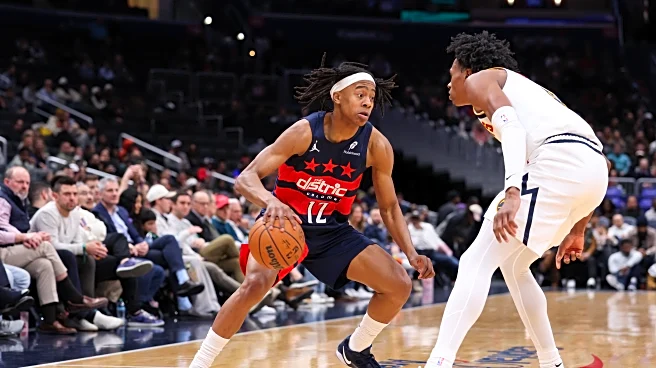



In a classic dog days of the NBA season kind of game, the Wizards lost to the Denver Nuggets, 107-97. It was Washington’s eighth straight loss, and it was a slog to watch.
Both teams seemed tired and low energy. The Nuggets had something of an excuse — they played Tuesday in Los Angeles and flew across the country. Washington’s last game was at home on Monday afternoon. Maybe they had some hard practices?

Despite both teams missing loads of shots, they combined for 17 total transition points — nine
for the Wizards, and eight for the the Nuggets. The Nuggets walked the ball up the floor on many possessions. They exhibited relatively disciplined shot selection and won just enough possessions to get the win.
The Wizards, who usually push the ball up the floor quickly after opponent makes or misses, were content to walk it up themselves. Unlike the Nuggets, they were far more likely to take a quick shot. If there was a theme in this game, it was Washington working hard individually to get a difficult shot, and the Nuggets working as a team to get better ones.
This was certainly not a rule. Jamal Murray had a “Murray Flurry” (as dubbed by the Nuggets broadcast) in the third quarter that was heavy on isos. Peyton Watson had a few terrific one-on-one play. In general, though, the Nuggets would run actions and move ball and players until they got an advantage, and then attack.
Watson played great for the Nuggets — a career-high 35 points along with 8 rebounds, 3 assists, 2 steals, and 4 blocks. He took a hard fall when he got clotheslined trying to dunk on Khris Middleton after earlier turning his ankle landing after scoring a highlight-reel bucked on Alex Sarr. His emergence as a quality offensive option is a great development for Denver — made possible by Nikola Jokic’s knee injury.
Thoughts & Observations
- While transition defense wasn’t much of an issue last night (the Nuggets were apparently too tired to run), one play early in the game exemplified the team’s struggles defending in transition. Denver came up with a steal and Murray started up the floor. Tre Johnson was the only defender back — two Nuggets players were ahead of the ball. Johnson had to choose — match up with his man on the wing or pick up Aaron Gordon in the center of the floor. Correct prioritization would have sent him to Gordon. Johnson went to the wing. That left Gordon alone under the rim for an easy dunk.
- I could be wrong on this one, but…there was an offensive fast break I think the Wizards got wrong. They had a three-on-two. Kyshawn George had the ball and was dribbling to the offensive end right-of-center of the court. To his left was Sarr in the middle and Will Riley on the wing. To me, the right play would have been for George to go to the middle and for Sarr to cross over to get on his right — ball in the middle flanked by offensive players. Another option could have been for George to move further right to open more of a lane for Sarr to come down the middle of the lane and force a Denver defender to guard two guys. Instead, George dribbled straight up the floor, Sarr and Riley ran their lanes, and Denver defenders never had to make a real decision. The tight spacing gave George only two real options — drive into two defenders or kick it out to Riley on the wing. The tight spacing meant there was a relatively short closeout. Riley missed the three-point attempt, and the Wizards didn’t score on a three-on-two break.
- George was this close to having an impressive game, despite shooting just 6-17 from the floor. He had 12 rebounds, 7 assists, and a steal. The three turnovers were acceptable given the assists and his overall offensive load. He’s gotta stop fouling so much — especially the pointless tantrumy ones.
- The spate of “injuries” meant that Anthony Gill got rotation minutes, and he wasn’t bad.
- One good thing: unlike their last matchup with the Nuggets, I didn’t see the Wizards helping off Murray. He had to work harder to generate offense.
Four Factors
Below are the four factors that decide wins and losses in basketball — shooting (efg), rebounding (offensive rebounds), ball handling (turnovers), fouling (free throws made).
The four factors are measured by:
- eFG% (effective field goal percentage, which accounts for the three-point shot)
- OREB% (offensive rebound percentage)
- TOV% (turnover percentage — turnovers divided by possessions)
- FTM/FGA (free throws made divided by field goal attempts)
Stats & Metrics
PPA is my overall production metric, which credits players for things they do that help a team win (scoring, rebounding, playmaking, defending) and dings them for things that hurt (missed shots, turnovers, bad defense, fouls).
PPA is a per possession metric designed for larger data sets. In small sample sizes, the numbers can get weird. In PPA, 100 is average, higher is better and replacement level is 45. For a single game, replacement level isn’t much use, and I reiterate the caution about small samples sometimes producing weird results.
POSS is the number of possessions each player was on the floor in this game.
ORTG = offensive rating, which is points produced per individual possessions x 100. League average so far this season is 115.1. Points produced is not the same as points scored. It includes the value of assists and offensive rebounds, as well as sharing credit when receiving an assist.
USG = offensive usage rate. Average is 20%.
ORTG and USG are versions of stats created by former Wizards assistant coach Dean Oliver and modified by me. ORTG is an efficiency measure that accounts for the value of shooting, offensive rebounds, assists and turnovers. USG includes shooting from the floor and free throw line, offensive rebounds, assists and turnovers.
+PTS = “Plus Points” is a measure of the points gained or lost by each player based on their efficiency in this game compared to league average efficiency on the same number of possessions. A player with an offensive rating (points produced per possession x 100) of 100 who uses 20 possessions would produce 20 points. If the league average efficiency is 114, the league — on average — would produced 22.8 points in the same 20 possessions. So, the player in this hypothetical would have a +PTS score of -2.8.
Players are sorted by total production in the game.