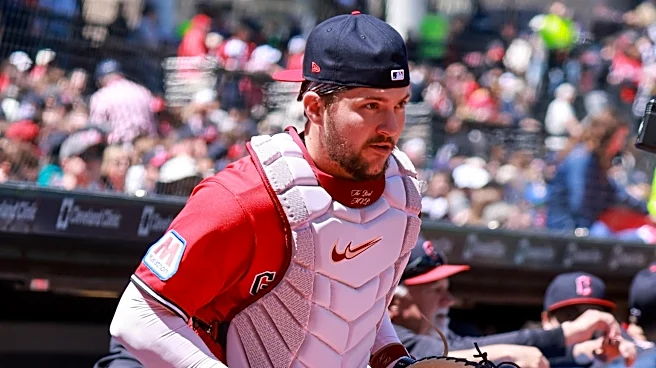






In Patrick Bailey’s second start in Cleveland, he showed why the Guardians decided to trade for the defensive-first catcher.
Bailey’s task on Tuesday was to handle the Guardians’ worst starting pitcher so far in 2026, Slade Cecconi. Coming into the game, Cecconi had a 19% whiff rate and had been attempting a fairly even pitch mix between his five offerings – 34% four seamers, 26% cutters, 16% sinkers, 15% curveballs, and 10% sliders/sweepers. Below, you can view a map of Slade’s pitch selection patterns
for the year from Baseball Savant:

After the game, Cecconi told reporters that he did not shake Bailey off even one time, so we know that the game-calling was the catcher’s doing when analyzing differences below. During his four innings of work against the Angels, Slade achieved a 25% whiff rate while going to a fastball-heavy mix, throwing his sinker 38%, his four-seamer 33% and his cutter 22% of the time, cutting his curveball and sweeper usage to a combined 6%. He also displayed a significant change in location choices, as seen below with a chart from Baseball Savant:

If you do some quick math, here, you’ll see that Bailey had Cecconi avoiding wasting pitches below the zone, instead peppering the top of the zone and above. Cecconi’s sinker and four-seamer both are above average in vertical movement, so this seems to reflect Bailey trusting that this movement would result in more whiffs if aimed at a higher location, while encouraging Cecconi to let loose with his velocity (his fastball mix showed improvement over his year averages by over 1 mph for each pitch).
Bailey’s choice to focus on fastball mix was interesting because the Angels are solidly top five in MLB against four-seamers and cutters… however, they are 29th worst team against sinkers in MLB. Cecconi’s sinker, meanwhile, has been his best pitch by run-value in 2026 at +2.5 runs above average. My guess here is that Bailey particularly liked how the sinker would play off of Slade’s cutter and fastball, and chose to risk the Angels’ ability to hit those two pitches in order to get the most out of a pitch in the sinker that has been the Halos’ kryptonite. This turned out to be an effective strategy, and demonstrates Bailey’s quickness in being able to analyze both pitcher and opposing team to devise an effective game-calling strategy.
Bailey also displayed his elite pitch-framing ability, particularly in an at-bat against the most dangerous hitter on the Angels, Mike Trout, in the third inning. As seen in the graphic below, Bailey was able to steal two strikes in that top of the zone section he was targeting throughout the game to neutralize Trout in pitches three and five (a big deal, for as any Guardians’ fan who has followed the future Hall-of-Famer’s exploits against Cleveland for the past decade knows). Not only was the umpire fooled, but Trout – who has one of the game’s most elite eyes at the plate – was confused, as he offered no ABS challenge.

Later that inning, Cecconi surrendered a double and Bailey’s framing went to work on Vaughn Grissom, as seen below:

Pitch number one was PROBABLY a strike, remembering that GameDay’s zone and the ABS zone do not always align. The umpire and Grissom believed it was, at least. He then expanded his zone later in the at-bat to get the swinging strikeout accordingly.
Homeplate umpire Jeremie Rehak had a very good game, but Bailey was still able to help provide a 0.15 run advantage in his framing work as outlined by @UmpScorecards on Twitter.
It will likely be difficult to watch Patrick Bailey hit. He is unlikely to be much better than what Bo Naylor was, there, during his cumulative time with the Guardians. So, when we ask ourselves why the team gave up valuable assets to acquire Bailey and risked disrupting their pitching and catching situations, we need to carefully watch how he affects the game defensively. The Angels did not attempt any steals against Bailey, who is excellent in the run-game management category, nor did Bailey allow any passed balls. Most importantly, Bailey seems to have the inherent trust of his pitchers due to his reputation, and demonstrated the ability to plan an execute an effective game-plan to get the most out of a struggling pitcher against a solid lineup.
I am not willing to say that Bailey’s defensive prowess will make up for his lack of hitting ability quite yet. It’s his second game catching, here, and I will likely need to endure some painful outs from him while hitting for a while to know how I feel. But, I do think it’s important to remember that one of the things analytics has most trouble capturing is catcher value. Catchers – especially as Cleveland uses them – have a dramatic impact on the confidence levels and talent maximization of pitchers.
If Bailey costs the team in run-production, he may be able to more than compensate by assisting them in run prevention. Some have called the Patrick Bailey-Austin Hedges tandem an “Iron Curtain” strategy by the Guardians. For one night, at least, the early returns were positive as the plan unfolds.