


Joe Flacco started in 44 games in which his defense held the opponent to 10 points or less, the highest value among active quarterbacks. Would you be shocked to find out that Flacco is 44-0 in those games?
As a quarterback, there clearly is a benefit in playing for a team with a strong defense, as other NFL QBs and their W/L records will attest. Lamar Jackson, Flacco’s successor in Baltimore, is 27-0. Patrick Mahomes is 25-0 when the opponent scored 10 points or fewer, Matthew Stafford is 25-0, Sam
Darnold is unbeaten at 14-0. In fact, of the 32 QBs penciled in as the starters for their teams by ourlads.com, 25 have never lost such a game. Of the rest, only one QB lost more than one game when the opponent was held to 10 points or fewer: Aaron Rodgers is 33-2 in those games.
The reality is, it’s very hard to lose a game where the opponent is held below 10 points. Yet if you were to read some of the headlines floating around after gameday – and if you were to give those headlines any credence – you could easily get the impression that it was the superstar QB all by himself who won those games.
The QB, whether you like it or not, is the only player on a football team who has a W/L record in his personal stats. But that doesn’t mean the QB is actually winning games for his team. Teams can win games with a strong defense, great special teams play, or a good ground game despite the QB, yet the QB will get the win on his record.
Which is why today we’ll take a more objective, stat-based look at the W/L records of NFL QBs and try to figure out which NFL quarterbacks are winning games for their teams, and which aren’t. To do that, we’ll look at ‘Wins Over Average’ (WOA) to understand which offenses, and by extension their QBs, contributed to wins for their teams.
Unlike the more established QB metrics like passer rating and ESPN’s QBR, WOA is a little off the beaten path, but can help us get a more complete, and perhaps more nuanced, picture of QB performance than the more established metrics alone can.
WOA was developed by Doug Drinen at Pro-football-reference.com (PFR). The underlying assumption for WOA is that it’s a lot easier for a QB to win games when the defense holds the opponent to 10 points than it would be if the defense gave up 30 points.
What WOA does is it calculates a QB’s winning percentage against a given bracket of points scored by the opponent (e.g., 0-10 points, 11-17 points etc.) and then compares how many games a given quarterback won versus how many games an NFL-average QB would have been expected to win.
To calculate WOA, we first need a baseline to determine what ‘NFL average performance’ looks like. For our purposes here we’ll use the 10-year league average winning percentage in regular season games between 2016 and 2025. In the table below I’ve crunched the regular season numbers for all NFL teams for the last 10 years, formed five clusters by points allowed, and looked at the winning percentages for each cluster.
body .sbnu-legacy-content-table td, body .sbnu-legacy-content-table th, body .sbnu-legacy-content-table { border: 1px solid #000 !important; border-collapse: collapse !important; } body .sbnu-legacy-content-table td, body .sbnu-legacy-content-table th { padding: 0px 6px !important; }| 2016-25 | QB Record versus Points Allowed | ||||
| 0-10 | 11-17 | 18-24 | 25-31 | 32+ | |
| W/L record | 664-26-2 | 814-218-2 | 718-691-8 | 318-881-6 | 115-813-2 |
| Win % | .961 | .788 | .510 | .266 | .125 |
How to read the table: A QB (and by extension, the team) will almost always win the game when the defense holds the opposing team to 10 points or fewer (664-26-2 winning record). The NFL average winning percentage is .961 against the ‘0-10’ points bracket. The more points a team allows, the lower their chances of winning the game. When your defense allows 32 points or more, your QB’s chances of winning the game are very low (.125 winning percentage, 115-813-2 record).
What separates the good from the merely average QBs is their ability to win games that an average QB would not win. And that is exactly what WOA measures. We’ll use Tony Romo’s 127 career starts to further explain the concept.
body .sbnu-legacy-content-table td, body .sbnu-legacy-content-table th, body .sbnu-legacy-content-table { border: 1px solid #000 !important; border-collapse: collapse !important; } body .sbnu-legacy-content-table td, body .sbnu-legacy-content-table th { padding: 0 px 6px !important; }| Tony Romo’s Wins Over Average | ||||||
| Points Allowed | 0-10 |
11-17 |
18-24 | 25-31 | 32+ | Total |
| W/L record | 21-1 | 21-4 | 23-10 | 8-14 | 3-20 | 78-49 |
| Win % | .957 | .840 | .697 | .391 | .130 | .614 |
| Wins Over Average | -0.1 | +1.3 | +6.2 | +2.9 | +0.1 | +10.4 |
Tony Romo and Wins Over Average:
- Tony Romo has a record of 23-10 as a starter in 33 games when the defense allowed between 18 and 24 points. The average NFL QB would be expected to win 16.8 of those games (33 games x .510 NFL average), so with 23 wins, Romo delivered +6.2 wins over average in this points bracket.
- In the 11-17 points bracket, Romo has a 21-4 record in 25 games, an average NFL QB would be expected to win 19.7 games (25 games x .788 NFL average), Romo therefore gets +1.3 WOA. Across all brackets, Romo has accumulated +10.4 WOA as per the table above.
So statistically, over the course of his 10 seasons as a starter, Tony Romo accounted for almost eleven more wins for the Cowboys than an average NFL quarterback would have. At first glance, that doesn’t sound like all that much, so in the next step we’ll try to understand how that number compares to other quarterbacks around the league.
Before we do that though, keep in mind that when I say “Tony Romo”, I’m not just talking about the QB, but also the receivers, the O-line, the running back, the coaches, and many more people who make up or influence the Dallas Cowboys offense. Quarterbacks don’t win or lose games, teams do. But if quarterbacks are going to be measured by wins, let’s at least make sure we understand the quality of those wins.
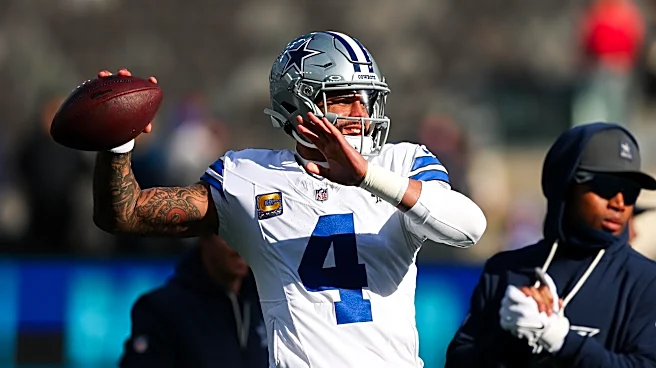
Before we go there though, let’s have a look at what is increasingly looking like Romo’s statistical twin, Dak Prescott.
body .sbnu-legacy-content-table td, body .sbnu-legacy-content-table th, body .sbnu-legacy-content-table { border: 1px solid #000 !important; border-collapse: collapse !important; } body .sbnu-legacy-content-table td, body .sbnu-legacy-content-table th { padding: 0px 6px !important; }| Dak Prescott’s Wins Over Average | ||||||
| Points Allowed | 0-10 |
11-17 |
18-24 | 25-31 | 32+ | Total |
| W/L record | 19-1 | 24-4 | 26-11 | 8-21 | 6-17-1 | 83-55-1 |
| Win % | .950 | .857 | .684 | .276 | .261 | .601 |
| Wins Over Average | -0.2 | +1.9 | +6.6 | +0.3 | +3.3 | +11.9 |
Same logic as with Romo before. The first three points brackets look similar for both players, but the main difference is in the higher points brackets. Where Romo got a big chunk of WOA in the 25-31 bracket (+2.9), Prescott got his in the 32+ point bracket (+3.3).
Prescott has a record of 6-17-1 as a starter in 24 games when the defense allowed 32 or more points. The average NFL QB would be expected to win three of those games (24 games x .125 NFL average), so even with “just” six wins and a tie, Prescott delivered +3.3 wins over average in this points bracket.
That +11.9 total WOA for Prescott over ten years looks very similar to Romo’s 10.4 over ten seasons. But they do have a different number of games started, so we adjust for that by dividing WOA through the total number of games started.
For Romo, that gives us 8.2%, which tells us that Romo won 8.2% more games over his career than an NFL average QB would have. For Prescott, that number is slightly higher at 8.7%. We’ll compare all QBs in this exercise by their WOA%, as this will allow for a better comparison of the quarterbacks regardless of how many games they started.
In the next table, I’ve listed the 32 projected starting quarterbacks, split them into starters with more than 34 career starts and starters with 34 or fewer starts, and also added 11 backups. There is another table further down that lists a selection 20 retired quarterbacks for comparison. WOA and WOA% are calculated for all QBs in the same way I calculated Romo’s and Prescott’s numbers above.
The base line for the color code is determined by the 22 starters with more than 34 games, who average a +5.3 WOA%.
Players in green are above that average and have a WOA% between +5 & +10. Blue is the elite tier, where players average more than +10 WOA%. The yellow tier denotes below average players between zero and +5 WOA%, red denotes the underformers with a negative WOA%.
The average WOA% by player status:
- +5.3%: 22 starters with more than 34 games
- -1.8%: 10 starters with 34 or fewer games started
- -2.4%: 11 backup QBs
- +5.1%: 20 retired players selected more for their name recognition than their performance.
| QB | 2026 Team | Career Starts | W/L | WOA | WOA% |
| STARTERS > 34 Starts | |||||
| Patrick Mahomes | KC | 126 | 95-31 | 23.2 | 18.4% |
| Jalen Hurts | PHI | 82 | 57-25 | 12.6 | 15.3% |
| Lamar Jackson | BAL | 105 | 76-31 | 12.5 | 11.7% |
| Aaron Rodgers | PIT | 257 | 163-93-1 | 28.1 | 10.9% |
| Josh Allen | BUF | 124 | 88-39 | 12.2 | 9.6% |
| Brock Purdy | SF | 45 | 30-15 | 4.2 | 9.3% |
| Jared Goff | DET | 151 | 90-60-1 | 13.4 | 8.9% |
| Dak Prescott | DAL | 138 | 83-55-1 | 12.1 | 8.7% |
| Joe Burrow | CIN | 77 | 43-33-1 | 5.7 | 7.4% |
| Kirk Cousins | LV | 167 | 88-77-2 | 12.0 | 7.2% |
| Justin Herbert | SD | 95 | 52-43 | 4.2 | 4.5% |
| CJ Stroud | HOU | 45 | 28-18 | 1.8 | 3.9% |
| Matthew Stafford | LAR | 238 | 120-118-1 | 6.5 | 2.7% |
| Jordan Love | GB | 48 | 27-20-1 | 1.1 | 2.4% |
| Sam Darnold | SEA | 90 | 49-41 | 1.4 | 1.6% |
| Baker Mayfield | TB | 120 | 58-62 | 0.8 | 0.7% |
| Kyler Murray | MIN | 86 | 38-48-1 | -1.2 | -1.3% |
| Trevor Lawrence | JAX | 77 | 35-42 | -1.7 | -2.2% |
| Daniel Jones | IND | 80 | 32-49-1 | -4.2 | -5.1% |
| Geno Smith | NYJ | 96 | 42-56 | -5.1 | -5.2% |
| Bryce Young | CAR | 44 | 14-30 | -5.5 | -12.4% |
| Jacoby Brissett | ARI | 64 | 20-45 | -9.5 | -14.6% |
| STARTERS <= 34 Starts | |||||
| Jayden Daniels | WAS | 23 | 14-10 | 3.3 | 14.0% |
| Bo Nix | DEN | 34 | 24-10 | 3.4 | 10.1% |
| Drake Maye | NE | 27 | 17-12 | 2.1 | 7.2% |
| Tyler Shough | NO | 9 | 5-4 | -0.1 | -1.5% |
| Caleb Williams | CHI | 34 | 16-18 | -1.0 | -3.0% |
| Shedeur Sanders | CLE | 7 | 3-4 | -0.7 | -10.6% |
| Jaxson Dart | NYG | 12 | 4-8 | -1.4 | -11.5% |
| Michael Penix | ATL | 12 | 4-8 | -1.7 | -14.1% |
| Malik Willis | MIA | 6 | 3-3 | -0.9 | -14.2% |
| Cam Ward | TEN | 17 | 3-14 | -2.6 | -15.4% |
| Backups | |||||
| Tua Tagovailoa | ATL | 75 | 44-32 | 5.8 | 7.6% |
| Deshaun Watson | CLE | 71 | 37-35 | 2.0 | 2.8% |
| J.J. McCarthy | MIN | 10 | 6-4 | 0.2 | 2.1% |
| Carson Wentz | MIN | 99 | 49-49-1 | -1.0 | -1.0% |
| Jameis Winston | NYG | 89 | 36-53 | -1.4 | -1.6% |
| Andy Dalton | PHI | 168 | 84-83-2 | -3.7 | -2.2% |
| Joe Flacco | CIN | 200 | 107-94 | -8.6 | -4.3% |
| Marcus Mariota | WAS | 81 | 36-46 | -3.6 | -4.3% |
| Sam Howell | DAL | 18 | 5-13 | -1.4 | -8.0% |
| Mac Jones | SF | 55 | 25-32 | -5.6 | -9.8% |
| Will Levis | TEN | 21 | 5-16 | -4.3 | -20.3% |
Tier 1: Planet Mahomes (blue)
No real surprise at the very top of the list, where Planet Mahomes makes every other QB look like a second tier player. Lamar Jackson and and Aaron Rodgers aren’t much of a surprise either (both have been at or near the top in most of the quantitative QB reviews we’ve looked at recently). But Jalen Hurts is a surprise in this top tier; I have never considered him a particularly good QB, and to have him show up so high here caused me quite some consternation.
Initially assuming I must have made some data entry mistake, I reviewed the data in detail and found something astonishing: the average NFL quarterback wins only about a quarter of the games (.266) when the opposing team scores between 25-31 points. There are 43 QBs in the table above and a further 20 retired QBs we’ll review later in this post. Only five of them have a winning percentage in that 25-31 bracket, here are four of them:
- Patrik Mahomes (18-11, .621)
- Jared Goff (19-7, .528)
- Tom Brady (34-31, .523)
- Andrew Luck (10-9, .526)
And then there’s Hurts with as staggering 8-3 record (.727) in that points bracket running laps around some of the best QBs to have played the game. But this is where we hit the limit of using QB wins to judge QBs, because as I pointed out earlier, we’re not just talking about QBs here, but also WRs, the O-line, the running backs and much more.
The combination of an average to slightly above average passer in Hurts and an above average WOA suggests that the Eagles have been winning more games than Hurts’ performance as a pure passer would warrant, and maybe that’s part of his appeal, especially for Philly fans: He may never be the greatest passer in the league, but he and his team have consistently found ways to win like great QBs and their teams do. And that’s quite something.
Tier 2: Franchise QBs (green)
After the top four QBs with double digit WOA percentages there’s a six-man second tier of above average QBs who can all play spectacularly at times but are also prone to inconsistent performances. This group is so tightly bunched that a single win in a shootout or a loss in a low-scoring game could rearrange the order completely. Also notice that outside of Kirk Cousins (who is a bit of a surprise in this group) none of the QBs here ever left their team in free agency (Goff was traded). That makes this the “franchise QB” group, a group that also contains the four QBs at the very top of the list: consistent and longtime overperformance that teams will quite literally pay any price to keep.
Tier 3: The QB Mezzanine (yellow)
A mezzanine is an intermediate or partial floor in a building that sits between two main stories. This six-man group’s WOA% is below the average of the active veterans (+5.3%) but still above the league average of 0%). These QBs may not win their teams a lot of games, but at least they aren’t losing too many either, at least as measured by WOA, and there is definite value in that.
But there are always questions about these QBs, because nobody is quite sure of their trajectory, are they moving up one floor or moving down one floor. A quick scan of the top ten headlines on Google for each player illustrates the point:
- The Athletic: Justin Herbert, Chargers left with hard questions after quiet wild-card loss to Patriots
- Sports Illustrated: Newest C.J. Stroud Rumor Casts Doubt on Texans Extension This Summer
- Turf Show Times: Can Matthew Stafford win without a ‘super team’?
- Cheesehead TV: Is Jordan Love That Guy?
- Yahoo Sports: Seahawks face worrying Sam Darnold question despite Super Bowl win
- Sports Illustrated: Buccaneers Owners Believe in Baker Mayfield Despite Questions
Tier 4: Below average NFL QBs (red)
Of the six QBs with a negative WOA percentage, only two (Trevor Lawrence, Bryce Young) remain with their original team, and Young’s time in Carolina may end soon. Their performance as measured by WOA% suggests they are backup-quality QBs who only have a job as a starter because their teams couldn’t find anybody better.
Starters with <= 34 starts
Some of you might wonder why I pushed the cutoff between veteran and young starters to 34 games, when in previous QB posts this was usually 20 starts. Nick Foles is the reason.
In his first three years in the league, WOA suggested Foles would be a Mahomes-level superstar: his WOA% over his first three years and 24 starts in Philly was an impressive +16.4%. Since then, Foles has combined for a -8.3 WOA% over 34 starts for a career value of “just” +1.9%. Much like Hurts, Foles looked good on strong Eagles teams, but couldn’t sustain that performance outside of Philly.
And this is key for the young guys at the bottom of the table above. Jayden Daniels, Bo Nix, and Drake Maye look good early in their career, but can they sustain that performance over 10+ seasons and the ups and downs that come with it?
To illustrate that specific point, here’s Dak Prescott’s up-and-down WOA% by year:
body .sbnu-legacy-content-table td, body .sbnu-legacy-content-table th, body .sbnu-legacy-content-table { border: 1px solid #000 !important; border-collapse: collapse !important; } body .sbnu-legacy-content-table td, body .sbnu-legacy-content-table th { padding: 4px 6px !important; }| Year | 2016 | 2017 | 2018 | 2019 | 2020 | 2021 | 2022 | 2023 | 2024 | 2025 |
| Starts | 16 | 16 | 16 | 16 | 5 | 16 | 12 | 17 | 8 | 17 |
| WOA% | +18.8% | -0.3% | +6.3% | -6.9% | +19.8% | 18.5% | 18.4% | 7.6% | -5.2% | 13.1% |
Prescott’s numbers show that there can be a lot of variability from year-to-year. Five elite-level seasons, two above average seasons, and two below average seasons highlight how hard it is to maintain consistent performance over time.
But Prescott’s numbers also reemphasize the point about Hurts and that it’s not just the QB driving total wins.
Prescott had a spectacular rookie season, but he was supported by fellow rookie and the NFL’s leading rusher that season in Ezekiel Elliott, along with an offensive line that won the inaugural Offensive Line of the Year award for that year. But nothing lasts forever in the NFL. In 2017, Elliott was suspended for six games and the O-line regressed, and two up-and-down seasons followed in which OC Scott Linehan outwore his welcome, Jason Garrett was nearing the end of his tenure, and the WR room was in turmoil.
From 2020-2023, Prescott was clicking with OC Kellen Moore before McCarthy decided he needed to take over playcalling with his dumbed-down scheme in 2024. A new regime, and an invigorated offense with George Pickens, helped the offense back to some gaudy numbers in 2025, but the defensive collapse prevented the Cowboys from making anything out of it.
Extra tier: Retired QBs
The 20 retired QBs in the table below are by no means a representative sample, I selected them largely for their name recognition and because I’ll take any chance to dump on former NFC East QBs.
body .sbnu-legacy-content-table td, body .sbnu-legacy-content-table th, body .sbnu-legacy-content-table { border: 1px solid #000 !important; border-collapse: collapse !important; } body .sbnu-legacy-content-table td, body .sbnu-legacy-content-table th { padding: 0px 6px !important; }| QB | Career Starts | W/L | WOA | WOA% |
| Peyton Manning (HOF ret.) | 262 | 186-79 | 42.9 | 16.2% |
| Tom Brady (HOF ret.) | 332 | 251-82 | 48.4 | 14.5% |
| Andrew Luck (ret.) | 86 | 53-33 | 10.5 | 12.2% |
| Drew Brees (HOF ret.) | 283 | 172-114 | 31.1 | 10.9% |
| Tony Romo (ret.) | 125 | 78-49 | 10.4 | 8.2% |
| Ben Roethlisberger (ret.) | 247 | 165-81-1 | 17.3 | 7.0% |
| Ryan Tannehill (ret.) | 150 | 81-70 | 6.7 | 4.5% |
| Matt Ryan (ret.) | 232 | 124-109-1 | 9.6 | 4.1% |
| Russell Wilson (ret.) | 202 | 121-80-1 | 6.9 | 3.4% |
| Philip Rivers (ret.) | 243 | 134-109 | 5.0 | 2.1% |
| Nick Foles (ret.) | 57 | 29-29 | 1.1 | 1.9% |
| Cam Newton (ret.) | 144 | 75-68-1 | 1.9 | 1.3% |
| Jay Cutler (ret.) | 149 | 74-79 | 0.3 | 0.2% |
| Michael Vick (ret.) | 108 | 62-52-1 | 0.2 | 0.2% |
| Eli Manning (ret.) | 234 | 117-117 | 0.3 | 0.1% |
| Carson Palmer (ret.) | 179 | 92-88-1 | -0.4 | -0.2% |
| Robert Griffin (ret.) | 41 | 16-26 | -1.1 | -2.7% |
| Donovan McNabb (ret.) | 159 | 98-62-1 | -5.4 | -3.4% |
| Mark Sanchez (ret.) | 72 | 37-36 | -3.0 | -4.1% |
| Sam Bradford (ret.) | 83 | 34-48-1 | -9.1 | -11.0% |
The fact that we have three Hall of Famers topping this list is a bit of a validation for this approach. At the same time, the fact that Eli Manning is being discussed as a potential future Hall of Famer suggests the Hall of Fame is planning a new wing, the Hall of Mediocre Longevity.
The ranking also highlights how close Tony Romo’s performance is to the Hall of Famers on this list, and how frustrating it is for Cowboys fans to know both how good he was and how bad the front office was at providing him with a team that could have gotten him a ring.
Tony Romo also provides an insight into how this whole WOA thing works: Romo’s .614 W/L percentage is almost identical to Donovan McNabb’s (.612). But the difference between the two per WOA is that Romo elevated his team to achieve that record while McNabb had to lean on his team to get to that record.
Obviously, there are many ways to evaluate a QB’s performance. This is one way that you probably haven’t seen much of before, but taken with other valid metrics out there, I hope it helps solidify an overall picture of today’s NFL quarterbacks, and perhaps raises a question or two.