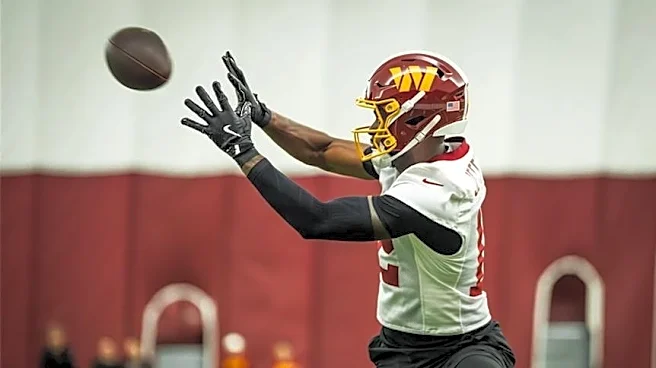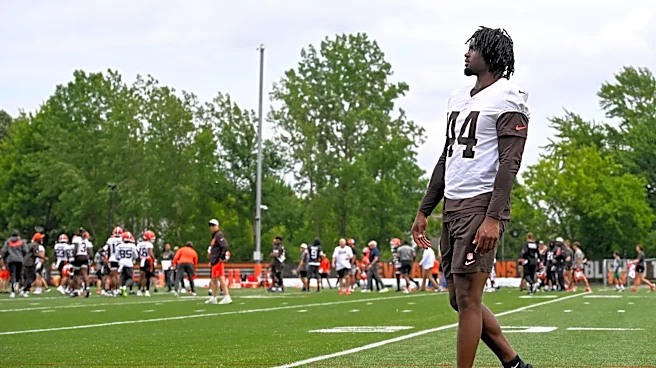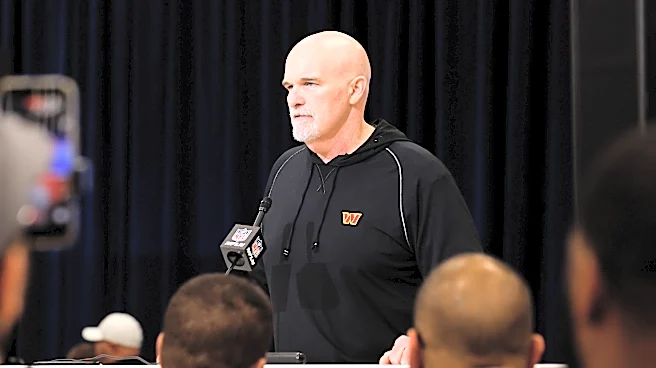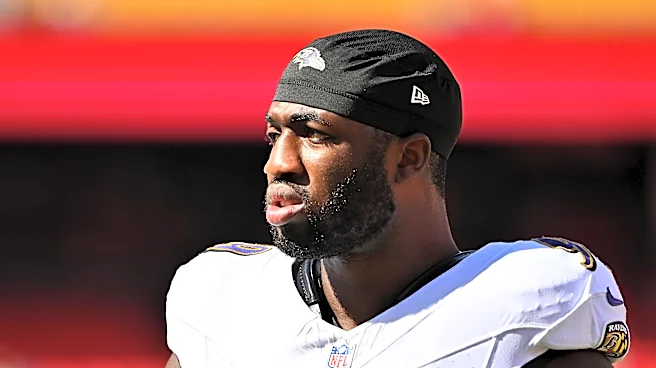

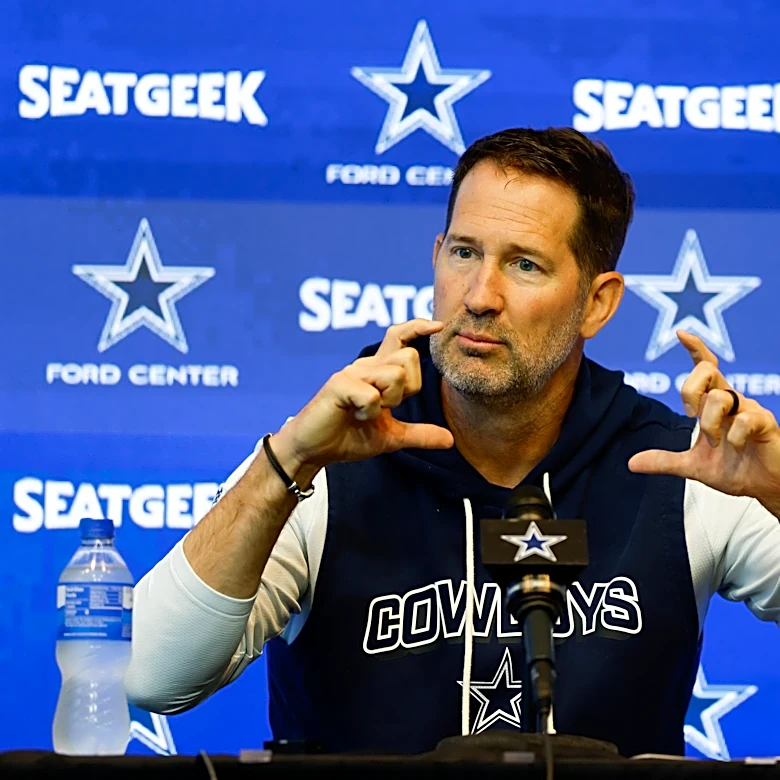
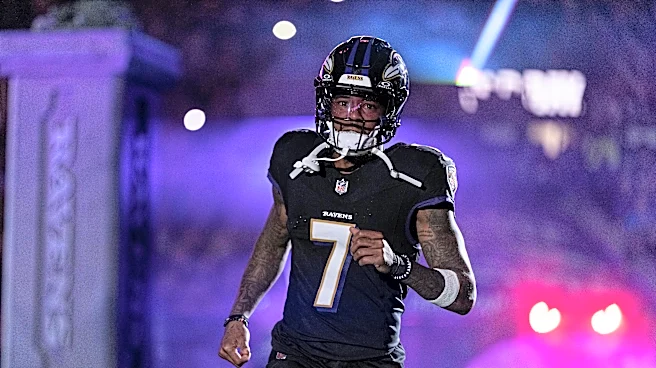


Odafe Oweh recently discussed how he loved Commanders defensive coordinator Daronte Jones’ defensive style, because of the attack mentality it brings. Oweh was signed to a $96-million contract that has $68 million guaranteed, of which $50.6 million is fully guaranteed at signing.
Washington’s significant investment indicates that Adam Peters views him as a key player in Washington’s defensive plan going forward. Odafe was my favorite free agent back in March, but I didn’t provide a lot coverage because
I did not believe he would be available. However, the Chargers chose not franchise tag on him and Baltimore forewent a reunion with new head coach Jesse Minter in favor of trading for Maxx Crosby. By the time that deal was nullified by the Ravens, Odafe had already signed with Washington.
My preference for Oweh stemmed from his athletic ability, pass-rush toolbox, and ascending play. The 6-foot-4, 257-pound EDGE is an athletic freak, with a 4.37 40-yard dash and elite ratings in explosion, speed, and agility.
Oweh’s speed and explosion translate to the field, with the ability to convert speed to power. He has a number of pass rush moves available to him. They include spin moves, cross chops and hand swipes, along with an understanding of how to sequence his moves to set up blockers. Odafe has the bend desirable in an edge player. Following a midseason trade last year, he took off in the Chargers defense and finished the year with the sixth-highest pressure rate in the league at 17.3%, and recorded 10.5 sacks, 2 forced fumbles, 42 total tackles, and 47 total pressures in 2025 (all including playoffs). Oweh just turned 27, and he’s playing the best football of his career as he heads into his prime.
The concern revolves around his lack of production prior to this season. The fact that Baltimore flipped him for a so-so defensive back and a Day 3 NFL draft pick says something about how they estimated his value. Oweh had just 13 sacks over the first three seasons of his career combined. He has never been consistent against the run, hitting the 40-tackle mark just once in his career. Although his production last season was good, it is not elite, which is the issue some analysts had with paying the free agent such a hefty contract.
There is still reason for optimism amongst the Washington faithful. All of Oweh’s 7.5 sacks last year came after he was traded to the Chargers in Week 6, despite only playing 50% of the team’s defensive snaps. Clearly, the defensive scheme in Los Angeles was a better fit. Former Chargers defensive coordinator and current Ravens head coach Jesse Minter discussed how he unlocked Oweh’s talent in his introductory presser.
“We created an environment for him that he played with a lot of confidence. Simplified some things we were asking him to do. Allowed him at times to have a little more freedom as a pass rusher.”
Now that the blueprint has been established, the question becomes how Jones could model his defense to maximize Odafe’s skill set. The answer is his defense could already be built this way.
Per Hogs Haven Mark Tyler, Jones is expected to utilize a 3-4 under hybrid front for their base defense.
The base 3-4 UNDER hybrid uses a nose tackle who shifts to the strongside 1i (outside shade of the center). A 5- or 6i-technique DE is over the tackle and a walked-up SAM LB as the strongside overhang who would play outside of the end man on the line of scrimmage. The 3-technique is lined up up over the outside eye of the weakside guard and the weakside EDGE is usually in a stand-up 7-tech.
Strength simply means the side of the formation with the most offensive personnel. Here is an image of what the 3-4 under front looks like on the field.

This gives you a good idea where players will line up in the base front, which allows the defense to easily shift into blitz packages while maintaining strong run fits. Flores frequently morphs this into a different look called “amoeba” or “psycho”. In this front, one or both of the second level defenders are brought up closer to the line of scrimmage into the gaps which is called a “mugged” look. Often it is the linebackers to create a 6-1 look pre-snap but safeties and cornerbacks are also an option. Besides the nose tackle, most of the players on the line of scrimmage are standing and shifting position trying to create confusion. Referencing an article discussing Flores’ blitz schemes from Football Film Room’s Nick Kehoe we can see the concept in action.
Here is the amoeba front pre-snap with the defenders mugged up. You can see how the additional players on the line create a numbers strain.

The offensive line slides to the right at the snap to cover the additional rushers freeing up the edge on the weak side. This leaves the middle of the field vulnerable, but at the snap the two marked interior defenders read the play and drop into coverage.

This creates a free rusher as the mugged front forces the Rams to use five offensive linemen to block what in actuality is only four players rushing. The quarterback sees the edge coming unchecked and makes the quick decision to unload the ball across the middle. This proves to be a poor choice as he fails to notice the defender in coverage and the result is an interception. Here it is in real time.

This is the concept presented at a very basic level, but it provides insight into how Jones could use his scheme to create free rushes and one-on-one matchups on the outside for Oweh, where his athleticism and ability can take over. The number of stunts and blitzes that can be employed from similar simulated pressures are extensive, and there are a lots of ways to get after the quarterback. Behind this look, the secondary plays a Cover-0 or other soft coverage that allows the defensive backs to sit on the deep ball and drive on anything thrown underneath.
That’s where the weakness of the scheme comes into play. The 6-1 look is susceptible to quick passing and misdirection that exploit the spaces left by blitzers. It can leave players out of position and susceptible to being sealed off from the play or blocked more easily. The consequences of the secondary biting on playaction fakes and misdirection can be disastrous and outside runs present challenges if defenders can’t get off blocks and cover ground laterally.
This type of defense requires both discipline and execution. Importantly, defenders must develop an instinctual feeling for their reads and what the other players are doing. That is why these offseason activities and preseason are so critical for a defense that consists of so many new players. Jones scheme could be the perfect fit, and Oweh believes that team can solidify their understanding this offseason and be ready to utilize the Commanders new speed on defense come week one.
“That’s what [practice] is for; that’s what camp’s for. We’re honing ourselves, looking at different looks and different situations we’re gonna be in based on the same call. I think that’s what DJ [Jones] does a good job of, having different variations of the same call. Once you start memorizing that and understanding why you’re doing that, when the game comes, we’re moving fast. The bullets are flying.”