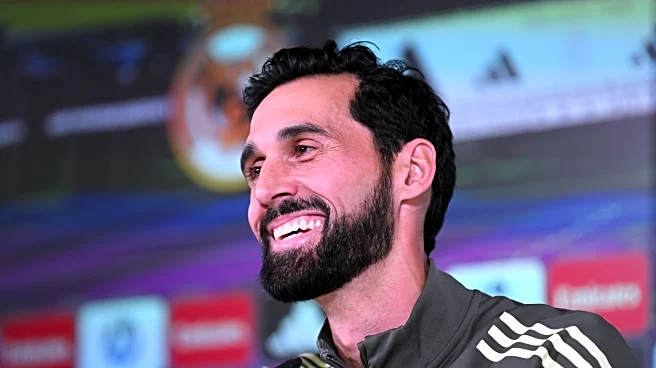


In his opening press conference, Real Madrid’s new coach was clear: “I will be Álvaro Arbeloa, I won’t be scared of failure, but if I wanted to be Jose Mourinho then I would fail spectacularly”. But who is Álvaro Arbeloa?
Most Madridistas remember his as a strong squad player, a back-up who offered versatility and consistency at right-back over 238 appearances for Real Madrid and 94 for Castilla. In addition to being part of Spain’s golden generation to win the the World Cup and two European Championships,
he won La Liga once and two Champions League titles at club level.
But that was as a player. As a coach, his appointment is rooted in performance at La Fábrica. Earlier in his coaching career with youth teams he delivered measurable results: league titles at under-14 and under-16 level, and a treble with Juvenil A in the 2022-23 season. That Juvenil A side won La Liga, Copa and Youth League while producing players who have since entered elite pathways. Speaking on Carrusel Deportivo, José Ignacio Tornadijo described him as “possible the most successful coach La Fábrica has ever had”, and it would be hard to argue against that given his achievements in such a short timeframe.
Arbeloa’s Castilla tenure was marked by clear tactical definitions. At the time of Arbeloa’s appointment, Castilla sit in fourth place. The team registered an inconsistent start, but results have picked up quickly and he’s had a solid start to life at that level. Many of those youngsters will hope to have first-team opportunities, with seven included in his first matchday squad, as Arbeloa said in his presentation that, “Real Madrid’s youth academy is the best in the world”, adding that, “the players know that they have an opportunity with a first team coach who knows them better than anyone”.
How does an Álvaro Arbeloa team play?
Tactically, Arbeloa favours structures that reflect the Real Madrid first team under both Carlo Ancelotti and Xabi Alonso but with specific nuances. Castilla’s default shape operated predominantly in a 4-3-3 that could shift into a 4-2-3-1 in possession. The emphasis was on narrow possession with a bias toward vertical progression when possible, controlled pressing triggers rather than indiscriminate pressure, and full-backs contributing aggressively from wide positions.
His emphasis is on rapid recovery of possession and proximity between lines to enable faster transitions after losing the ball. Analysts inside the club have pointed to his team’s intent to recover possession high and exploit recovered possession quickly rather than circulate without forward purpose. These were features also seen in his youth teams.
While early reports of a Gegenpressing style may be a slight exaggeration, his style certainly relies on a high press. The most likely approach is believed to be one where Arbeloa deploys a deeper block looking to transition quickly, rather than relying on pressing in the same way as his Castilla teams.
When Arbeloa first took charge of Castilla, he publicly stated his intent for the team to be “courageous, daring and dominant”, adding that he wanted the side to transmit enthusiasm and identity reflective of Real Madrid values. He acknowledged the high technical quality of his young squad and emphasised accelerated adaptation to the realities of Primera Federación competition.
Individual development has been a notable effect of his coaching. César Palacios became a central figure in Castilla’s campaign, scoring eight goals and contributing three assists, emerging as both top scorer and joint top assister and being called up in Arbeloa’s first senior squad. Jorge Cestero, another academy graduate, earned first-team minutes in the Copa del Rey under Xabi Alonso, and right-back David Jiménez registered two first-team appearances during Alonso’s tenure and has featured regularly for Arbeloa.
Criticism of Arbeloa has often come in the form of accusations that he lacks a clear plan B when his teams are struggling. Particularly in high intensity games, Arbeloa’s sides have come unstuck when under pressure and made defensive mistakes, which he may hope will be avoided by stepping up to the first team with elite and much more experienced players.
Who are Arbeloa’s coaching influences?
Arbeloa worked under a number of high-profile coaches throughout his time as a player. José Mourinho was the most clear-cut example, and the coach who gave Arbeloa the most appearances with 122, all for Real Madrid, but he also featured for former Real Madrid coaches Rafa Benítez at Liverpool and, in addition to Mourinho at Real Madrid, Vanderlei Luxemburgo, Manuel Pellegrini, Carlo Ancelotti and even a handful of appearances under Zinedine Zidane.
In style, he has been likened to Mourinho. His strong character and feisty press conferences have become well-known with Castilla. After two red cards in a game earlier this season, he said, “it’s another week in which Castilla ends up with two players sent off… it’s something that, although it may not seem like it, happens every week and is something we have to fight against, and it’s not easy to fight against all this.” Remind you of anyone?
Arbeloa’s approach is one built upon building relationships. His first press conference, referring to journalists by their first name before answering each question, reflected that. It’s also been key to ensuring that he could build relationships in the club and ensure that this appointment has been a long-time coming.
“This was always the plan,” a source close to Arbeloa told Managing Madrid. The source revealed that Arbeloa was under consideration as a possible replacement for Carlo Ancelotti in the summer, but critical voices on the board insisted on a more experienced option with the opportunity to appoint a Bundesliga champion and one of the brightest young coaching talents being seen as too good to pass up. Florentino Pérez remained a strong supporter of Arbeloa.
What’s different between Arbeloa and Alonso?
One of the biggest weaknesses that eventually led to Alonso’s downfall was player power. In moments of conflict with his squad, Real Madrid as a club publicly backed their players, rather than their coach. Vinícius Júnior was not punished for his public protests against his own coach. The club did insist on gambling on Arda Güler as the solution in midfield. There was criticism when Alonso gave in and gave the team extra time off ahead of the defeat to Celta Vigo. If any coach is positioned to have the backing of Florentino Pérez and company, it could be Álvaro Arbeloa, who enjoys a superb relationship with the president.
Where does that come from? To fully understand Arbeloa’s relationship with Florentino Pérez, you have to travel back in time to the José Mourinho era. The times of real conflict between Real Madrid and Barcelona. At the time, the dressing room split into two sides, those who sought to resolve the conflict through the national team and were considered ‘anti-Mourinho’, such as Iker Casillas and Sergio Ramos, two squad heavyweights, and those who opted to resist those attempts and were considered Mourinho loyalists. Arbeloa led that group, which also included Xabi Alonso. Alonso, however, left the club shortly after and avoided much of the conflict, whereas Arbeloa has spent almost every minute of his career since then, other than a final year at West Ham, at Real Madrid.
Arbeloa has already shown that he will be more player-friendly than his predecessor. Reports say that the locker room has compared his first training sessions more to those of Ancelotti and Zidane than those of Alonso. For the majority, that is good news. A more relaxed style, putting trust in players and managing workloads, is what many of the current squad have grown accustomed to and demand.
Who else will form part of Arbeloa’s staff?
Arbeloa has brought some trusted collaborators from his Castilla days and the club kept some existing figures to create a mixed technical staff, with Arbeloa showing no sign of holding back from relying on the figrues trusted by the powers that be.
The most newsworthy appointment has been that Antonio Pintus returns as head of physical preparation, recovering a role he previously held under Carlo Ancelotti and Zinedine Zidane. The Italian is widely regarded as one of the world’s leading fitness coaches and under Arbeloa’s structure Pintus takes a central role in conditioning and injury prevention, a priority for the club given fitness concerns this season. Pintus has also brought with him his deputy Sébastien Devillaz to the first-team setup.
Continuing from Xabi Alonso’s staff, long-term goalkeeping coach Luis Llopis remains. Initially having joined the club in 2015 in the youth set-up, he returned for a first-team role in 2021 and has developed a strong relationship with Thibaut Courtois and Andriy Lunin, making him an established figure. A notable omission from the first-team staffing, despite earlier speculation, is former Real Madrid goalkeeper Diego López, who was linked with a possible role but ultimately did not join the senior technical team, perhaps to avoid forcing out Llopis.
One of the most important roles, that of Arbeloa’s assistant, has gone to Julián Carmona. Carmona has worked with him through the Madrid youth system, including at Castilla, and represents a direct trusted link within the coaching group. Carmona went to school with Arbeloa in Zaragoza, where the pair grew up, and developed a coaching career at clubs including Almudévar, CD Ebro, Escalerillas and SD Ejea, before joining Arbeloa’s set-up as assistant in 2021 in La Fábrica, rising through the ranks alongside the former right-back.
Also joining from Arbeloa’s staff at Castilla are Kevin Cardeiro Carmona and Ricardo da Silva. Da Silva was previously in charge of physical preparation at youth levels and steps up with the team, while Cardeiro provides support on the coaching side.
Another new face is that of Francis Sánchez, who steps up from the youth system as an analyst for tactical and opponent preparation. Sánchez spent 10 years at Atlético Madrid as an opponent analyst, joning Real Madrid in 2022 and initially working with the youth teams.
The club has also reinforced the medical side. Croatian doctor Niko Mihic returns to lead the medical department alongside Felipe Segura as part of efforts to address injury issues within the squad, in a change which was already touted before Alonso’s exit.