
Every Power 4 program’s goal should be to make the College Football Playoff. That’s the one thing we learned from the Indiana Hoosiers being crowned national champions — two seasons ago, Indiana was a Big Ten bottom-feeder and one of the worst programs in the sport. Hiring the right head coach and investing in the transfer portal led to them to the mountaintop.
But it wasn’t just Indiana, as all 10 of the Power 4 teams in the CFP this season ranked in 247Sports top-25 for transfer portal rankings
last offseason. This new age of college football isn’t for the weak, but where teams are investing their resources and NIL is making a significant impact on how they finish the season.
Teams are heavily investing in areas of weakness for immediate turnarounds. Look no further than Texas Tech, as the Red Raiders were 8-5 in 2024 and returned a lot of talent on offense. They hit the portal hard on defense, completely reshaping that side of the ball and getting veteran starters like David Bailey, Romello Heights, Lee Hunter, Brice Pollack and Cole Wisneiwski. The result was telling — their defense went from 122nd in the country in 2024 to No. 3 in 2025, allowing a staggering 23 fewer points per game.
Their high school recruiting class? No. 51 in the country.
The same can be said for those Hoosiers, who were 49th in high school recruiting but 25th in the portal, highlighted by Heisman-winner Fernando Mendoza, starting running back Roman Hemby and starting center Pat Coogan. Selectively and strategically winning in the portal clearly equated to success on the field.
This idea of portal success is highlighted more than anywhere at the quarterback position. Of the 12 teams in the CFP this season, eight had portal quarterbacks, including all the teams that made the semifinals, and six of the final eight teams.
Making matters even more interesting, eight former five-star recruits were among 247Sports’ top-30 available players in the portal. Dozens more that were top-300 in their high school recruiting classes (usually what is equated as a four-star recruit). According to the NCAA, more than 10,500 players were on the market out of 70-80,000 student-athletes across the three divisions of the sport. 1,200+ FBS scholarship players were still in the portal when the window closed.
Investing in high school recruiting could be a dying trend. Think of how many social media posts we saw across the country, even some from current Michigan Wolverines, that were STAYING with their programs. Teams are creating graphics they essentially signed individuals to contract extensions akin to the NFL. It’s a puzzling time when there is so much of an emphasis on players returning for just one year at a time.
Without the proper guidance from the NCAA or any form of leadership, this could be a trend that sets in of more of an emphasis being placed on the portal rather than high schoolers. The days of developing are all but over. Too often these student-athletes are leaving the programs that gave them a chance for other opportunities whether that’s financial or experiential for a shot at winning a national championship.
If that’s the way college football is going, it would be much better for Michigan to get ahead of the trend under Kyle Whittingham. It’s hard to gauge the Wolverines’ portal philosophy in Year 1 of his tenure with a few Utah players following him, but Michigan was No. 17 in the country with 17 commits.
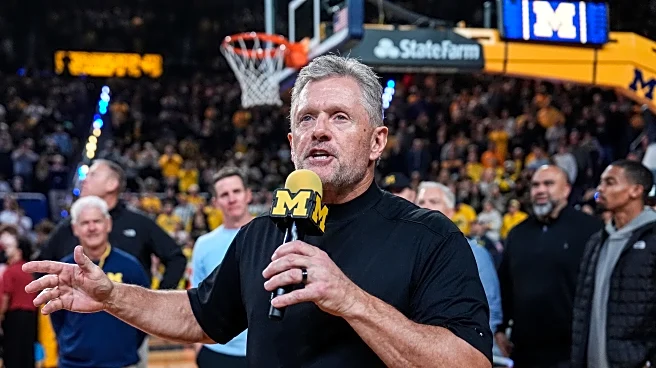
The Wolverines have shown some hesitancy for football, while basketball has seen much of their success this season because of the way they attacked the portal. Whittingham and the program could maybe learn a thing or two from Dusty May’s staff.
Since NIL became legal in 2021, Michigan’s football portal classes have ranked No. 54, No. 17, No. 57, No. 30 and No. 17, averaging No. 35 in the country. Whittingham’s philosophy at Utah was also behind the times, averaging No. 42 nationally over his final four seasons with the program.
At the same time, part of the lack of success could be tied to his situation at Utah, because he saw the value of bringing in quarterbacks to Salt Lake City. Devon Dampier transferred from New Mexico to Utah last offseason and was the Big 12 Newcomer of the Year. The year prior, Whittingham took a swing at former five-star quarterback Sam Huard to compete for the starting job. Even in the 2026 portal at Michigan, Whittingham earned commitments from veteran Colorado State starter Brayden Fowler-Nicolosi and former four-star Colin Hurley. We’re already examining a propensity to add the most important position from the portal, and had he not inherited Bryce Underwood, he likely would have been much more aggressive.
The No. 17 ranking was because of time and energy spent on Utah players, the quarterbacks mentioned, and former Texas wide receiver Jaime Ffrench. But it will be interesting to examine the approach to recruiting and NIL allocation moving forward. It might make more sense for Michigan to attack the portal more aggressively based on the success we saw from teams that did that in 2025.