


What is the story about?
R1:
Walter Johnson
R2: Goose Goslin
R3: Sam Rice
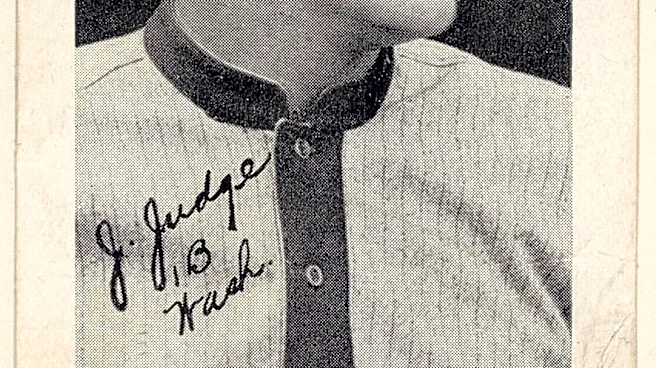
R4: Joe Judge
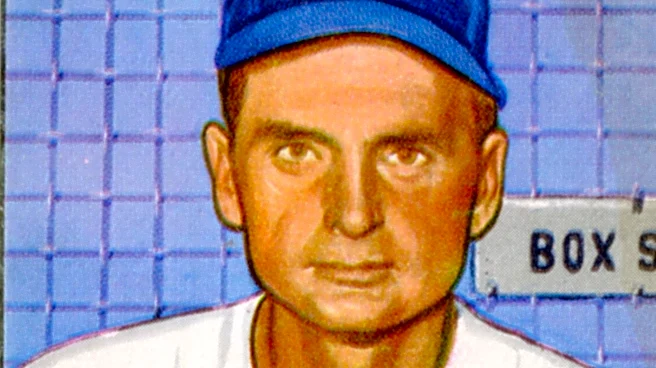
Famed New York Giants manager John McGraw looked at Joe Judge and saw a player too short to make much of an impact on the diamond. Fortunately, Judge’s local postal carrier had other ideas and McGraw’s loss was Washington’s gain.
Up next: a sturdy shortstop who just kept slapping singles and doubles!
Round 5

- Buddy Myer (1925-1927, 1929-1941): 1,828 H, 305 2B, 113 3B, 118 SB, .303 BA, .801 OPS, 109 OPS+, 42.3 bWAR. A college baseball star at Mississippi State, Myer was the Nick Punto of his era—bouncing around multiple infield positions as a proto-utility player. At the plate he was known for a keen eye, with OBPs routinely at .370+ (including five .400+ OBP years). Buddy’s 1935 season was his apex, seeing him take home a batting title (.349), score & drive in 100 runs, and finish 4th in MVP voting to slugger Hank Greenberg. Never one to back down from a challenge, the diminutive (5’10”) Myer once brawled with Ben Chapman (surprise, surprise) when Chapman spiked Myer and hurled antisemitic insults at him—leading to fans charging the field and multiple disorderly conduct arrests.

- Clyde Milan (1907-1922): 2,100 H, 1,004 R, 495 SB, .285 BA, .706 OPS, 109 OPS+, 40.8 bWAR. Before Ty Cobb re-wrote the record books for speed on the base paths, Clyde “Deerfoot” Milan was the gold standard of stolen bases. Twice leading the American League in bags swiped (88 in 1912; 75 in 1913), Milan averaged 40 steals per season over his 16-year MLB career. What Clyde lacked in Dead Ball Era power numbers (17 career round-trippers) he made up for by choking up on the lumber and compiling a .353 career on-base percentage. In 1911-1913 he garnered three consecutive top-9 AL MVP finishes. Milan could man all three OF stations and often led the league in assists, double plays & Range Factor. A high error total speaks as much to Clyde’s ability to even have a chance at suppressing more flying spheres than his contemporaries.

- Joe Cronin (1928-1934): 1,090 H, 242 2B, 72 3B, 51 HR, 577 R, 673 RBI, .304 BA, .842 OPS, 118 OPS+, 37.0 bWAR. Joe Cronin played just seven seasons for the Senators—but he certainly made the most of them. A doubles and triples machine (once leading the league in each), the swaggering shortstop cracked the 100+ RBI mark five times in Washington via his penchant for clutch knocks. Per Connie Mack: “With a man on third and one out, I’d rather have Cronin hitting for me than anybody—and that includes Cobb, Simmons, and the rest of them”. In 1933, he became a player/manager—and in his first year at the helm led the Nats to a pennant (alas, a World Series loss to Bill Terry’s New York Giants). Joe would join the Cooperstown ranks in 1956—then be named American League President in 1959. During his tenure (‘59-‘73), the AL would expand by four markets and shift around four other franchises.

- Firpo Marberry (1923-1932, 1936): 117 W, 3.59 ERA, 1,654 IP, 133 GS, 64 CG, 251 GF, 94 SV, 117 ERA+, 26.3 bWAR. Frederick “Firpo” Marberry was a hurler far ahead of his time. With a nickname bestowed for his scowling resemblance to pugilist Luis Firpo, Marberry was the first pitcher to ever make 50 relief appearances and record 20 saves in a single season—while also starting 133 games for the Senators. In the 1924 World Series alone, Firpo relieved in G2, started G3, and came out of the pen again in G4 & G7 to help the Nats secure their first championship. Truly the ultimate swingman on the mound. In 1949, Marberry was involved in an auto wreck that saw his left arm severed from his body and found in the other car. He died from a stroke in 1976 in his home state of Texas.

- Cecil Travis (1933-1941, 1945-1947): 5,417 PA, 1,544 H, 265 2B, .314 BA, .786 OPS, 108 OPS+, 30.4 bWAR. A shortstop and third baseman for a lot of really bad Washington Senators clubs, Cecil Travis just kept hammering out hits (singles and doubles, mostly). In 1941, his 218 H, 106 R, 101 RBI, .359 BA (second only to Ted Williams’ .406), & 150 OPS+ earned him a sixth-place MVP finish. Travis then enlisted in the U.S. Army where he was sent to Europe in 1944—narrowly avoiding feet amputation after a bad case of frostbite at the Battle of the Bulge. Understandably, his final post-WWII seasons were of somewhat lesser statistical quality. In the run-up to his announced final game in 1947, a “Cecil Travis Night” was held at Griffith Stadium—at which no less than General Dwight D. Eisenhower made an appearance! Travis remained with Washington as a scout until 1956, after which he retired to his family farm in Georgia and passed away in 2006 at the age of 93.