
We have finished the first three weeks of the 2026 college baseball season as we sit here on March 2nd and considering the Atlanta Braves have three very high picks in the 2026 MLB Draft, now is a good time to check in on the stock of some of the college players that are going to be candidates for the picks.
This isn’t meant to be a scouting report for these players, as much as it is to see where their stock is at in this current point in time. There is still plenty of time for these players to move
themselves up or down, but this should give you a better idea of who may or may not be available when the Braves make their picks.
Note all stats are through Saturday, February 28th.
Myles Bailey, 1B, Florida State
FSU’s slugging sophomore first baseman had a monster freshman year with 19 HR, and through the end of February is on pace to potentially eclipse that. More importantly he has been walking more and striking out less. It’s a little early to make the call until he consistently faces better competition, but he could end up making himself a candidate for the Braves second round pick.
Brady Ballinger, 1B, Kansas
Ballinger came into the year as a candidate to go with the #26 pick, but he hasn’t yet shown the power that made him a 16 homer guy with a 1.164 OPS. Through Saturday he is hitting just .326/.392/.395 – all down from a year ago, with three doubles as his only extra base hits, and a slightly elevated strikeout percentage.
Eric Becker, SS, Virginia
Becker came into the season as a candidate to go Top 10, and through his first nine games he has been putting up numbers similar to what we saw from him last year. He hasn’t really moved the needle much in either direction to date.
Tyler Bell, SS, Kentucky
Bell also came in as a potential Top 10 pick as a sophomore-eligible player, but unfortunately he injured himself in the first game of the season. He is presently out indefinitely with a shoulder injury, and while he hasn’t done anything directly to knock himself down the boards, his injury clouds his draft status a bit at the moment.
Jake Brown, OF, LSU
One of the bigger stars of the first month of the season, Brown was a candidate to go in the Top 100 picks coming into the season. However he is hitting .408/.473/.735 with four homers and just five strikeouts to open the year for the defending champs. He will need to continue producing at a high level, but he could potentially push himself into the mix for the later part of the first round.
Drew Burress, OF, Georgia Tech
After hitting 44 homers in his first two seasons, Burress came in as a candidate to go Top 5-10 despite being a bit undersized. He hasn’t done anything to change that opinion, as he is off to an excellent start to his season, posting a 1.263 OPS – however the most notable part of his stat line may be that he has struck out just four times through his first 56 plate appearances.
Cole Carlon, LHP, Arizona State
Carlon came into the year in the mix for the top college lefty in this class – a class lacking an elite prospect, but has only helped his case through his first three starts. Carlon is currently pitching to a 2.87 ERA and 0.77 WHIP with 19 strikeouts to five walks over 15.2 innings. It is worth noting that he left his most recent start early with a lower body injury, which will be something to monitor going forward. He could push his way into the conversation for the 26th pick as his four pitch mix has a fastball up to 98, a swing and miss slider, and two other solid pitches.
Roch Cholowsky, SS, UCLA
The #1 prospect in the draft has had an absurd start to his season and has further locked himself into that #1 spot. He came into Sunday with six homers and a 1.452 OPS, and hit a game tying seventh homer in the ninth against Mississippi State.
Derek Curiel, OF, LSU
Curiel had a big freshman season last year slashing .345/.470/.519 with seven homers, making him a candidate to go in the Top 10 this season as a sophomore with a strong year. Unfortunately he hasn’t lived up to his 2025 campaign, as he is hitting just .318/.400/.386, as he hasn’t really shown much power this year to date. He still has time to turn things around, but right now he is looking more like a candidate for #26 than he is for #9.
Daniel Cuvet, 3B, Miami
Cuvet is a bit of a polarizing prospect due to questions about his defensive home and amount of swing and miss, though he is posting what would be his third straight 1.000+ OPS season for the Canes. Despite his already six homers, he hasn’t seen his stock move much, as the same questions remain. He could end up being a candidate in the second round.
Jason DeCaro, RHP, North Carolina
DeCaro has been a strong starter for the past three years for the Heels, but seems to be enjoying a potential breakout season in 2026. Not only are his ERA and WHIP both set to be new career best’s, but his 9.5 K/9 is nearly two better than his previous high of 7.8. If DeCaro keeps missing bats in ACC play, he could lock himself into the first round, after being a borderline first rounder coming into the season.
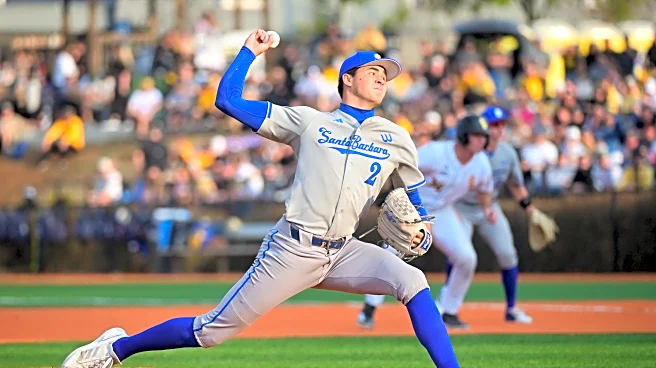
Jackson Flora, RHP, UC Santa Barbara
Jackson Flora came into the season as a candidate to be picked ninth, but through two starts he has looked like someone who may not even be there when the Braves get on the clock. Not only have Flora’s numbers been dominant, but his stuff also looks the part of a Top 10 selection.
Cameron Flukey, RHP, Coastal Carolina
Flukey came in as a candidate for the #9 pick and turned in a strong first start. Unfortunately he went down with injury and is expected to be sidelined for at least the next eight weeks. The injury and layoff will cloud his present draft status a bit, and in a class as strong as this one could potentially help push him down to the mid to later part of the first round if he doesn’t quite look the same when he returns.
Gabe Gaeckle, RHP, Arkansas
Gaeckle came into this season as a candidate for the #26 pick, but also as a guy needing to answer questions as he is an undersized righty who has never spent a full season as a starter. After a dominant effort in the opener he looked like he could push his way to somewhere above the Braves second selection. However he has merely looked good since then. If he can continue to hold up in his starting role, the stuff which earned comps to Spencer Strider and Gage Wood, could get him drafted around #26 – but his stock is volatile as he could move up or down quite a bit in the next couple of months.
Will Gasparino, OF, UCLA
After two quality years with Texas, Gasparino came to UCLA for this year and has been out of his mind. He is hitting .382/.512/1.265, and on Sunday he hit his 10th homer of the season – in just 11 games. While expecting anyone to keep hitting at that rate is unrealistic, he is moving himself up draft boards significantly. Gasparino came in as a guy who could go between rounds 3-5, but could push himself into the first or second rounds – depending on where he settles in after this hot streak.
AJ Gracia, OF, Virginia
AJ Gracia came into the year as a candidate for #9, that was if he was even still available at that point. Unfortunately for the Braves Gracia seems to have taken the next step after transferring to Virginia. So far he is hitting .412/.571/.941 with five homers and 11 walks to just three strikeouts over 49 plate appearances. At this point it would be fair to assume he figures to be gone before the Braves even pick.
Gavin Grahovac, 3B, Texas A&M
Grahovac went into last year expecting to be a high pick this year, but his season was limited to just six games because of injury. He seems to be on track to be a first rounder again this year, as he is hitting .316/.426/.500 with one homer – though that isn’t quite the power he showed as a freshman, when he hit 23 homers. Most importantly his strikeout rate is down in a big way, dropping from 29% as a freshman to 10.6% in his first 47 plate appearances. Grahovac could be a candidate at #26, but watching his power and strikeout totals will really help determine where he ends up going.
Chris Hacopian, SS, Texas A&M
Hacopian came into the year as a candidate to be taken #9, but he has struggled to stay on the field so far in his first year as an Aggie. A back injury kept him out for two weeks, only to flare up again this weekend in his first game back. Back injuries are injuries that give teams reason for concern, and with his lingering his status is very much in question at the moment until teams get a chance to look closer.
Owen Kramkowski, RHP, Arizona
Kramkowski came into the year as a candidate to go somewhere between #26 and the Braves second round pick. However the disaster season that the Wildcats are having has affected Kramkowski too, and he is currently pitching to a 8.49 ERA and 2.06 WHIP through his first three starts. He will still have time to right the ship, but he doesn’t look like a guy who belongs with any of the Braves top few picks.
Tegan Kuhns, RHP, Tennessee
I wrote about Tennessee sophomore Kuhns being a candidate for the #26 pick leading up to the season, and he has more than backed that up. Kuhns has a 2.45 ERA and 0.71 WHIP with 22 strikeouts in 18.1 innings, but also his stuff has been electric. Kuhns only threw 36 innings last year, so we will need to see how he holds up with a full season workload – but he could be pitching himself towards a spot where he wouldn’t be around for #26.
Vahn Lackey, C, Georgia Tech
Coming into the season Lackey was in the mix for the top catcher in the draft and a potential first round pick. With his performance so far (.514/.647/.892, four homers), Lackey has locked up that top catcher spot, and could be pushing himself into that Top 10, as this once glove-first catcher is starting to see the bat and power catch up to the rest of his game.
Tommy LaPour, RHP, TCU
Tommy LaPour came in as a candidate for the Braves second round pick, but after one solid start has been out with elbow soreness. LaPour’s stock is on hold at the moment as any pitcher with an elbow problem would be.
Justin Lebron, SS, Alabama
Lebron came in as a favorite to go in the Top 3 and has backed that up by hitting .325/.491/825 through Sunday with his six homers matching his six strikeouts. Similar to Cholowsky, Braves fans can forget about seeing Lebron in Atlanta in July.
Ethan Norby, LHP, East Carolina
Norby is the other lefty competing with Carlon for the top college lefty in the class. His overall numbers have just been decent thus far, but his stuff has looked great and he is striking out 13.5 per nine. Norby would likely be a candidate for the Braves second round pick right now.
Liam Peterson, RHP, Florida
Liam Peterson has been an interesting pitcher his entire career. He’s always had the pure stuff to be the first pitcher off the board in this draft, but the results have never quite been what you’d want to see for that type of arm. However this year the results have started to match up to the stuff a little better, as he has career best totals in ERA (3.77), WHIP (1.26), and K/9 (14.4). Peterson came in as a guy who the Braves would need to take at #9 to even have a chance at, and while that remains true for him, there seems to be a bit more room for a Flora to overtake him and actually have him available at #9.
Chris Rembert, 2B, Auburn
Rembert is another sophomore eligible player in this draft. Unfortunately injuries have limited him to just four games thus far, and a very small sample size. Right now his stock is pretty even from where it came in at – which would be a potential candidate for #26.
Ace Reese, 3B, Mississippi State
Ace Reese came into the year as a guy fairly locked in on the first round, but seeming to be ticketed to somewhere between the Braves two first round picks as a player who isn’t likely to stick at third base. This season though, he’s seen his stock rise with a hot start, and he could even be a candidate for #9. Right now he is hitting .444/.490/.889 with eight doubles and four homers, hitting well for both contact and average.
Caden Sorrell, OF, Texas A&M
Sorrell has a similar story to his teammate Grahovac, a strong freshman year that had him looking like a first rounder this year, a huge chunk of his sophomore year lost due to injury, and a good start to 2026. Right now Sorrell is hitting .412/.459/.882 with five homers, though with three walks and 12 strikeouts in just 37 plate appearances. He will be a first rounder it seems like, but the elevated strikeout totals could push him down a bit. He feels a little too risky for the #9 pick because of the strikeouts, but probably not around for the #26 pick either.
Sawyer Strosnider, OF, TCU
Strosnider is another sophomore eligible player, though one who has some differing opinions thanks to his swing and miss. On the optimistic side he could be a candidate for #9 coming into the year, but others would see him more as a candidate for #26. So far this year his slash line is slightly better than last year, with a fairly similar strikeout rate- though he has seen his walk rate spike. After walking every 8.0% of his plate appearances last year, he is at 31.1% this year, with his 14 total walks just six behind last season’s total in just 45 plate appearances so far. With this added element to his game, the Braves could need to draft him at #9, as he doesn’t seem likely to be there for #26.
Joey Volchko, RHP, Georgia
After two years at Stanford with first round stuff but late round pick results, Volchko transferred into Georgia for this year. So far so good as he has a 3.00 ERA and 1.20 WHIP with 18 strikeouts to five walks in his first 15 innings. The stuff remains high end and his command has improved dramatically, which is only helping his stock. SEC play will help determine where he goes, but the first round is a real possibility if he keeps this up.