

The Portland Trail Blazers are carrying a 27-29 record into the stretch run of their 2025-26 regular season campaign. In some ways the year has seemed long already. Their 5-3 start to the season—with wins over the Lakers, Warriors, Nuggets, and Thunder—seems almost like another lifetime. In other ways, the year has gone quickly. Injuries have given us eight different versions of the lineup, each blooming and disintegrating like a dandelion before winter.
Through it all, Portland has remained more
or less in the middle of the NBA’s Western Conference. They currently rank 9th, with designs on an upper-level Play-In Tournament spot, at least. But that perch in the middle has given rise to a persistent question: Are the Blazers any good? During a couple 4- and 5-game winning streaks, they’ve looked all but unbeatable. Other times—including losing 6 in a row in the last month, not so much.
Several questions from the Blazer’s Edge Mailbag in the past few weeks have generally followed these lines, some advancing optimism and others ready to let the season go already. As the team gets ready to resume post-All-Star play and finish their year, let’s take a look at where they are.
Positives
The biggest case for optimism is that the Blazers are finally recovering some of their players from injury. Scoot Henderson and Jrue Holiday have returned. Jerami Grant and Robert Williams III have been putting in games too. A thin, cobbled-together lineup has suddenly discovered depth. In a homely sense, that should bolster their chances of rising above mediocrity. If you can win X games already, you should be able to win “X + more” with four good players returning.
The schedule also provides reason for hope. A few games against the Timberwolves and Nuggets remain, but a whole lot of fluff and tanking populates the opponent list otherwise. 16 of Portland’s 26 unplayed games come against teams that will struggle to make the playoffs.
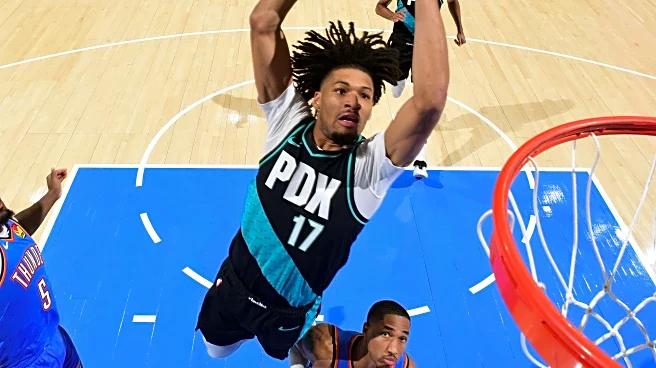
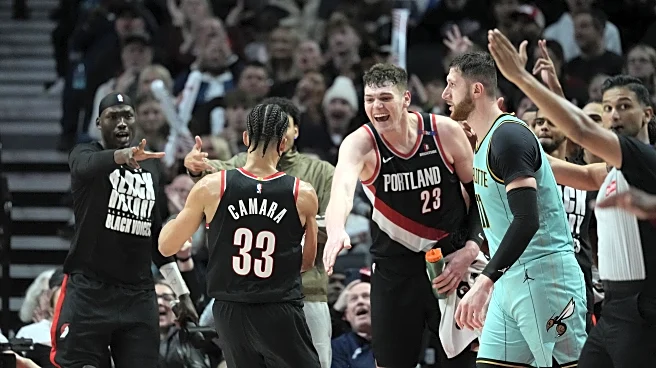
The Blazers have developed a couple of key players over the course of the season, including at least one star. Deni Avdija’s play has been stellar. He’s averaging 25 points, 7 rebounds, and 7 assists per game. Donovan Clingan has become one of the premier rebounders in the league. He’s averaging 11.5 boards per game overall, a league-leading 4.7 offensive, all in just 28 minutes of play. Toumani Camara’s shooting, Shaedon Sharpe’s scoring, and Holiday’s heady play have filled in the gaps between. If Henderson takes off, the Blazers might become downright dangerous.
Portland has also refined their play style. They’ve managed to get up tons of shots (6th in the league in field goal attempts, 3rd in three-point attempts, 7th in free throw attempts) to make up for their general lack of shooting skill. They’re the second-best offensive rebounding team in the league. They’ve maintained some sense of integrity on defense. They’re not great defensively, but they’re not bottom trawling either.
The best way to describe the Blazers right now is that they couple a base-level defense with an opportunistic offense. They need to score a lot most nights, but when they do—particularly when the three-pointers fall—they’ve got a great chance of winning against any opponent. The road to victory is almost always open. Does the team have enough horsepower to take it? That’s the nightly question.
Negatives
Unfortunately for Portland, we have to pile on several speculative positives because the negatives surrounding the team are much more tangible.
The Blazers remain the worst team in the league committing turnovers. Once upon a time they forced them too, but now their 15.2 turnovers-forced rate looks anemic compared to the 17.3 per game they give up. This was supposed to be an area of advantage for Portland. It’s the opposite.
The story is the same with fast break points. The Blazers started the season wanting to play quick and run hard, scoring easy buckets before the opposing defense could set up. 13.8 fast break points ranks them 21st in the NBA, a fairly flabby position. Meanwhile they give up 17.3 points on the run, dead last. That leaves them a 3.5-point deficit in a category they once hoped to dominate.
Portland seldom goes to the post up, but they like to drive on most possessions, breaking down the defense to set up their scoring. They’re running a 2.4-point deficit in points in the paint too, another area of strength that just isn’t strong enough.
The only “easy-point” category in which Portland holds any advantage comes at the foul line. They draw 25.5 free throws per game and give up 24.7. (Thank you, Deni!) But it all ends up with a dead-even 19.7 free throws made for each side on average, exactly zero edge.
We haven’t even gotten to the fun part yet. Remember the large number of shots the Blazers take per game, forcing a theoretical advantage over opponents? That’s squandered by their lack of accuracy. The Blazers rank 28th in the league in overall field goal percentage, 29th in three-point percentage. They need all those shots to stay afloat, rising above their own offensive ineptitude. They can’t actually get ahead when they’re shooting that poorly.
The Verdict
On a given night, Portland’s talent and speed make them dangerous. Overall, though, they’re just not that good. They’re still following their preseason game plan of getting up more shots than the opponent, but the shift in emphasis from forced turnovers and run-outs to offensive rebounding hasn’t had the desired effect. Forcing turnovers creates mistakes for the other guy. Offensive rebounding depends on your own mistakes (in the form of missed shots). Those two are not the same.
In some ways, Portland’s prowess is an illusion. If they don’t get hot from the field, their extra shots don’t end up mattering enough. Their defense, foul-drawing, and transition games—though decent—just aren’t enough to make up for it.
This is reflected in Portland’s average margin of victory, a paltry -2.0. That’s the lowest rank among any team currently in position for the playoffs or play-in tournament. Among the teams that have a whisper of a ghost of a chance of a Top 10 finish in their conference, only the Chicago Bulls (-3.8) rank lower.
Blazers fans have to hope for some kind of dramatic turn-around in the final third of the season, likely fueled by a combination of health and an easy schedule. Chances are, wins will come slightly more often between mid-February and April than they have up to this point. Whatever has been happening hasn’t really been working, so any such change will be welcome.
We can certainly say the Blazers are better off this season than they have been in recent years. That’s the same as saying that a burger from the national chain with the pale-colored fortress is better than one from the place that’s drive in and park only with the slushies. It’s true, but neither one are that far above the school lunch line. They’re better, but still a long way from being good.
The team will have a chance to change that narrative when they resume play tomorrow night with a game against the Denver Nuggets at 7:00 PM, Pacific.