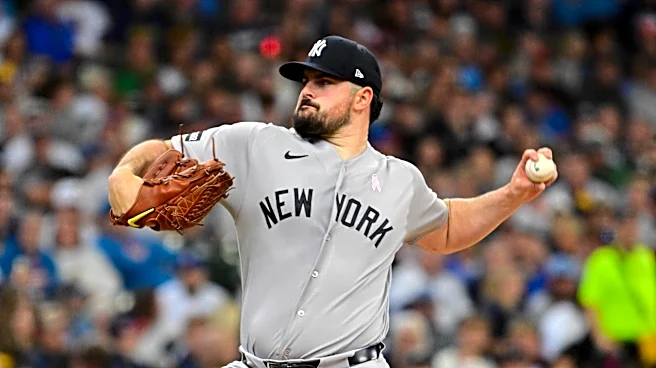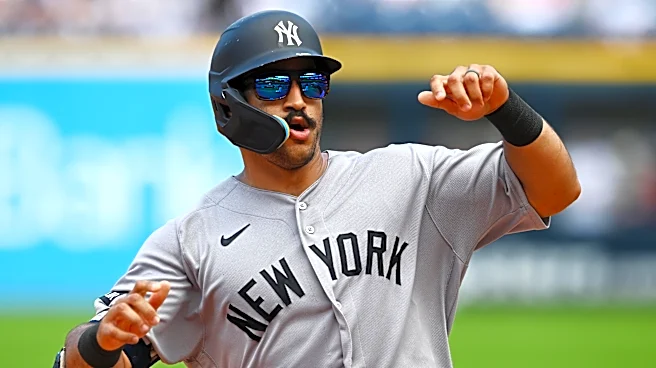









It’s hard to argue against the idea that a Yankees outfield feels incomplete without the 6-foot-7 right fielder manning the grass, warning track, and wall. No, Aaron Judge isn’t just a huge presence in the field missing (literally and figuratively), but losing a .907 OPS with 17 home runs and 38 RBI in 59 games is a major hole in the lineup that needs to be filled for the time being.
For a while, there was a concern about the team’s outfield with Trent Grisham starting in center following his signing
of a one-year, $22.025 million qualifying offer to remain with the team. Through his first 29 games of the season in March and April, he was batting .151 with a BABIP of .145 and a wRC+ of 76. For a guy hoping to prove that his breakout 2025 season wasn’t a fluke and that he deserves a significant free-agent contract after 2026, Grisham was not doing a very good job through the first couple months of the season. However, over the last 30 games, the tide has turned in his favor.
Grisham went from well below the Mendoza line in the box in his first 35 games of the season to slashing .296/.382/.454 in his next 30. Now, he’s hitting .232 on the season with an 114 wRC+ and a career-high walk rate and career-low strikeout rate (to this point).
The Yankees needed this change, but what’s driving it? It was highly unlikely that Grisham would hit .150 all year, but the change has been a tale of two halves through the first 65 games of the season.
There are a few major changes to what Grisham has been doing in the box that have helped expedite his resurgence. First, he’s probably just gotten some better luck. He was hitting the ball hard through the early parts of the season, but it was right at defenders. His process was not terrible, showing the same solid plate approach that helped him excel in 2025, but he just wasn’t seeing the ball find grass.
But Grisham has also seen an improvement in his batted ball profile. He’s seen an increase in both pulled balls (slightly up from 41.1% to 41.6% in May and 43.3% in June) and those hit to the opposite field (up from 17.8% to 24.7% in May and 20% in June). But he has also seen an increase in line drives and decreases in both groundballs and fly balls. His line drive rate through March and April was 8.2%, well below the league average, and that shot up to 14.3% in May and is even higher in June (23.3%). The line drives have made it easier for him to score runs or put his team in position to do so, like this hard-pulled line-drive triple following an incredible ABS challenge, which kept the inning at one out and allowed Grisham to score the fourth run on a sacrifice fly. And the Yankees would go on to score two more runs in the inning to make the score 6-3.
The Yankees needed their outfield production to replace Judge in the aggregate (or at least try their best with a rookie Spencer Jones still getting a hold of playing in the majors), and Grisham’s return to an above-average level is a boon. A change in approach that involves putting the bat to the ball while also keeping emphasis on high exit velocities has helped Grisham not just find the gaps in both right and left more, but it’s kept his power around. There’s still quite some time left until Judge returns, but the Yankees will have an easier time weathering the storm as long as Grisham continues at this rate. Grisham resembling the version of himself from 2025 (as well as Cody Bellinger’s return to MVP-caliber form) will go a long way to keeping the team afloat in Judge’s absence.