

Yesterday, Edwin Garcia wrote about the WNBA teams that have revved up the tank.
With USC’s JuJu Watkins headlining a prospective 2027 WNBA Draft class that also includes Texas’ Madison Booker and Notre Dame’s Hannah Hidalgo, in addition to other players possessing pro-ready skills, it makes sense for the seven WNBA teams outside the playoff picture—or, more specifically, the five teams outside the playoffs that own their own draft pick (sorry Phoenix Mercury and Chicago Sky fans)—to prioritize draft positioning.
Even if these teams choose not to intentionally lose games, they aren’t incentivized to go all out to win them.
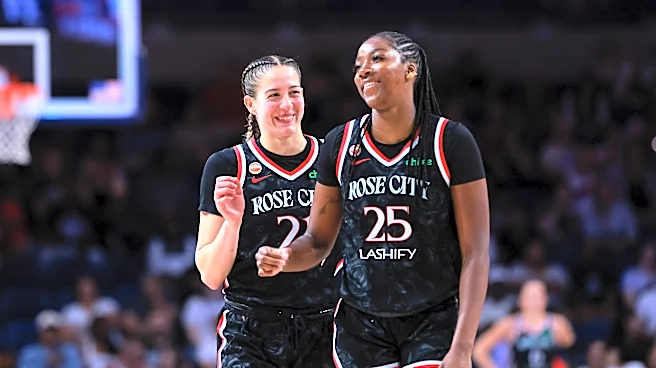
The one team Edwin did not touch on when discussing the tankers was the Portland Fire. Currently No. 9 in the WNBA standings, they’re a team that’s tough to pin down.
While the likes of the Mercury, Sky, Los Angeles Sparks and Toronto Tempo were unabashed about their playoff ambitions before the season, Portland was not. And yet, those four teams are all looking up at the Fire in the standings.
Even as they were measured about their first-season fate, recognizing the value in investing in strategic systems and player development over chasing wins, Portland has proven too competent to bottom out. And the Fire, like many of the lottery-bound teams that had playoff hopes, have not been immune from injuries. Still, they’ve ground out more wins than teams that not only were prioritizing winning, but also were perceived as more talented.
By endorsing process over results, Portland’s process has produced better results than anticipated.
But, could this be a bad thing?
Would Portland be better off with a record that resembles that of their Friday night opponent and revived Pacific Northwest rival, the Seattle Storm? On Friday night, the Fire have the opportunity to effectively shut down any notions of a rivalry, outside of geographic proximity, as they can sweep the season series with their Pacific Northwest counterpart with another win (10 p.m. ET, ION).
I think remaining true to their process is the right decision.
Just as Portland did not get tempted by their early season overachievement and begin to adopt a playoffs-or-bust approach, they’re not going sacrifice development and data collection opportunities in order to rack up losses that might improve their draft lottery odds. That seems especially wise since the WNBA has yet to announce how odds will be calculated for the 2027 WNBA Draft Lottery. (That seems like something teams probably should know by now.)
This a Fire than smolders, not blazes. It’s a slow burn that, eventually, will ignite into a winner.
So, which members of the Fire will be part of that winner? Or rather, which players, important to this inaugural season, might NOT be part of that winner?
Rather than tanking for a top pick, the Fire can acquire more high-caliber young players by trading some of their older players for future draft assets. After sitting tight at the trade deadline, the offseason could present an opportunity for the Fire to flip vets who have increased their value for picks or young players with longer runways.
Megan DiLeo will be 30 years old before next season begins, while Bridget Carleton will turn 30 early into the 2027 season.
That age, certainly, isn’t their basketball expiration date.
But, if Portland continues to pursue a slow, steady build, with the playoffs again not serving as the organizational aim in 2027, it could make sense to cash in on career years from DiLeo and Carleton, even if such a decision might seem overly aggressive, and antithetical to the culture Portland seeks to cultivate.
Outside of those two, Portland’s oldest key contributor who likewise has increased her stock in her first season in the Rose City is Emily Engstler. After stops in Indiana, Minnesota and Washington, the now 26-year-old has maximized her defensive playmaking, all while finding enough of an offense role thanks to becoming a more willing 3-point shooter.
Set to be an restricted free agent this offseason, she’s a keeper.
And Carla Leite, unquestionably, seems sure to be in Portland for a long time. Before her ACL injury, Sarah Ashlee Barker also looked like the recent top-10 pick she never got the opportunity to be in Los Angeles, thus securing her status as a future Fire fixture.
The Fire likely will remain invested in 2026 draft picks Frieda Buhner and Serah Williams, while Jordan Harrison, an undrafted rookie who recently was elevated from a development contract to a standard roster spot, is making a solid case for herself as a reserve guard with two-way punch. These three players have seen their minutes perk up since the All-Star break, an indication that the organization is committed to assessing their development, regardless of the wins or losses that come with it.
Rather than revving up the tank, Portland continues to cruise along, quietly cultivating a culture of competitiveness and competence
What are your thoughts about the Fire, their first-season strategies and their future?
Would you like to see the organization extend their slower and steady build into next season? Or, do you think they should seek to level up this offseason and begin to construct a team that could contend? And among the franchises that began that season as playoff hopefuls but are lottery bound, which one would be best advised to try to emulate Portland’s process?