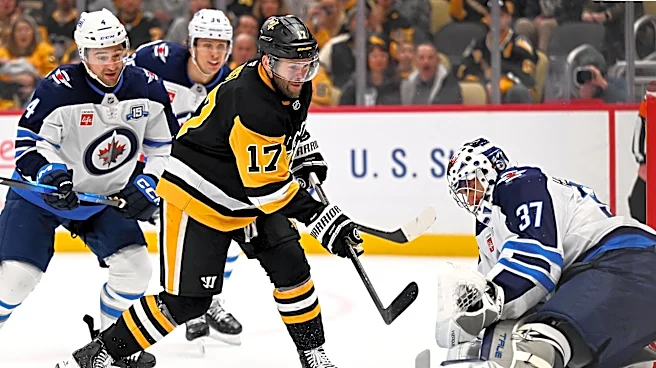





On Thursday we dove into the Pittsburgh Penguins roster and how it stacked up with the rest of the league on The Athletic’s player tier ranking, and how it showed the team is lacking some younger, proven impact talent.
Today, we are going to take a similar dive into the prospect pool after The Athletic’s Scott Wheeler published his prospect tier list with the help of some NHL scouts and executives. It is a slightly more promising look at the long-term outlook of the franchise, especially in comparison
to where the prospect pool was just a couple of years ago.
In this instance the word “prospect” is doing a lot of work because it also includes young players with something of an NHL track record. It’s basically a look at the best young players connected to an organization, both in and out of the NHL.
Overall, the Penguins have seven players make an appearance on Wheeler’s list, including two players (goalie Sergei Murashov and center Ben Kindel) in the Tier 4 “Star” group.
Harrison Brunicke, Rutger McGroarty, Bill Zonnon, Liam Ruck, and Will Horcoff all appear in the Tier 5 “Contributor” section.
In a vacuum, all of that means nothing without any context with the rest of the league, or within the Penguins farm system itself.
So let’s offer some context.
First, as it relates to the Penguins.
If you go back just one year the Penguins only had three prospects appear in Wheeler’s tier rankings, and all of them (Rutger McGroarty, Ben Kindel, Harrison Brunicke) were Tier 5 prospects.
If you go back two years, the Penguins had just one prospect appear, and it was also as a Tier 5 prospect (McGroarty).
So just based on raw numbers, going from one prospect on the list, to three prospects, to seven prospects, all in the span of just two years is a strong increase. Especially when two of the young players moved up into a higher tier.
But how does having seven players on the list stack up with the rest of the league? It is not bad.
There are only 10 total teams in the league with at least seven players on the list.
There are only six that have more than that, and only four that have nine or more. Chicago is at the top of the list with 11, while San Jose, Anaheim and Detroit all have nine.
The one area where the Penguins are lacking, again, is in the Tier 1 and Tier 2 prospects, where they have zero (and also zero in Tier 3). But that is also not something that is completely unique to them. There are only seven teams in the league that have one Tier 1 or Tier 2 prospect, with San Jose leading the way with two of them (Macklin Celebrini and Ivar Stenberg). Chicago (Connor Bedard), Anaheim (Leo Carlsson), Montreal (Lane Hutson), Philadelphia (Porter Martone), New York Islanders (Matthew Schaefer) and Toronto (Gavin McKenna) all have one each.
There are simply not a lot of those guys to go around.
It is also important to keep in mind that not everybody on here is going to pan out. Nor do you need them to given the way NHL rosters are actually constructed. If even three of these seven players become NHL regulars I think you take that as a win. Anything after that is probably a bonus.
It then comes down to which players are in that group, and how far they can climb.
I am confident in saying Kindel looks like an NHL player, and as a center there is a lot of value in him. As I said on Thursday, Murashov becoming a “star” player would change a lot of things for the Penguins outlook in both the short-term and long-term outlooks.
Can Brunicke be a No. 2 or 3 defenseman?
Can one of McGroarty, Horcoff or Ruck become a top-six scorer?
Can Zonnon be a middle-six center?
Could a couple of players here be used as trade bait at some point, along with your collection of draft picks, to try and add somebody more significant that is more proven as a younger, impact NHL player?
All of that is still a work in progress, but it is still nice progress in a very short period of time. Especially when you consider the highest pick the Penguins have had over the past two years is No. 11 overall. It is also another reminder that even though this is not taking on the look of a traditional rebuild that we have become accustomed to over the past decades, the Penguins are very much focussed on the future more than the present. The number of draft picks they have accumulated (both already used and both still ahead, as well as the young NHL players they have focused on in trades) is absolutely the sign of a team that is thinking long-term.
They needed to improve their prospect pool. They are in the process of doing that. They still need to find “the guy” somewhere, but there is progress being made.