
In head coach Brenda Frese’s 24 seasons with No. 22 Maryland women’s basketball, the team has never lost five games in a row.
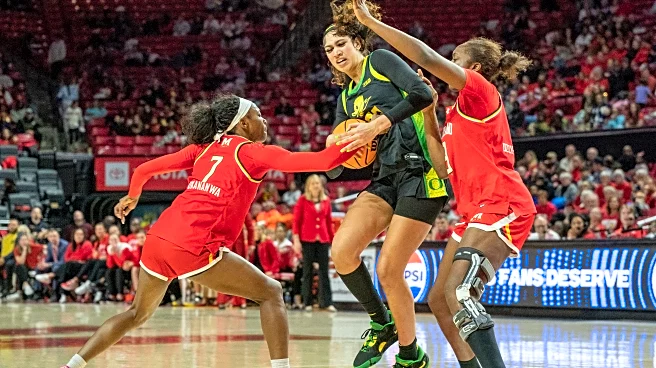
On Saturday, the Terps fell to Oregon, 68-61. That was their fourth consecutive
loss, a span that includes a winless three-game homestand.
Despite suffering two overtime losses and a fourth-quarter collapse, Maryland looks to avoid a dubious record. But an even tougher opponent stands in the way — No. 12 Michigan State, which gets to play at home.
Wednesday’s game will tip off at 6:30 p.m. from Breslin Center and will be streamed on Big Ten Plus.
No. 12 Michigan State Spartans (19-3, 8-3 Big Ten)
Head coach Robyn Fralick is in her third season with Michigan State. She has led it to two NCAA Tournament appearances, and another is likely on the way. Before Michigan State, she spent five seasons at Bowling Green and three with Division II Ashland. At Ashland, she was a Division II champion and runner-up with a combined 104-3 record — the highest winning percentage in NCAA history with at least 100 games.
The Spartans moved up a spot in this week’s Associated Press poll despite falling to No. 9 Michigan in overtime on Sunday, 94-91. Their other two losses on the season are to No. 10 Iowa and Wisconsin — opponents the Terps went 1-1 against.
Michigan State’s best wins this season came over No. 13 Ole Miss, No. 24 Washington, Nebraska, USC, Oregon and Illinois. The Terps and Spartans have eight common opponents — Maryland is 4-4 and Michigan State is 6-2.
The Spartans have won eight of their last 10 games.
Players to watch
Grace VanSlooten, senior forward, 6-foot-3, No. 14 – VanSlooten is in her second season with Michigan State after spending two seasons with Oregon. Last year, she was named to the All-Big Ten second team after averaging 16.5 points and 7.4 rebounds. Those numbers have slightly dipped this season — she averages 15.1 points and 6.3 rebounds — but VanSlooten remains Michigan State’s leading scorer, shooting 50.7% from the field and 66.3% from the free throw line. She is almost guaranteed to score between 10 and 20 points each game — she has scored less twice and more once in 22 games.
Kennedy Blair, redshirt sophomore guard, 5-foot-9, No. 35 – Blair has taken a major step into Michigan State’s rotation this season after being relatively impactful last year. She leads the team with averages of 7.1 rebounds and 5.4 assists per game, numbers that rank 10th and fourth-best in the conference, respectively. She is also a secondary scoring option, averaging 13.7 points on 52.3% shooting from the field. Blair’s biggest weakness is turnovers; she averages more than three turnovers per game, fifth-most in the Big Ten.
Rashunda Jones, junior guard, 5-foot-8, No. 1 – Jones is in her first season with Michigan State after transferring in from Purdue. She is primarily a strong defensive force — her 2.6 steals per game are second-most in the Big Ten. She also averages 12.6 points, 3.8 assists and 3.5 rebounds per game this season.
Strength
Scoring offense. Michigan State is the third-highest scoring team in the Big Ten, averaging 86.2 points per game. The Spartans’ 24.3 point differential is also third-best in the Big Ten, below UCLA and Michigan. Michigan State shoots well from the field at 49.4%, which is second-best in the conference. The Spartans also average the second-least turnovers at 12.4 per game, and their 1.51 assist-to-turnover ratio is third-best in the Big Ten.
Weakness
3-point shooting in conference play. Overall, Michigan State has the third-best 3-point percentage in the Big Ten at 37.4%, despite not having a clear sharpshooter. However, that is due to the Spartans shooting 42.4% from deep in nonconference play. Things have taken a turn for the worse since Big Ten play began, and they have shot 31% from beyond the arc in 11 games — third-worst in the conference. Maryland is only slightly better from deep throughout its 11 Big Ten games, shooting 31.3% — fourth-worst.
Three things to watch
1. A new low. Maryland fell six spots in this week’s AP poll to No. 22 after losses to Washington and Oregon last week. It’s the Terps’ lowest spot since 2023-24, when they were unranked — and their lowest spot while remaining in the poll since 2010-11.
2. The Big Ten has been rough. Maryland is currently 5-6 in Big Ten play with a tough road contest coming Wednesday. Since joining the Big Ten, Maryland has never had a losing record in conference play — its worst was 9-9 (0.500) in 2023-24. In the Frese era, Maryland has had a conference losing record twice — in 2002-03, her first season, and in 2009-10. Three of Maryland’s seven remaining opponents are ranked.
3. Where can Maryland improve? Through 11 Big Ten games, the Terps have been solid in most areas, but three have led to their downfall. First, the Terps have struggled to win close games; in all but one loss, the Terps were within at least one point in the fourth quarter. Turnovers have been a major problem as Maryland averages 15.9 turnovers per game in Big Ten play — sixth-most in the conference. Maryland’s 3-point shooting has been dreadful, 31.3% and fourth-worst in the conference.