

Recently, my dad invited me to a meet-and-greet with former White House reporter, St. Louis native, and author Terry Lemons, who was there to premiere his new book, The Year St. Louis Became a Baseball Town: The Cardinals, Babe Ruth, and the 1926 World Series. I couldn’t go, but I remembered the book when I was debating what to write today, because when this is being posted, I will be on vacation, with no access to my computer. The book is new, which makes this somewhat timely. I also do not need
to know anything about how the Cardinals have performed recently.
First things first, this is a book seemingly designed to be read on the toilet and I mean that as a compliment. It is a brisk 181 pages, with many pictures and 19 chapters. It is a thorough exploration of the 1926 World Series, going game-by-game to share results and reactions from fans, the media and the players themselves at the time. We also get a hefty dose of context, the real reason to read this book.
Did you know for example that St. Louis in 1926 had the reputation, essentially, that Philadelphia has right now? The mayor and newspapers were very worried about how the crowd would behave during the World Series, because St. Louis was suddenly on a national stage. The Cardinals were perhaps the original perennial losers, as the Cubs, Pirates, Indians, and even the Washington Senators had all won World Series. I have to share this very funny quote from a Washington Post reporter that is in this book:
“The only remaining question to be settled is how seriously the St. Louis fans are going to take their world’s series. In this town, where rabid support of the ball team is among the fundamentals, the fan takes the nearest weapon at hand to display his objections to the course of events. Pop bottle showers are the events of the first social importance in Sportman’s Park. They become so much the rage, in fact, that soft drinks are now poured by attendants into paper cups. No one doubts, however, that the St. Louis partisans will come armed for any eventuality. This reporter may yet be a war correspondent seeking a s shell hole for safety.”
And to be fair, this was warranted. Well he went hypberbolic, but St. Louis fans had history. A fan once threw a soda bottle at an umpire in 1907 that caused a skull fracture and hundreds of bottles were lobbed earlier that year in a Cubs-Cardinals matchup. In a funny twist, Yankees fans cheered Rogers Hornsby when he first came to bat in Game 1 – his mother had recently died and he wasn’t able to go to the funeral. It was actually noted when Cardinals fans did not cheer Babe Ruth when he came to the plate for the first time. Although that changed in Game 4, when Ruth hit three homers.
This was essentially the beginning of St. Louis’ reputation as a fanbase changing in effect. The crowd behaved themselves this series. Not only did they behave themselves, this book made me wish I could be there. Crowds filled the streets, full stadiums, huge parties. Due to the fact that teams traveled by train and the fact that St. Louis was the westernmost and southernmost of the teams, the team finished the season on a 33-day road trip and then stayed in New York for games one and two. So they didn’t witness the impromptu celebration St. Louis had when they won the pennant. When they finally arrived in St. Louis after a 21-hour train ride, they were shocked by the crowd. New York in comparison, was pretty subdued when the Yankees won the pennant.
It was also kind of a perfect storm for the Cardinals fanbase to grow exponentially. Radio was a relatively new thing and most people did not actually have one yet. World Series had been broadcast on the radio before, and there was a ton of interest across the country on this particular World Series. It was almost literally New York against the rest of the country. Just about everyone was rooting for the Cardinals. And because St. Louis was the only team even remotely close for a lot of places, this World Series made them fans.
KMOX was not KMOX yet, but the fervor created by the pennant race and this World Series led to them broadcasting games regularly in 1927. This was a time when crowds of people would gather around a scoreboard and then wait for them to update the games. Someone would have a radio and hear the results and then pass along the information to be put on the scoreboard. Basically our modern day equivalent is staring at Gameday for an update.
There are numerous anecdotes grabbed from papers at the time that make this a fun read. There is a story that a fan came all the way from Newark, New Jersey to buy tickets to Game 3. He hitched rides all the way to St. Louis despite being partially paralyzed and in crutches. In Game 7, a fan apparently had a heart attack at a stressful moment in the game and died. A 12-year-old kid created a makeshift radio to listen to the game that made national news. It’s sprinkled throughout each game.
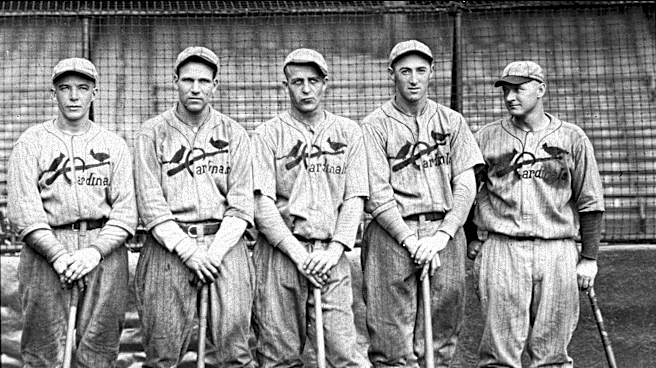
And of course the other factor that made this such an important World Series: it was an all-timer. It went seven games, most of the games were close, it featured fourteen future Hall of Famers. An eye-popping number to be sure, although less impressive when you know it’s because Frankie Frisch put in all his buddies (Jim Bottomley, Chick Hafey, Jesse Haines) and of course the nature of being on a bunch of World Series winning teams probably put a few Yankees in that aren’t really Hall of Fame caliber (Tony Lazzeri, Waite Hoyt, Herb Pennock), BUT nonetheless they were all at least great players.
And despite my snide remarks, it did feature truly legends of the game. Hornsby was unfortunately M.I.A. when the games were actually being played, but his prickly personality causing him to get traded is the only reason there isn’t a debate about whether he or Stan Musial is the best Cardinal. Well that and pre-integration, but Hornsby was that good. Babe Ruth hit a then-MLB record four homers in the World Series, including three in one game, which caused the St. Louis fans to give him a standing ovation.
And of course, the biggest legend of them all, Grover Cleveland Alexander. He claimed he pitched better hungover, which is the most alcoholic logic I’ve ever heard. But he pitched Game 2 and Game 6, and finished off Game 7, coming off a complete game in Game 6. He came into Game 7 with his only warmup pitches being off the mound, casually and slowly greeting the centerfielder and shortstop on the way there. And he got out of a bases-loaded, 2 out jam when the Cardinals were holding onto a one-run lead with a strikeout.
And the stats bear out his greatness that World Series. In a career where he struck out 8.3% of batters and just 5.8% in 1926, he struck out a very modern looking 22.5% of batters in this World Series. After striking out Lazzeri, he said “I have no nerves; the strain was naturally on Lazzeri.” He was one of the greatest pitchers who ever lived and he could have been even better. I suspect his drinking held him back. But he turned into a myth, because the rumor mill suggested he was found in a tavern and whisked to the game to pitch in the 7th, still drunk, proposed by none other than Damon Runyan.
The best thing I can say about the book is that it makes me want to go back in time to experience what St. Louis was like when this was happening. The city went nuts when they won the pennant. And they went nuts when they won it all. To quote the Post-Dispatch: “It was a city wide detonation. It was as if dynamite had been planted in a hundred scattered spots and all touched off at the same instant. The downtown exploded in noise. Two minutes after victory the din was deafening. Automobile horns and sirens, back-firing of motors, tin horns, bells that had been muffled in silence for the one moment turned loose.”
St. Louis was the epicenter, but celebrations occured through many other states. This book argues, effectively, that this series created the fanbase we have today. KMOX obviously is responsible for its reach, but who is to say the radio covers every game if not for this 1926 season. They experimented with games per popular demand in August for the pennant chase, so it legitimately seems like the success of this team caused the radio to cover every game, which of course caused the fanbase to explode.
Should you get this book? I don’t think I need to tell you. You can probably tell if it’s your thing or not. My one complaint is probably the play-by-play of each game could have been more streamlined. At the same time, you do get a sense for how the game’s going, so it’s kind of a double-edged sword to only focus on important moments. Like if the pitchers are trading zeroes, you don’t really need to go through each inning. But I don’t want to make it sound like he goes through every batter, he doesn’t, and in the grand scheme, I’m talking about a few pages per game.
Here’s a line in the sand maybe. Does the name Tommy Thevenow mean anything to you? Thevenow was an unfathomably bad hitter who was the David Freese of 1926 – in terms of being an unexpected hero. I’ve never heard that name in my life. If you have, you may already have enough knowledge of this series to pass on the book. Depends on your appetite for this kind of thing and how okay you are with risking reading stuff you already know. If you’re into Cardinals history and barely any of this sounds familiar, you’ll probably like this.
It’s a short read with short chapters, so I don’t know if the author literally envisioned the book being the type of thing you read on the toilet, but it’s very easy to stop and start. I’m sorry I’ve emphasized that point, but that is one of its selling points to me and I’m sure others. It is not a misleading title, it did convince me that St. Louis became a baseball town in 1926.