



It is one thing for young prospects to see significant game time on a Euroleague team, and we’ve looked at a few already (even if they will not be selected in this year’s draft). However, it’s another thing to have a significant role as a young player on a successful Euroleague team.
With respect to Adam Atamna and Momo Faye, their teams did not fare well among Europe’s elite, ASVEL were bottom of the Euroleague, and Paris finished 16th out of 20 in the regular season. However, in the case of today’s
prospect, this is not the case.
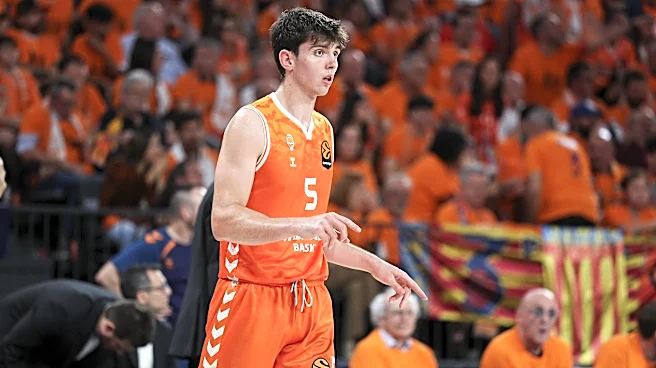
20-year-old Spanish wing Sergio De Larrea played a role in Valencia’s stellar Euroleague campaign, finishing second overall in the regular season only behind finalists Olympiacos before falling in the semifinal of the postseason to Real Madrid. De Larrea averaged seven points per game on 45% shooting from the field on 4.7 attempts per game, 41% from three on 2.2 attempts, 2.8 assists, and two rebounds in 14 minutes per game in 59 games played across all competitions, per RealGM.
Let’s take a look at the film — De Larrea wears the number five and often wears orange shoes to accompany Valencia’s orange.
Offense/scoring
Just under half of De Larrea’s field goal attempts come from three, where he shoots an excellent percentage. Let’s take a look at how De Larrea dispatched his three-pointers.
In catch-and-shoot scenarios, De Larrea is effective as an outlet to pass to. Here on the drive, De Larrea is planted in the corner and when he receives the ball he immediately brings it up for a straightaway shot, converting on this attempt:
Very much like Zaccharie Risacher when he was coming out of the draft, De Larrea can go straight up without bringing the ball down and this allows for a quicker shot.
De Larrea does the same again on this next possession as he is above the break to receive the ball and upon the catch, he immediately rises into a three:
Wide open this time off of the drive, De Larrea is unfazed by the openness of the opportunity and dispatches the three:
Above the break this time, De Larrea is in place to receive the ball on the kick-out, and he hits the catch-and-shoot three:
Catch-and-shoot opportunities are more likely to be the shot that De Larrea would see if he was to be drafted and play in the NBA, but it also helps that this is not the only means De Larrea can hit a three-pointer.
In transition off of a rebound, De Larrea pushes ahead, gives up the ball and locates to the corner where he receives the ball once again, and he hits the three-pointer:
Speaking of transition, while this wasn’t a made three, De Larrea does a good job to open up the opportunity as he fakes the shot to create an opening but misses the three:
De Larrea can also hit three-pointers off of the dribble, as he does so after a made basket, taking the ball up and pulling up for the three-pointer:
Coming off of a screen, De Larrea takes advantage of the defense sagging and rises into a three-pointer:
De Larrea is quick to recognise the space that he has and doesn’t hesitate to step into the three off of the dribble:
After the switch on the screen, De Larrea sizes up his opponent and despite the switch again at the end of the possession, De Larrea pulls up into another three-pointer off of the dribble:
De Larrea is also capable of scoring inside the arc too, although perhaps not as consistently or prolifically as he can shooting the three-pointer.
From the corner, De Larrea ball fakes, drives to his left and while this is heading towards the help defense inside, De Larrea switches hands to evade the defense and finishes at the rim:
Possession is rescued at the baseline, and De Larrea runs onto the pass, switches to his left hand and adjusts to make a difficult finish at the rim:
Coming off of the drag screen, De Larrea hesitates before shifting gears, lulling the defense, and boosts his way to the rim to finish with his left hand:
De Larrea drives on this possession, halts his dribble, and swivels inside to score near the rim:
From his own paint, De Larrea pushes the ball up the floor and takes it all the way to rim, finishing with an emphatic dunk, highlighting his athleticism, which he doesn’t feature too often in his game:
De Larrea can also get himself to the free throw line, averaging over two attempts per game.
These can come from fouls on jumpshots:
Coming off of the pick-and-roll, De Larrea draws the foul and free throws on the runner attempt inside:
On the drive to the rim, De Larrea draws heavy contact and is sent to the free throw line:
Passing/playmaking
De Larrea averages 2.8 assists per game, which is quite impressive in just 14 minutes per game. Let us take look at some of the ways De Larrea creates offense for his teammates.
After a miss, De Larrea receives the ball and when the defense steps up to meet him, he shifts the ball ahead for an assist on the three:
De Larrea possesses good awareness of his surroundings, as he draws the defense before whipping the pass behind him for a three-point attempt:
Using the screen, De Larrea draws the defense and slips the pass off the ball for a three-point attempt:
Again using the screen, De Larrea does a great job to spot and find his teammate in the weakside corner for a three-point attempt:
He is able to repeat the same play just moments later, though this time the defense does a better job defending the three-point line and forcing the drive:
On the drive after the slip screen, De Larrea finds his teammate in the corner for the assist on a three:
On this play, De Larrea drives when he receives the ball and kicks back towards the area he drove for the assist on a three:
On another drive, De Larrea is able to get to the rim and kick out to the corner for a three which is missed:
On the cut, De Larrea delivers a solid bounce pass for the assist at the rim:
Following a difficult catch, De Larrea is able to arc himself to kick the pass back out above the break for the assist on a three-pointer:
Defense
Valencia often ran a zone defense, so opportunities to assess De Larrea’s on-ball defense aren’t always plentiful. In watching De Larrea engage within the zone defense he certainly played his role, often looked to pick up the ball-handler and wasn’t a player that opposing teams targeted.
This is a good play that exemplifies De Larrea’s defense. He picks up his man full court (in this case, former NBA player Ricky Rubio), and sticks with Rubio on the drive, forcing Rubio to pass out. Then, De Larrea switches back into the zone defense as an anchor near the rim, and the three-pointer is hit on the outside:
The three being hit is not De Larrea’s fault, but it’s a good example of De Larrea’s work defensively both individually and within the team.
Again, De Larrea picks up full court, and he does well to stick with the drive to the rim and gets a good contest up at the rim, forcing the miss:
This next clip is highlights some really good defense activity and denial from De Larrea, but when he stumbles on the drive the basket is scored:
De Larrea is also capable of contributing to a steal, which can fuel his team’s opposition.
De Larrea extends good pressure at the halfcourt line, before digging in from behind to knock the ball loose and produce the steal:
Again as the help defender, De Larrea reaches in from behind to cough the ball up for another steal:
As part of his role in the zone defense, when the pass comes over in his direction De Larrea is in place for the steal, but his attempted alley-oop isn’t converted:
Near full court, De Larrea picks up his man, and when he has to give the ball up, he extends his reach and when the pass-return is attempted De Larrea knocks the ball loose, take it in transition and finishes with the dunk:
In closing…
Sergio De Larrea is a well-rounded prospect. At 20 years old (21 in December), De Larrea is not one of the youngest prospects in this draft, but he has experience few in this class possess. De Larrea has played professionally for a number of seasons now, this latest one his most successful as he contributed efficiently — despite limited minutes — to a very successful campaign in Europe. He has played in high stakes games in the Euroleague postseason and has performed well. Watching him play, his mentality, approach, edge, and maturity on Europe’s biggest stage was really impressive to watch.
Elsewhere on the court, De Larrea isn’t the most explosive athlete, nor does he have elite size for a wing at approximately 6 foot, 5 inches, but he’s able to get to the rim well on his drives and can finish with athleticism when it’s called upon.
Offensively, three-point shooting is De Larrea’s best strength right now, and that will hold value to NBA teams. De Larrea can hit threes both off of the dribble and in catch-and-shoot scenarios — I suspect the latter will be called upon more in his rookie season than creation off the dribble. Nevertheless, the ability to rise into a three off of the dribble — while not perfected — is still be a useful tool in De Larrea’s arsenal.
De Larrea does a pretty decent job of finishing inside the arc, and he’s comfortable finishing — and switching — between either hand. De Larrea can also get himself to the free throw line. If there was a criticism of De Larrea’s game offensively, his handle can be a little loose and pounced upon, and his ability to finish at the rim is can be inconsistent at times.
From a playmaking point of view, De Larrea is able to spot and make a pass, particularly out of pick-and-roll/drive attempts. Similar to his offense, a loose handle can contribute to turnovers, but overall, De Larrea’s passing/playmaking is passable, for a lack of a better term. While he may not be the primary ball-handler, this ability is, again, a very useful skill to be able to call upon and adds to the versatility of De Larrea’s overall game.
Defensively, I liked De Larrea’s defensive activity: he picks up full court often, he does well to stick with drives, he does well getting around screens and can deny the ball to his opponent. It’s difficult to fully assess De Larrea’s defense as Valencia often played a zone defense, but De Larrea played well within that concept while also showcasing his own individual defensive ability and activity.
In terms of his NBA prospects, I’d be a little concerned as to what De Larrea’s ultimate ceiling is. If he became more than an NBA starter I would be surprised, but that’s not to see he cannot be a productive bench player, which I think would be the role he would probably be bested suited to. De Larrea’s versatility will certainly help his cause. He has a diverse skillset offensively, decent defensively, and can play multiple positions.
Now, let’s take a look at what other outlets have reported in their assessment of Sergio De Larrea.
ESPN have De Larrea ranked 45th overall as part of their Best Available list, with Jeremy Woo of ESPN mocking De Larrea 43rd overall. Sam Vecenie of The Athletic has De Larrea mocked slightly more favorably at 34th overall. Kevin O’Connor of Yahoo Sports has De Larrea mocked in the first round at 28th overall with this to add about the selection pertaining to the Minnesota Timberwolves:
Just look at how crucial Mike Conley still was to the Timberwolves in these playoffs. But he’s 38. And Ayo Dosunmu and Bones Hyland will both be upcoming free agents. The Wolves might need a guard. De Larrea is a tall playmaking guard with major feel and a knockdown jumper who thrives within team concepts. He suffered a dislocated shoulder that ended his 2024-25 season and removed him from draft boards, but it ended up a blessing in disguise since he returned with a bigger role and stronger production for a great team in the EuroLeague. With size, smarts, and defensive versatility, he has the tools to far exceed his draft slot. And Minnesota general manager Tim Connelly knows more than anyone how important those international hits can be to building a contender.
On reading this assessment, it would make more sense for De Larrea to end up on a playoff caliber team. I wouldn’t feel as strongly about that this year with De Larrea as I did with Hugo Gonzalez, and how he would be perfect for a playoff team off the bench (fast forward a year later, Gonzalez had a successful season with the Boston Celtics), but the sentiment would be similar. De Larrea is a mature player and to end up on a mature squad who need depth would be a more ideal match.
In terms of a fit with the Atlanta Hawks, it would appear with their current selections (unless a trade comes through where the Hawks trade up/down), De Larrea may not end up on their radar, but I think would be a player who would be beneficial to a team’s depth and would appeal to the diverse nature of the current roster.
As always, time will tell…