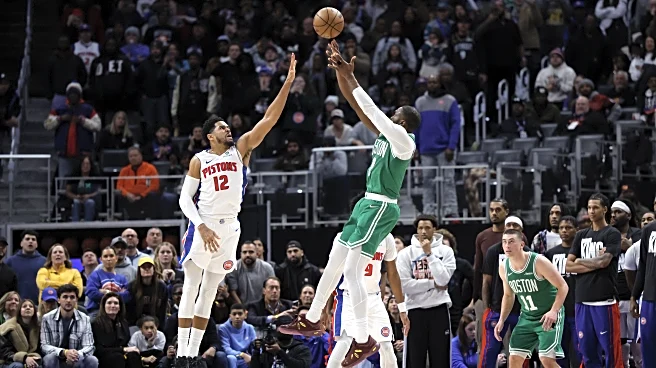




The dust has settled on the regular season series between Boston and Detroit right at the midway point in the season, culminating in a 104-103 Pistons win that came down to the final possession.
After four games, we have a pretty clear idea of what to expect of this matchup between the Eastern Conference’s two best teams. If there’s one thing we’ve learned from this series alone, it’s that Detroit has maintained a clear identity in J.B. Bickerstaff’s second year in charge.
They’re nasty, physical and
a genuine pain to deal with. The Pistons have no problem turning a game into a drudgerous affair, in fact I think they prefer it that way. With that style comes a playoff-like intensity in every game they play. Although in the case of Boston specifically, things don’t exactly appear to be all Kumbaya.
But that playoff intensity is important because as it stands, these two teams have a real chance of seeing each other in some capacity in the postseason, and we have a pretty clear idea of what that hypothetical series would look like if the season ended today.
In some ways, this matchup gives strong hints of the 2022 Eastern Conference Finals against the Miami Heat, who took the Celtics to seven games with a centerpiece star, a physically imposing big man and a collection of role players built to make life a living hell on opposing offenses. When Duncan Robinson signed his three-year contract to join the Pistons, it was meant to be that the Pistons’ transformation from a confusing amalgamation of players with no clear fit into a team with an identity built for a seven-game series was all but solidified.
Outside of the 3-1 series record, the raw head-to-head numbers tell us a compelling story. When these two teams play, it consistently comes down to the wire, and we’ve gathered a few observations that are worth highlighting if these two ever see each other again this spring.
Jaylen Brown can (and will) carry the load
Jaylen Brown has been a downhill force in this four-game series, averaging 35 points on 44/34.5/72 splits. In this most recent loss, Brown was often the sole source of offense in the first half, before things opened up for Sam Hauser and Anfernee Simons in the third quarter.
In the fourth quarter, Brown aggressively sought his spots, right down to the very last possession, one that generated a fadeaway jumper at the elbow that had a chance of bouncing in.
Considering the score differential of this series is a tight +11 in favor of Detroit, we’ve seen a heavy dose of clutch minutes between these two teams. If there is any semblance of playoff-like basketball in a regular season setting, it’s within those 5-under-5 opportunities.
In the case of the Celtics, that means a lot of Jaylen Brown isolations. Regardless of what they throw his way, Brown attacks with brute force and finishes in pirouette form. It’s a fascinating collision of elite-level attacking against elite-level defensive pressure.
Brown holds a 43% usage rate against the Pistons, higher than his 36% usage for the season (for reference, he is second in the league behind Luka Doncic in usage, who is at 38%). 39% of his field goal attempts against Detroit came off possessions where he had 3-6 dribbles, and 24.5% were off seven or more dribbles before firing.
In the majority of his late-game chances with the ball, Brown is seal hunting.
Specifically, he’s Duncan-hunting. The two are well-acquainted from years of Miami/Boston battles, and this year has been no different, with Brown consistently seeking that mismatch switch. In total, Brown has matched up with Robinson for a grand total of 5:04 in four games, and he’s scored 32 points on 56.5% shooting from the field and 67% from three.
To put that in perspective, his 32 points on Robinson is the most he’s scored on any one matchup so far this season, even more than Tobias Harris, who has guarded Brown more than anyone to this point with 28:47 matchup minutes where Brown has scored 31 points on 30% efficiency.
All this to say, Brown wants to attack this hard-nosed defense head-on. He’s taken no less than 25 shots in this series with a great deal of success, but that activity can also come at the cost of offensive flow.
Clearly, Brown takes on the challenge to win these game, and he knows he can score against this team, but it does open up some hints of Brown’s past tunnel vision. Detroit, especially with Robinson matched up, has no problems collapsing its help, and last night Brown’s four turnovers were the most on the team (although to his credit, just one happened in the fourth quarter).
Who’s on Cade?
The Celtics have done an overall pretty good job on Cade Cunningham, who had his worst outing against Boston on Monday after shooting 4-of-17 for 16 points. Half of his scoring output came from the free throw line, where he went 8-of-10, and a lot of credit should go to Jaylen Brown and Jordan Walsh, who spent the bulk of the time guarding him, holding the All-Star starter to a combined four points on 2-of-9 shooting.
But Cunningham, like a true superstar, is more than just a bucket-getter. Even in an off-night, Cunningham still dished out 14 assists without a single turnover to his name, while having three stocks on the other end.
The challenge is not in just holding Cade from catching fire as a scorer, it’s in stymieing his entire flow. To completely stifle Cunningham is to stifle the entire foundation upon which the Pistons offense is built. That’s a huge task. That’d be like attempting to remove the entire engine of a Ford F-150 with someone already behind the wheel.
But in Boston’s collection of wing defenders, who’s been the most successful attempting it? The aforementioned Walsh and Brown may be the best answers.
Walsh is third in matchup minutes against Cunningham this season, behind Dyson Daniels and Davion Mitchell, and he’s been up to the challenge. His defense against Cade in Boston’s win on Nov. 26 was a major factor in that clutch closeout, and in total, he’s held him to 17 points, five assists and four turnovers on 31% shooting in three games.
In nine total minutes this series, Brown has held Cunningham to 2-of-10 shooting for five points with five assists, and just one shooting foul.
Cade has found ways to consistently attack his own mismatches to get to his 29-point average in his four Boston matchups, generating the most success against Derrick White and Payton Pritchard. White rarely found himself guarding Cunningham last night, in fact it was on just three partial possessions, but in their four games, Cunningham’s 20 shot attempts against White are the second most he’s taken against any player, and he’s shooting 50% on those looks.
To help on Cade is to sell out on the notion that he’ll make the right read, but to a player you’d rather live with beating you. That was the case last night, and Cunningham assisted on four Robinson threes and 11 of Tobias Harris’ team-high 25 points. Cunningham plays winning basketball in this Detroit ecosystem, and it’s a fun challenge to consider the pros and cons of the many approaches you can have to dealing with his offensive gravity.
Detroit puts Boston’s rebounding outlook into greater focus
Even as Boston’s emphasis on defensive rebounding has turned that issue from glaring to middle of the road, this matchup in particular really shows just how far apart Boston’s 16th-ranked defensive rebounding is from Detroit’s fourth-best offensive board-crashing.
The Celtics are not alone in this dilemma. The Pistons average 13 offensive rebounds a game, led by Jalen Duren’s four per outing, which is third best in the league behind Steven Adams and Donovan Clingan.
So it’s not just a Celtics issue, yet the Celtics do in fact struggle especially hard against this specific matchup. Detroit’s 15.3 offensive rebounds per game against Boston is well above their season average, and in total, they’ve won the collective rebounding battle 191-164.
It’s worth noting the Celtics have progressively gotten better in this department these last two matchups, even winning the glass battle 45-41 on Monday thanks to a 14-9 offensive rebounding difference headlined by a combined nine offensive boards between Jaylen Brown and Derrick White, but it is still an issue this matchup presents. In a series that drags out to six or seven games, the chances of low-scoring slugfests only rise, and the team that can create more second chance opportunities through their rebounding and paint scoring will have the advantage.
The Pistons and Celtics are both top-10 teams in second-chance points (Celtics are third, Pistons sixth), but where the interior scoring differs is in overall points in the paint, which Detroit is second in with 58.3 compared to Boston’s 28th-ranked 44 points inside.
There’s no debate that Luka Garza and Neemias Queta are generally good rebounding and interior bigs, but is this the kind of conference matchup that Brad Stevens looks at and identifies as proof of additional frontcourt assistance? Do they stand firm and await the return of Jayson Tatum, one of the league’s best rebounding forwards who’s averaged double-doubles in each of the past three postseasons?
Only time will tell, but the battle on the boards has been a huge element to this regular season series, and it’s only amplified once you hit a series format.
The Celtics have three months and 40 games left before any real conversations about this matchup possibility begin to take shape. It makes this a bizarre conversation to even be thinking about by mid-January, yet we’ve got four legitimately entertaining games’ worth of film we can unpack from the Eastern Conference’s two best teams in case they do ultimately meet come playoff time.