





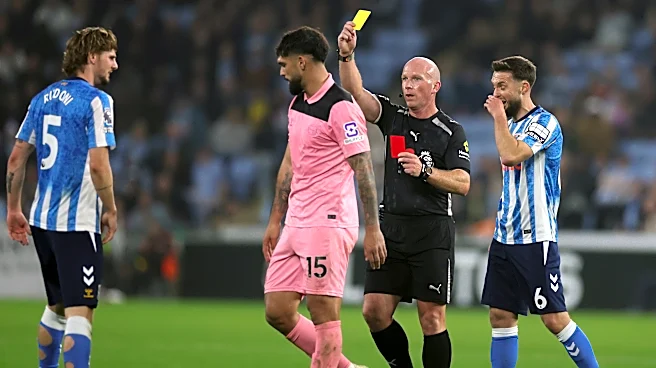


As the Halloween horror show at Coventry unfolded, leaving those clad in Elvis kits in the stands not so much falling in love with those on the pitch as thoroughly all shook up, the famous line coined by Martin Johnson, one-time cricket correspondent of The Independent, sprang readily to mind.
“There are only three things wrong with this England team,” he wrote on the eve of the 1986/87 Ashes series Down Under. “They can’t bat, can’t bowl and can’t field.”
On the evidence of the first hour at the CBS
Arena last Saturday, Sunderland couldn’t defend, couldn’t score and couldn’t get a grip in midfield.
After a fifth defeat in six Premier League games (a solitary point from the last 18 available), a single goal from the last four league games (and that from the penalty spot), the omens are not looking particularly auspicious for a Sunderland side stuck at the foot of the table, 12 points down on their return from the first nine matches of last season.

Already treading water in the league in a fixture list cramped by the additional demands of the Europa League and the League Cup, the task is hardly going to ease beyond the visit of Chelsea on Sunday and the international break, with eleven more fixtures to fulfil on all fronts before the turn of the year.
And yet…
The gap to the psychologically dizzy height of 17th spot, the one above the drop zone, is only two points.
That, it seems, is the comforting bottom line for Régis Le Bris, his dysfunctional squad and the increasingly fretful – if not yet wholly disaffected – red and white fanbase.
There is time yet to turn the tide – though not much, admittedly, before the sheer weight of Premier League fixtures might prove totally overwhelming.
And also, taking a break from the domestic doom and gloom, as Régis and the Lads do with the visit of Dinamo Zagreb to the Stadium of Light on Thursday night, there is Sunderland’s proud home record in European competition to cling to: a red and white rubber ring with knobs on.

Back in the old days, a little before my time as a Roker Park regular, the front page of the programme for home matches used to carry a list of club honours – six times winners of (ye olde) First Division, FA Cup winners in 1937 – and underneath the proud boast: “Only club which has never played in any other than the First Division.”
That claim came to an end with Sunderland’s first relegation in 1958 – a phenomenon with which I first became acquainted as a tearful eight-year-old when the Liverpool right-back Chris Lawler sealed the fate of Alan Brown’s 1969/70 side with an 86th-minute finish at the Fulwell End.
We may be only one and a bit campaigns into Sunderland’s history of continental conflict, but the programme for Thursday night’s contest with Dinamo could include the line: “Only North-East club unbeaten at home in European competition.”
I was there at Roker, alongside my Dad and sister in the Clock Stand Paddock, when Dennis Tueart converted the penalty that earned a 1-0 second-leg win against Vasas Budapest in the first round of the 1973 European Cup Winners’ Cup.
We were in the same spot when Bobby Kerr and Micky Horswill scored the goals in a 2-1 second-round first-leg victory against Sporting Lisbon, Hector Yasalde’s late away goal ultimately ending that pioneering continental campaign by Bob Stokoe’s FA Cup-winning immortals.
I was also in the East Stand at the Stadium of Light when Enzo Le Fée smacked home the penalty that earned the 1-0 win against AZ Alkmaar in the opening fixture of this season’s Europa League campaign.
That magical night seems like a lifetime ago now, but the fact is Sunderland have a 100% home record in UEFA competitions.
They are the only North-East club unbeaten at home in Europe.
Middlesbrough were beaten at the Riverside in both of their UEFA Cup campaigns: 3-2 by Sporting Lisbon in 2004/05, and 1-0 by Stuttgart the following season – before progressing on away goals and reaching the final.
Newcastle’s first European loss at St James’ Park came in the second round of the UEFA Cup in October 1977. They were beaten 3-1 by the Corsican side Bastia.
Johnny Rep scored an eighth-minute opener and hammered home a late long-range thunderbolt that sealed the fate of a Newcastle side featuring Paul Cannell, the local lad striker who inspired the (credit where credit’s due) classic Leazes End chant of “F***ing hell, it’s Paul Cannell.”
Rep was a nominal striker, alongside Johan Cruyff, in the Dutch national side that patented Total Football in the 1970s. He scored two goals on his World Cup debut against Uruguay in Hanover in 1974.
The next Netherlands player to achieve that particular feat was one Brian Ebeneezer Adej Brobbey, who bagged a brace in the 5-1 Dutch victory against Sweden in Houston in June.
The signing of a new contract this week by our Marvellous Marvin Hagler of a Number Nine (ask your Dad) is one reason to hope that Sunderland’s season might not be Scrooged by Christmas.
Another might be mention of the fact that the England cricket team which supposedly couldn’t bat, couldn’t bowl and couldn’t field ended up bringing home the Ashes in the winter of 1986-87.