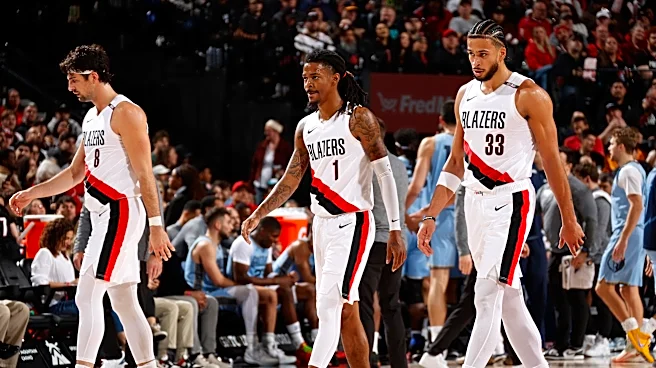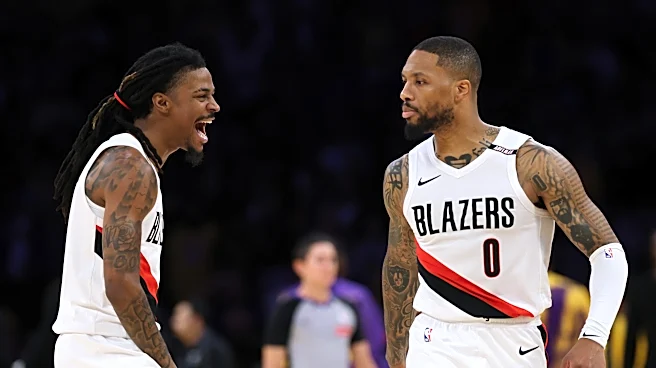




Yesterday the Portland Trail Blazers announced the full extent of the hamstring injury suffered by Ja Morant during Thursday’s loss to the Memphis Grizzlies. With Morant sidelined for at least a month, I want to focus on the preseason and four regular season games he’s played alongside Damian Lillard. How well have the two guards done so far and what might the Blazers miss with Morant out?
When Morant joined the Blazers in late June, three opinions were largely expressed by pundits and fans. One,
ownership and the front office had lost their collective minds. Two, another trade was waiting in the wings. And three, maybe Damian Lillard wouldn’t be the same after the Achilles injury and Morant would take his place.
Four months on, point two was false and point three is almost laughable. The jury is still out on point one, but it appears a judgment on the sanity of Blazers’ leadership is still a “wait and see”. I, for one, was critical of the move and confused at the suggestion that Morant and Lillard would be the starting backcourt.
We’d seen how a small, offense-first backcourt had fared during the CJ McCollum years — solid regular seasons but a catastrophe in the playoffs. While Morant had reached much higher individual heights than McCollum, the former Murray State standout has lost a step off the back of mounting injuries.
I could see the arrival of Morant, a former MVP candidate and All Star, as being acceptable if he was willing to accept a bench role with Lillard and Jrue Holiday serving as Portland’s starting backcourt. Morant and Scoot Henderson would prove a more than capable supporting role off the Blazers bench.
But new Coach Micah Nori decided to flout convention, choosing to give the Morant-Lillard combination a chance. At the very least, if the pair failed, he could argue that he’d tried to make it work and perhaps appease the front office who traded for Morant in the first place.
Offense
The statis don’t really offer enough real evidence after four games to justify any given lineup, but the fact that the Blazers sit third in offensive rating, third in points and assists per game, and fifth in field goal percentage is notable.
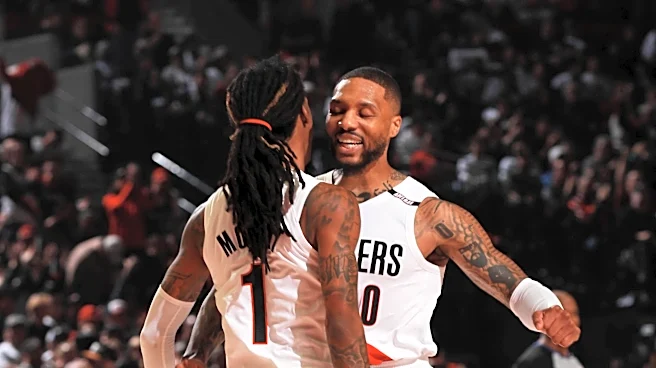
The argument that the Morant-Lillard pairing wouldn’t work on offense because both guards need the ball can be pretty safely rejected at this point. Though the two play the same position, their games are vastly different. Morant is the truer point guard and the best passer on the team while Lillard, still a gifted facilitator, is more adept at scoring the ball himself.
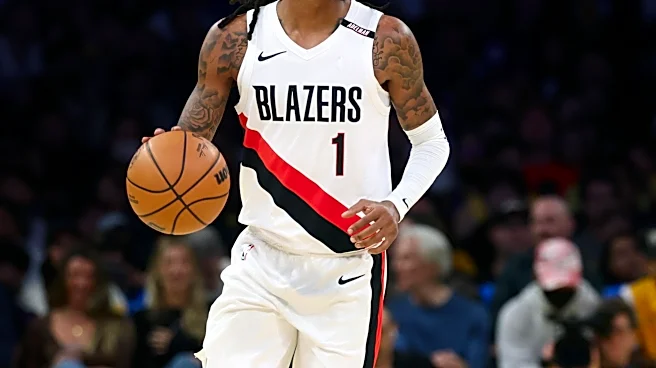
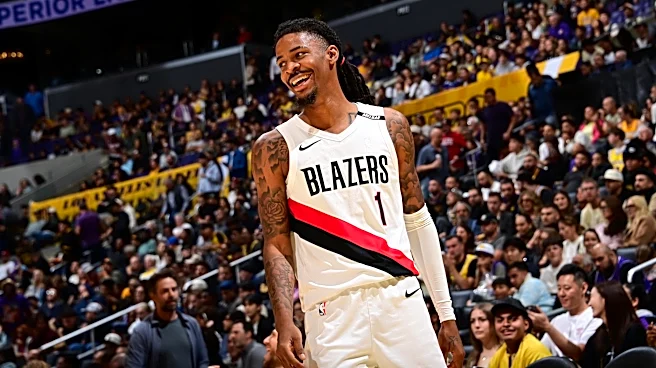
Though his athleticism isn’t as explosive as it was during his MVP-ballot years, Morant’s quick-twitch movement and midrange game remain, best exemplified during the Blazers win against the Los Angeles Lakers this week. Morant was able to confuse defenders getting to his spots and scoring with push shots, layups and mid-range jumpers, producing 23 points on 9 of 13 from the field. He may have one of the best natural touches for a guy his size, currently ranking first among point guards in the mid-range at 69.6 percent.
In the past, the Blazers have had issues keeping the scoreboard ticking over when jump shots start to fail and turnovers mount. Morant’s ability to score close to the basket is an important addition for this roster.
Morant’s passing has been as good as advertised. He finds open players. He’s formed a strong lob partnership with teammates, most notably with Robert Williams III.
Morant is also hitting 42.9 percent from three-point range, unthinkably good for him. Perhaps it’s a small sample size, but it could be the by-product of a reduction in facilitating responsibilities. If so, that rate can be perpetuated.
Morant’s ability to drive and kick has been a key part of the Blazers offense. He gives defenders headaches when Deni Avdija has free access on the weak side to drive and convert at the rim.
This leads me to Lillard. I was initially worried about how much taking the ball out of his hands would impact his contributions. But Lillard has thrived as the trailer and as a catch-and-shooter, hitting open three-point shots. He’s still making plays, but with reduced physical impact that might help prolong his career.
Playing alongside Morant has freed up Lillard to do what he does best: hit open shots with the occasional drive. Though his three-point shooting is slightly down from previous years (35.1%), he seems to be the same powerful, aggressive guard he always was.
Defense
Now that all the positive stuff is out the way, we can get to the defense. Aside from the Phoenix Suns game, which was more a reflection on the opponent than the Blazers, Portland’s defense has been difficult to watch.
The Blazers are currently 19th in defensive rating. While they aren’t short on elite defenders in Toumani Camara, Jrue Holiday, Robert Williams III, Donovan Clingan, and Sidy Cissoko, starting two non-entities on defense has not been ideal.
In the roughly 15 minutes a game Morant and Lillard have shared the court, Camara, Holiday and Cissoko have had to serve as point-of-attack defenders. Morant and Lillard have needed to be hidden despite the fact that Morant remains an opportunistic steal generator, averaging 1.0 through four games.
Against the Kings, the pair were hidden on Deandre Hunter and Keegan Murray, against the Lakers on Matisse Thybulle and Ziaire Williams,. Against the Grizzlies, Jaylen Wells was the only real weak link on offense. I fear how the Blazers will look against the Philadelphia 76ers, New York Knicks, and San Antonio Spurs, all of whom boast few offensive weaknesses in their respective starting units.
In the playoffs, the defensive pairing of Morant and Lillard will become this team’s biggest liability. Opposing offenses will look to make the most of the pair, neither of whom stand taller than 6’3 or weigh more than 200lbs. Lillard or Morant alone would be passable, but two negative defenders will cause issues for this team when the opposition gets serious.
Conclusion
The Ja Morant injury is a blow to a Blazers roster which has overperformed through the start of the regular season. But perhaps Morant’s absence will give coach Micah Nori a chance to look at Lillard and Holiday as the optimum pairing as starting guards. Holiday is almost the perfect complement to Lillard thanks to his two-way ability and his effectiveness both on and off the ball. Hopefully by the time Morant returns, the Lillard-Holiday backcourt will have been too effective to split up.
The Morant-Lillard combo has worked much better than I thought it would on offense but it raises real concerns defensively against better opponents. With two negative defenders in the backcourt, the lack of defense might be too much for the Blazers the likes of Toumani Camara and Donovan Clingan to cover for.