
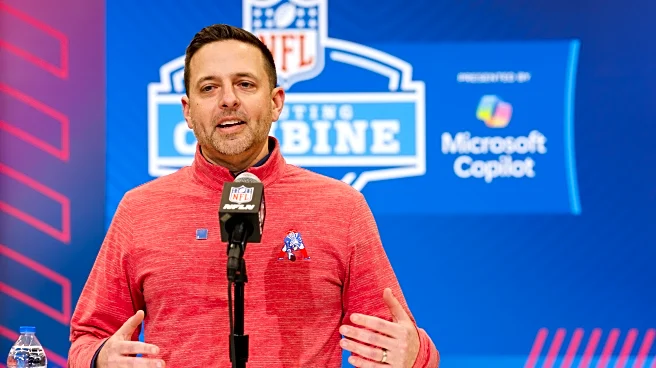
This past January, while the Texans sought (and failed) to breakthrough the Divisional Playoff barrier, they also saw the anniversary of their hiring of Nick Caserio as GM for the team. Five years ago, Houston finally got their man (as Houston had a rather abortive attempt at Caserio in 2019). Since that time, He oversaw the hiring and firing of three head coaches, churned through a myriad of free agent signings, most of the one-to-two-year variety, and been one of the more active traders in the game,
especially during the NFL Draft.
What to make of Caserio’s time in Houston? Certainly the long-standing interest Houston had in Caserio as a potential GM dominated discussions for some time in Houston circles. Back when it seemed that Houston was doing all it could to create Patriots South, bringing on board a GM from the New England dynasty seemed par for the course. The first two seasons of the Caserio regime, well, it was a good thing that few expected anything from the Texans, because they lived down to those expectations. A combined 7-26-1 playing some of the most boring, uninspiring football seen to date. However, in the past three seasons: 32-19 with two division titles and three playoff wins. Coming into his 5th offseason, Caserio’s tenure continues to see Houston a consistent playoff team trying to turn Super Bowl contender.
Here are some considerations about Caserio’s tenure:

Free agency:
If there is one thing that Houston saw from Caserio early on, it was value/risk-mitigations. In his first two years in Houston, Caserio signed over 60 free agents, with most of them on short-term, team-friendly deals. For a team trying to dig out of cap hell, with few premium draft picks and a rebuilding roster, there was no reason to go big for a couple of huge signings. As expected, those first couple of years were a mixed bag, with some players doing well (Jerry Hughes, Cam Johnston), but just as many serving the role of roster-filling. Some things have chanced over the past two offseasons. As Houston went from also-ran to playoff team, they could go “big-game” hunting. They did this with DE Danielle Hunter, LB Azeez Al-Shaair and TE Dalton Schultz. Yet the short-term free agent signings still remain a staple of the Caserio regime. You saw this with players such as Cam Robinson and Braxton Barrios. Sure, the success rate could be disputed, but few of those moves excessively crippled the team’s cap situation.
Drafting:
Not every draft will be akin to the 1974 Steelers or 2007 Giants. Still, Caserio’s record has seen more hits than misses. Franchise cornerstones such as Derek Stingley Jr., Jalen Pitre, Nico Collins, Will Anderson Jr, CJ Stroud, Kamari Lassiter, and Calen Bullock all were Caserio draft picks. Yet it is not all glory for those high draft picks. Some high level misses along the offensive line (Kenyon Green, Juice Scruggs) continue to haunt the squad. Not a lot of lower-draft picks are dominating, but enough picks are hitting to keep Houston a winning team.

Trading:
During the NFL Draft, few GMs wheel and deal like Caserio. Consider his signature move: The Day 1 Draft trade in 2023 that gave Houston the #3 pick in the Draft, bringing in Will Anderson, Jr. The genesis of this move was the Deshaun Watson trade in the 2022 offseason. However, with Houston in need of both offensive and defensive cornerstones, and with players like Stroud and Anderson available, Caserio took a calculated gamble and made the move to get them both. Additionally, Day 2 and Day 3 moves dominate Caserio’s draft actions. Nico Collins and Woody Marks came to Houston as a result of such deals. Additionally, as Houston held late 1st round picks over the past two drafts, they’ve followed a Patriots pattern and traded out of those to gain more picks in Day 2/3. Many of those turn into deal-chips which have yielded mostly decent results.
As for non-draft day trades, Caserio’s record is dominated by the Watson trade in 2022. Since Caserio couldn’t offload Watson before the 2021 Draft (as the multiple sexual crimes allegations came out before Caserio could execute a potential pre-draft deal), he played a patient game. This meant that Watson and his high cap hit remained on the sidelines while the legal system sorted out his off-field mess. Once criminal charges were off the table, Caserio worked the phones until he got buy-in from the Cleveland Browns. The Browns offering that massive fully guaranteed contract helped sell Watson, but Caserio got a pretty good return from that deal. 3 1st round picks, along with 3 other picks in return for Watson and a mid-round pick. Say what you will about the final returns but Caserio won that trade.
As for other trades, Caserio will sometimes apply his free agency policy towards the deals, as he will take swings on players in the last year of contracts, such as OG Shaq Mason, WR Stephon Diggs, WR Christian Kirk and RB Joe Mixon, with varying results. Sometimes, it is a one-and-done (Diggs, likely Kirk), and sometimes, it turns into an extension (Mason, Mixon). He is also not afraid to shake things up, like the trade of Laremy Tunsil. Did it weaken the left side of the line? Yes, but did it help the cap situation and provide Houston some decent cap ammunition for 2026 and 2027? Also yes. Getting rid of players maybe a year too early is also a New England trait.
Extensions:
Here, Caserio is both conservative and aggressive. For players like Stingley and Pitre, he signed them to market setting/stretching deals that have AAV, but short lengths (2-3 years). Hunter, Pitre, Collins and Stingley are examples of deals that worked, but Mason and Mixon can show the downsides of such actions. Still, even for Mixon, the potential cap savings can (and will) outweigh the dead cap hits. What will really test Caserio will be the pending extensions for Anderson and Stroud. It is possible that he punts on both with the 5th year options but if Caserio can find the balance, he will take it. Likely Anderson gets the big extension this year. Stroud’s situation, especially after this most recent playoff run, will bear further watching.
The “Trigger Finger”
When Caserio is on the clock, he has his signature move:
Other Thoughts:
Recall Caserio entered into a front office seen as akin to Game of Thrones. That Jack Easterby brought in Caserio over the hurt feelings of Watson didn’t exactly help Caserio settle into the team. Yet Caserio was hardly a “yes” man to Easterby. In the wake of the Culley firing in the 2021-22 offseason, both Caserio and Easterby had their preferred candidates. Easterby pushed hard for the one-time backup QB McCown, who only had high school position coaching to his resume and Caserio was in on then-recently-fired Miami Dolphins Head Coach Brian Flores. Neither came to Houston, but Caserio showcased enough independence from Easterby that he didn’t suffer when Easterby’s time ended later in 2022. Caserio maintained good working relations with Cal McNair. While never in the New England orbit, Caserio executed the move to bring in DeMeco Ryans. He generally let Ryans pick his inaugural staff, save Special Teams, which were under the capable hands of Caserio-hire Frank Ross. When Bobby Slowik’s schemes no longer worked in Houston, Caserio contact Nick Caley entered the fray, to mixed success.
Right now, Caserio’s tenure has been more success than failure. While he hasn’t hit on every personnel decision, he generally does not saddle Houston with many lingering bad contracts. His calculated gambles tend to work. While a Patriot Disciple, he isn’t afraid to go outside that universe. He helped take the Texans from irrelevance to playoff staple. However, the pressure is growing to get Houston over the Divisional Round hump. The failures to secure stability on the offensive interior are a flashing “Check Engine” light for Caserio, with major implications for Caserio and the franchise. While the McNairs seem good with Caserio, nothing is permanent in the NFL. Even as Caserio preps for the Combine and free agency, he needs to keep his eye on the bigger goal.