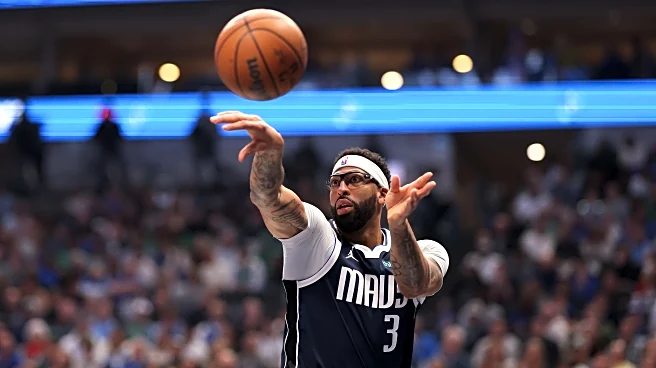




The Anthony Davis experiment in Dallas has reached its most familiar endpoint. According to ESPN’s Shams Charania, Davis is likely to undergo surgery to repair ligament damage in his left hand, sidelining him for several months and effectively ending his season with the Mavericks. Given both the medical prognosis and the organization’s current direction, this development does not merely pause the Davis era; it all but ends it.
More importantly, Shams followed that report with a second, equally revealing
update: despite the impending surgery, the Mavericks have reopened trade discussions with multiple interested teams. The implication is clear. Dallas no longer views Davis as a foundational piece, but rather as a movable asset whose value must be recaptured before the situation deteriorates further. If moved to a playoff contender, Davis’ recovery timeline could allow him to return during the postseason, shifting both the medical and financial risk onto another franchise. Now, there is a good chance this is all smoke from Davis’ agent, Rich Paul of Klutch Sports, who is known for working with Shams to leak news about his clients before Shams arrived at ESPN. But if there is genuine interest in Davis, the Mavericks absolutely need to look into it.
The situation has only grown more convoluted in the hours since Charania’s report. Shortly after ESPN’s update circulated, Anthony Davis himself took to social media, posting, “Y’all better stop listening to all these lies on these apps!” in apparent response to reports that his season is effectively over and that trade talks are ongoing. Around the same time, Marc Stein reported that there remains “some optimism in Dallas” that Davis could return at some point in March, even if surgery on his left hand is required.
That contradiction perfectly encapsulates the Anthony Davis dilemma. On one hand, league reporting suggests a months-long absence and an organization preparing for life without him. On the other hand, there is familiar optimism, timelines, projections, and framing that have accompanied nearly every Davis injury over the last several years. The gap between what is hoped for and what actually materializes has consistently defined his availability, and Dallas has already lived on the wrong side of that divide.
Even if Davis were to beat the timeline and return late in the season, it would not meaningfully alter the Mavericks’ trajectory. A March return would leave little runway for conditioning, rhythm, or reintegration into a roster already struggling for continuity. More importantly, it would not solve the franchise’s larger issue: the Mavericks are not a playoff-caliber team built around Anthony Davis, even when he is on the floor.
This moment did not arrive out of nowhere. The path to Davis’ season-ending surgery can be traced directly to the injury he suffered Thursday night against Utah. This game encapsulated the entire Anthony Davis experience in Dallas. Davis finished with 21 points and 11 rebounds on 20 shot attempts, a line that appears productive until you examine the context. With the game still within reach late, Davis injured his left hand while defending Lauri Markkanen, who had consistently overwhelmed him throughout the night and finished with 33 points.
The play itself was routine. Markkanen backed Davis down with a legal shoulder bump that caught Davis’ wrist. What followed was more damaging than the contact itself. Davis spent the next two possessions standing on the baseline clutching his hand, effectively leaving the Mavericks to defend four-on-five at a critical juncture. Moments later, he checked himself out and headed to the locker room, swinging the game and punctuating yet another night where availability proved more impactful than production.
Even before the injury, Davis’ performance had ongoing concerns. His scoring came primarily through complex, contested attempts, with minimal rim pressure and little defensive authority. He repeatedly settled for tough shots, struggled to impose himself physically, and was visibly disengaged in transition defense. Davis simply has not been bringing the effort required to reach baseline production, which was inefficient, unsustainable, and ultimately detrimental to winning basketball.
This has been a constant throughout the season. Davis occupies roughly 35 percent of the salary cap and is expected to function as a first or second option once Kyrie Irving returns. He is paid to be an elite, top-tier, two-way force capable of anchoring both ends of the floor. Instead, the Mavericks have received inconsistent defense, inefficient scoring, and a nightly sense that any moment could end his availability altogether. That concern has now materialized in the form of a hand injury severe enough to require surgery and end his season.
The lower-body issues that plagued Davis earlier in the year, with hamstring and adductor problems that have limited his availability and disrupted lineup continuity, have already placed him on unstable footing. The hand injury is not an isolated setback; it is the culmination. What began as short-term frustration has escalated into a definitive breaking point, reinforcing the central problem that has defined the Davis tenure in Dallas: there was always no margin for error.
His contract magnifies that reality. Davis is in the first year of a three-year, $175.4 million extension that runs through the 2027–28 season and includes a $62.8 million player option. He will turn 33 in March, and his deal consumes approximately 35 percent of the salary cap on a roster already pressed up against the second apron. The Mavericks are not just financially constrained, they are structurally locked in.
The second apron strips away nearly every way for the front office to upgrade its roster. Dallas cannot aggregate salaries in trades, cannot meaningfully replace lost production through free agency, and cannot maintain flexibility for contingency plans. When Davis is unavailable, the Mavericks are not simply missing a star; they are exposed as a roster built on an assumption that has repeatedly failed. But even when Davis is on the floor, that assumption has proven shaky at best. Dallas is paying for a dominant, stabilizing force capable of carrying a roster through difficult stretches. What it has received instead is an inconsistent offensive hub, a declining defensive impact, and a player whose presence no longer elevates the team’s ceiling. The center position does not merely collapse in his absence; it fails to drive winning even when he is present meaningfully.
This is the inherent danger of a top-heavy cap structure, particularly when the most expensive player also carries the most significant durability risk. The gamble only works if the cornerstone is reliably available. Davis has not been that player, and the current injury removes any remaining illusion that he will suddenly become one.
The organizational context makes the decision even clearer. Dallas is increasingly oriented around Cooper Flagg as its long-term pillar. Flagg’s rookie-scale contract provides rare cap relief in an otherwise inflexible financial landscape, and his developmental timeline does not align with a high-usage, high-cost center entering his mid-30s. Every additional season spent waiting for Davis to stabilize is a wasted opportunity in a league that punishes hesitation.
Shams’s reporting confirms that the Mavericks understand this reality. The fact that trade talks are continuing despite the looming surgery signals urgency, not optimism. Dallas is no longer trying to salvage the Anthony Davis experiment; it is trying to exit it. If another team believes Davis can return during a playoff run and can justify the long-term risk, the Mavericks should capitalize while that belief persists.
The Anthony Davis experiment did not fail solely because of bad luck or injuries. It failed because the version of Davis Dallas that is being paid for no longer exists. His offensive efficiency has become erratic, his defensive dominance has waned, and his ability to consistently impose himself on games has diminished. Even during his healthiest stretches, the Mavericks have not looked like a playoff-caliber team built around him. In a Western Conference defined by depth, versatility, and star-driven consistency, a roster centered on Anthony Davis, even at full strength, is not good enough. With his season effectively over and the Mavericks’ direction increasingly defined, trading Davis is no longer a controversial stance. It is the only responsible path forward.