



It’s no secret that the Mets were looking for rotation help this winter. Mets’ starters posted a 4.13 ERA and a 3.95 FIP last season, which doesn’t look so terrible on the surface until you zoom into the latter half of the year. After June 13 (the day after Kodai Senga suffered the injury that would derail his 2025 campaign), Mets’ starters posted a 5.27 ERA, the fourth-worst mark in MLB. Beyond that, Mets’ starters tossed just 796 innings in 2025, which ranked fourth from the bottom in the sport.
That also amounts to an average of just under five innings per game, which put an unnecessary strain on their bullpen and caused all sorts of problems for the team.
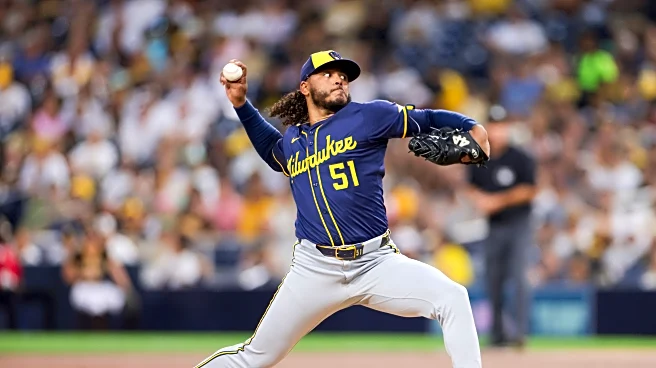
The Mets have overhauled their lineup and their bullpen this winter, but the rotation has been mostly untouched. That changed on Wednesday night when the Mets acquired Brewers’ starter Freddy Peralta in a four-player deal that also landed them pitcher Tobias Myers. With that, the club picked up that elusive ace who can slot at the front of their rotation, which immediately turned the team’s enigmatic rotation into a strength.
Peralta led the National League with 17 wins and finished fifth in Cy Young voting last year. Even better than his 2.70 ERA and his 204 strikeouts, he threw 176 2/3 innings and made 33 starts. For reference, David Peterson led the club with 168 2/3 innings, followed by Clay Holmes at 165 2/3, and then Senga at 113 1/3 innings. The 29-year-old made at least 30 starts in each of his previous three seasons and has recorded at least 165 innings in each of those seasons. For a team that is starved for a veteran pitcher who can give them valuable innings, Peralta gives the club exactly what they needed.
As for the rest of the rotation, it remains largely intact, although they have floated both Peterson and Senga in trade rumors this offseason. It is still conceivable that the club could deal one of them to fortify another position, but with their lineup and bullpen mostly set, it’s unlikely the team will be inclined to deal either player. That means that it’s very likely that the starters currently on the club’s 40-man roster will find themselves in the Opening Day rotation, with Peralta a leading contender to take the ball against the Pirates on March 26.
Nolan McLean, who burst onto the scene with a 2.06 ERA, a 2.97 FIP, and 57 strikeouts across in 48 innings across eight starts last year, will almost certainly be a guarantee to make the rotation, and you could make a strong case for him being the team’s number 2 starter. McLean, who fell two innings short of qualifying as a rookie, will garner a lot of Rookie of the Year buzz if he can match or exceed his performance last year, but he is no longer an unknown commodity around the league. Teams will certainly have a scouting report ready to go for the 24-year-old, and how he adjusts to that will determine how much success he has in his first true go-around in the majors.
Beyond the top two pitchers, there’s a lot of uncertainty but a lot of talent. Peterson had an All-Star season in the first half (3.06 ERA, 3.42 FIP, 20.5% K%, 8.1% BB% in 109 innings across 18 starts) but faltered after the break (6.34 ERA, 3.60 FIP, 21.2% K%, 10.1% BB% in 59 2/3 innings across 12 starts) as he blew past his career-high in innings. He is set to make $8.1 million in his final year before free agency, which is a relative bargain for a left-hander who has demonstrated his ability, but he remains a bit of an enigma. If he can recapture what he did in the first half, you could make a strong case for him slotting in at the three-spot.
Behind Peterson, Holmes was the team’s most reliable pitcher and steadiest hand in the rotation. The right-hander, who took the ball on Opening Day last year, signed as an experiment, an elite closer-turned-starter, and it paid immediate dividends for New York. After throwing right around 63 innings in each of his previous three seasons out of the pen, he threw over 165 frames, second-most on the team. He led the team with 12 wins and posted a 1.9 bWAR, the best of his career. He’s likely a guy whom the team won’t want to run too deep into games, and at points last year he was mostly limited to five innings, but he excelled at limiting the damage and keeping the Mets in games, which was a huge factor in his success.
The back-end of the rotation could be the deciding factor in whether the Mets have a great rotation or an average rotation. Sean Manaea and Senga have a wealth of talent but were derailed by injuries and poor performance last year. Both were expected to front the rotation in 2025 but instead became afterthoughts as the team flailed towards a late-season collapse. However, Manaea excelled in 2024 and Senga was an ace in 2023 and the first-half of 2025, so there is proof that they can be successful. A six-man rotation will keep their arms fresh and could help increase their impact.
All in all, a rotation of Peralta-McLean-Peterson-Holmes-Senga-Manaea is a strong group, and while it is high variance, the ceiling is extremely high for this set of starters. The team could look to sign or trade for another arm, but at this point it looks like the rotation may be set. Tobias Myers can also spot start in a pinch, and Jonah Tong can easily be stashed in Triple-A and ready to go at a moment’s notice, though his big league cup of tea last year proved that he needs a bit more seasoning in the minors.
David Stearns could have another big surprise up his sleeve, but for now he has done well to acquire a front-end starter that was sorely lacking. And along with his recent additions to the bullpen and lineup, he’s done well to overhaul this roster and put together a squad that should be competitive in a very tough National League field.