



The Cleveland Browns were building something heading into 1986.
Fresh off their first division title since 1980, the Browns were building an offense that, with the addition of wide receiver Webster and offensive coordinator Lindy Infante, was about to make a leap into one of the league’s best units.
The defense was an underappreciated unit that was coming into its own after allowing just 18.4 points per game in 1985. The unit was anchored by nose tackle Bob Golic, defensive ends Reggie Camp and Carl
Hairston, and linebackers Clay Matthews, Eddie Johnson, and Chip Banks.
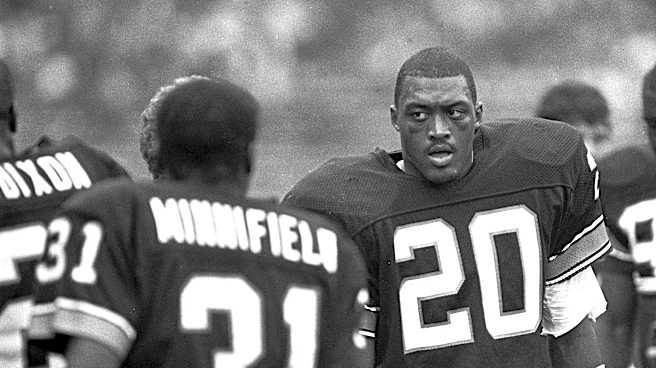
As talented as the front seven was, the secondary was in many ways the star of the defense, with cornerbacks Hanford Dixon and Frank Minnifield shutting down the game’s top receivers, and safety Don Rogers was there as the enforcer, ready to hit anyone who came into his area of the field.
Everything seemed to be in place for the Browns to win their ninth championship, but June 27, 1986, changed that in a way that will forever live in the “what if” category of the franchise’s history.
That was the day that the 23-year-old Rogers, who had been celebrating his upcoming wedding, was found dead of a cocaine overdose.
It was a major loss for the team as Rogers had finished second in the Defensive Rookie of the Year voting in 1985, and altered what the Browns could do on defense, as Minniefield shared in a 2016 article at clevelandbrowns.com:
“Don Rogers allowed us to do something that really would have changed probably the history of the Cleveland Browns as far as the Super Bowl is concerned. He allowed me and Hanford to play man-to-man. He could play the tight end 1-on-1 by himself. And that would have allowed us to add one extra person to the blitz package. But instead, when we lost Don Rogers, that meant we had to continue to double-team the slot and the tight end, basically never getting that opportunity to add that extra man to the blitz package.”
Later that summer, Sam McManis at The Los Angeles Times wrote a lengthy article highlighting how Rogers was struggling to deal with the stress of being financially responsible for his family.
Cody Risien, who played for the Browns for 10 years and worked out with Rogers in the offseason, recalled in the 2016 article how he could sense that Rogers was dealing with some issues:
“He seemed troubled to me. And I, I always think, you know, wow, I wish I’d had said more or wish I’d have dug more. You know, who knows, maybe I could have made a difference, but I always just feel sad that he seemed troubled and I wish I’d have picked up on it. He was such a talented young man and a talented player and well-liked.”
As someone who can remember hearing the news that Rogers had died, it is hard to believe it has been 40 years. But it is easy to wonder what might have been if Rogers had been on the field for a team that played in three AFC Championship Games from 1986 to 1989.
If you or someone you know is dealing with mental health struggles, emotional distress, alcohol or drug use, or just need someone to talk to, dial or text 988. Because you are not alone.