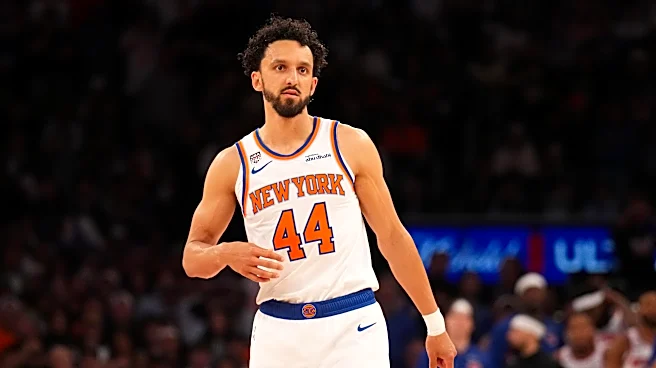






Make no mistake about it, what Landry Shamet did for the Knicks yesterday was a godsend.
Despite a multitude of contenders and playoff teams potentially interested in the sharpshooter, armed with full mid-level exceptions, Shamet rewarded the team that took a chance on him deep into September in back-to-back seasons, re-upping on a four-year, $24 million pact.
It was hard to fully pin down what Shamet’s value was heading into free agency, but an average annual value of $6 million is certainly on the low end. I believed fair market value for him would be around $8 million, but a bidding war amongst playoff teams could’ve pushed it near $10 million for guy coming off a playoff run for the ages.
Hell, did you see what Kevin Huerter and Julian Champagnie got? The St. John’s product inked a $15 million-a-year deal, while Huerter, who was unplayable for Detroit in the playoffs, signed for three years and $27 million.
Whatever went on behind the scenes to convince him to take this deal aside, this is tremendous news for the Knicks as they continue to work on the margins to build the best possible roster to defend their championship in 2026-27 without triggering the second apron, as per James Dolan’s edict.
But what are the actual financials that the Knicks have entering the official start of free agency at 6 pm tonight? That’s what we’re here for.
As of Tuesday morning, the Knicks are $11.7 million beneath the second apron with 10 players rostered, according to SalarySwish, but that is partially misleading.
For one, the full terms of Shamet and Jose Alvarado’s new contract structures are unknown. We can assume they’re naturally backloaded via Bird rights, but outside of that? They’re estimations.
The second caveat is that we know Mo Diawara has agreed to a multi-year deal worth over $10 million. We don’t know the full details of that, but several have theorized it’s an essential minimum deal across four years with a Year 1 salary of $2.87 million, just $423,000 over the vet min.
So let’s start by assuming all figures are accurate with Diawara’s $2.87 million starting salary. That shaves the space down to a narrow $8.83 million with three or four roster spots to fill. Three mandatory, four maximum.
That, on the surface, is scary. Four vet mins equals $9,828,000. That means the Knicks don’t have enough room even to fill out their roster. Hell, even three of them equal $7.37 million, leaving a small semblance of change remaining with an open roster spot to use in the buyout market.
But here’s the kicker. Remember how the Knicks made a bazillion trades on draft night to back out of the first round and save up to $2 million? This is where that comes into play.
The Knicks selected German guard Jack Kayil at No. 39 overall and Vanderbilt wing Tyler Nickel at No. 47. Neither of them would have much leverage in negotiating their contracts. The Knicks could always stash Kayil after Summer League, considering he was once supposed to enroll at Gonzaga for 2026-27, while Nickel is almost 23 years old after exhausting his collegiate eligibility.
That means that the Knicks can offer the bare minimum: the second-round exception.
The minimum value for the first year of the second-round exception, which can be given to as many players as needed, is $1.36 million.
There’s always a chance one of these guys starts on a two-way, but let’s imagine a world where both sign standard contracts at this sum. That means the Knicks will have 13 players rostered and $6,108,000 in apron space.
From there, they’d have two options:
- Use the 14th roster spot on the full Taxpayer Mid-Level Exception, which has a Year 1 salary of $6,065,000, and leave the 15th open for the buyout market (this would likely require not using every dollar, but hey)
- Sign two players to fill out the roster. One to the vet min, while the other can receive a contract as large as two years, $7,484,550. That’s a decent deal.
What if the Knicks only use one second-round exception? Well, replay those two scenarios, but chop off $1.09 million. You can either sign one vet min and another to about 60% of the TPMLE, or three vet mins. It’ll depend on Leon and co.’s preferences. Especially with Ariel Hukporti seemingly out the door, they might pick the latter just to be able to get two more bigs in the building.
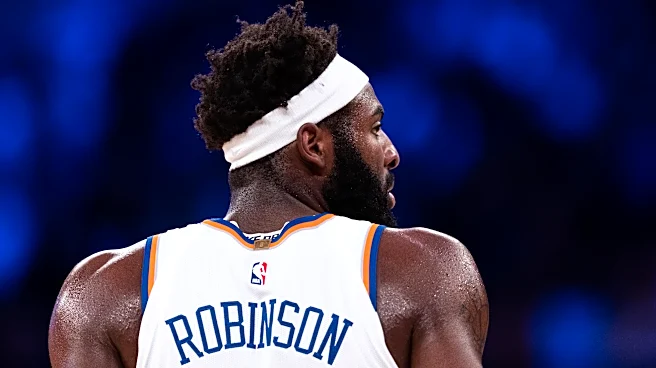
Lastly, I know people are wondering about Mitchell Robinson, and unfortunately, there’s no good news here.
There is no logistical way that Robinson will remain in the orange and blue without either a massive trade that completely tears up the cap sheet and generates a lot of apron space or an organizational shift in direction.
The former would entail one of the starters being traded, most likely Josh Hart, which is inconceivable off a championship. The latter would be Dolan being convinced by the powers that be to exceed the second apron.
A theory was surmised on WFAN on Monday that Dolan could agree to go into the second apron in 2026-27 to retain Robinson if pay cuts by Hart and Karl-Anthony Towns allowed him to dip under in 2027-28, but unless Craig Carton is acting as a mouthpiece for Dolan, this is just conjecture, folks.