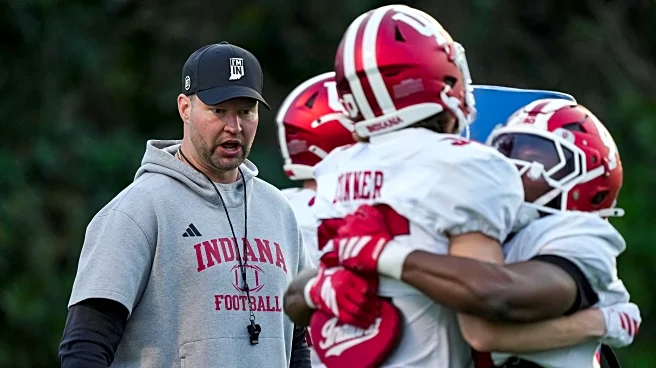

No. 1-seed Indiana football is set to take on No. 5-seed Oregon in the Peach Bowl, a College Football Playoff semifinal, on Friday at Mercedes-Benz Stadium in Atlanta, Georgia.
Bryant Haines, the Hoosiers’
defensive coordinator and a candidates for the Broyles Award in recognition of the top assistant coach in college football, spoke with reporters as part of a panel discussion on media day ahead of the game.
Here’s what he had to say, courtesy of ASAPSports:
Q. I’m working on a story on D’Angelo.
HAINES: D-Lo is my favorite. They are all my favorites, but I love D-Lo.
Q. Take me through a coach’s guys, what are the things that make him elite?
HAINES: Yeah, he’s got a very unique physical skill set. Track and field, I think he was a runner up in the 100 meter dash. This is an elite fast guy. If you were to beat him and gain a step on him, you won’t have it for very long, so elite skill set, very sudden, so physical traits are all there, the mental aspect. This guy is a film junkie. He is very intelligent, high football IQ, splits, formations, motions, tendencies, quarterback. He studies the game. So he’s got the mental side, too.
Last, but not least, and maybe most important, his competitive spirit.
I GA’d for a guy named Urban Meyer that talked a lot about competitive spirit especially at that position because defensive back can be a scary position. You are on your own quite a bit. Especially in our defense, I don’t give D-Lo any help. He don’t want any help. He would get mad if I try to give him help. Hey, I’m going to double team this guy for, D-Lo. He’s like, I don’t want that. You’re talking about the most elite competitive spirit. The guy wants one-on-ones. He wants your best receiver. He’s a special one.
Q. If you had to tell one story about him to try to get people to really understand him, whether it be game, practice, whatever, what would be the one story you would tell?
HAINES: It’s not a very specific story, but the thing I say about him is that he’s so competitive, he’s not going to let you catch a ball. Even if there’s an Indy drill that Coach Ojong is working where the receiver catches the ball and he’s coming out to punch it out, like he don’t even like doing that drill. He is like why I am letting him catch it and then punch it out, I’m going to beat him to the spot. So competitive, you can’t catch him in walk throughs. He’s going to break up the ball and walk through.
Maybe the hardest thing is pregame. Pregame, we’re supposed to let — it’s pack and go for the offense, and we’re working a shell. Every now and then, I am like he might come tomahawk it out of the receiver’s hands. He’s just so competitive.
I’ll give you one more. There’s a story from we were at JMU together. It was like his third college game. I wanted to start him field corner. Coach Cignetti kind of pushed back a little bit, but ultimately got to start at field corner. I had a two-trap pressure in, bringing overload and this team we were playing, they threw a lot of bubble screens. If they felt pressure, dumped the ball to the field flat. Well, in two trap, you have a quarter roll them out, pretty physical play. It can be high impact.
I remember I was sitting with a unit Friday night before the game on Saturday and I showed an example of them spitting the ball out. And I always — typically I give them a call, like we’re in this call against this look and I hit play. And I was like what do we think about that one? I go off with his head, huh, D-Lo? He’s like, yeah, off with his head.
Q. (Indiscernible) what does it mean knowing your guys have camaraderie and still a competitiveness that’s off the field?
HAINES: Yeah, just sounds like them. If you’ve ever been around Aiden Fisher and Bones and those guys, they compete in everything that they do. I like to recruit that way. If I’m looking for a high school player, I want him to be competitive. Whatever sport he’s playing, he is playing baseball, running track.
And Fish is that way with everything, ping-pong. These guys argue about playing Monopoly. We’re a competitive group in my room. I don’t want to speak to everybody else’s group because I don’t know them quite that well, but I like the fact that it permeates. A competitive defense is my type of defense.
Q. D’Angelo was talking about the Alabama game, how he was trying to lower his shoulder instead of trying to wrap up. He was talking about some external factors got him to think that way. Is that something you think the defense rallies around?
HAINES: I think it depends on the individual. I definitely think going back to the last question, that this is a competitive group. I definitely think that they see some things that could potentially rub them the wrong way. And whether it adds extra incentive for physicality or better performance, I lean into all that stuff, as long as it brings out a better version of themselves, go ahead, D-Lo, lower that boom a little bit.
Q. How do you think that worked against Alabama?
HAINES: I think he was hitting good.
Q. Obviously it’s more than just you against Will in terms of play calling, but the evolution of that chess match when you go up a coordinator that you’ve already faced?
BRYANT HAINES: Yeah, I’m just glad that he’s leaving the conference and going to Kentucky. He’s really good, and they asked me that over there, too. It’s just trying to avoid paralysis by analysis.
I want it to be Indiana’s defense against Oregon’s offense, not necessarily what happened in game 1 and how they might think I’m doing this. It takes too many weird avenues. Straightforward, do what we do, play good defense, and got a lot of respect for Coach Stein and the way that operation works. They’re really good at what they do, and we’re just hoping to be a little better.
Q. How do you keep that out of your head within the game, this is what they did against us last time, this is how we can counter that? You can say paralysis by analysis and do what we do, but is it tough to keep those thoughts outs of your head within the game?
HAINES: I don’t know yet. This is the first time coaching against the same team twice, although I do feel like we have both morphed away from what we were in game 1, but this is my first time doing it. So I don’t know for sure, but in the game plan process, it has been tricky. I am like I don’t want to do that again. I already brought that pressure and hit the quarterback. Now I’ve got to do it this way. But why? The first one worked.
So it’s a very delicate balance there.
Q. When you get to face an offense twice as good as Oregon has been as a defensive coordinator, how much does that excite you especially as a competitor that you get the second time to have your defense get challenged and potentially prove that you’re the better team?
HAINES: Yeah, I don’t need a lot of motivation, whether it be — this is our second time against this team or here’s a brand new team or this team has yellow jerseys on. It doesn’t take much.
If there’s an opponent and they have 11 players and I have respect for their players and how they operate, I’m going to be inspired and motivated to put a good plan together and hopefully the guys execute it well. I want them to play fast and have fun. If they do, all roads lead to success there.
Q. You had to change schemes a little bit the entire season with some guys going down. Obviously the story of the Rose Bowl tells the story of how that went, but inside the room, how did the guys feel going into that Alabama game?
HAINES: Yeah, I didn’t ask them man for man, but I know that they missed Stephen Daley. He’s a phenomenal player. They enjoyed playing with him. He fits right into what we do. He’s violent and physical and very talented. Same thing with Kellan Wyatt earlier in the year.
Those are two key pieces of the defense, so it was hard working around them. We’re always going to put 11 guys on the field that believe in each other. 11 guys that have a lot of faith that the man standing next to them can complete his job description and going to play fast and play hard for them, so they’re excited to play with their brothers.
Q. Can you speak to the strength of your secondary in man coverage and how it creates opportunities to get after the quarterback in a pass rush?
HAINES: D’Angelo Ponds I think is the best man corner in the country. The other guys are highly competitive. Again, it goes back to this whole idea that we’re a very competitive defense. Same thing with the guys on the back end, it’s a very competitive group.
Here’s what I’ll say: How much man do we play? Maybe every snap in this game will be man. Maybe none will. Maybe 50/50. I think keeping offenses guessing can make man coverage better. If the quarterback doesn’t know what coverage he’s getting, you can play better man and you can play better zones. Mixing it up, and I think that speaks to the greatest skill set of our defensive backs is they’re so versatile. They can play man. They can play zone. They’re good with both.