

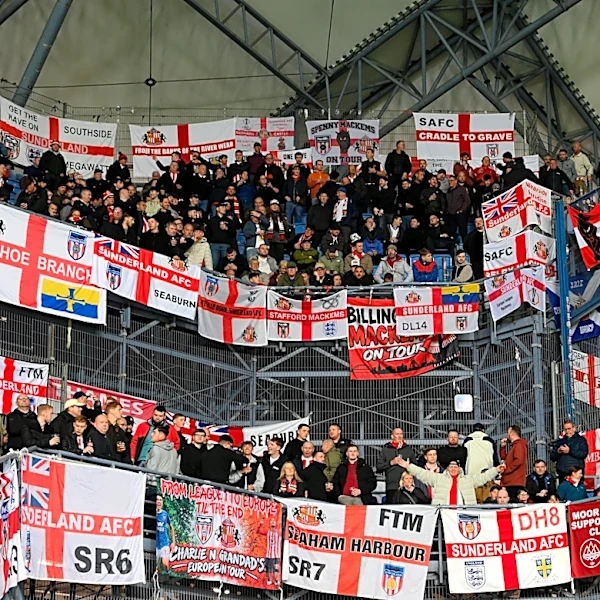



As excitement builds ahead of our historic clash with AC Milan at the San Siro, it’s worth remembering that not too long ago, Sunderland were travelling to places like Morecambe for EFL Trophy fixtures.
In front of a crowd of just 2,377, the majority of whom were Sunderland supporters, Josh Maja struck in stoppage time to secure Jack Ross’ side a place in the last 32 of the competition.
While the victory was a welcome one at the time, revisiting every chance, tackle and missed opportunity from a game
that now holds little historical significance seems rather pointless, particularly when you consider just how far the club has come since.
Instead, while looking back through the teamsheet from that evening, I found myself wondering what had become of the players who represented Sunderland that night.
Some have gone on to enjoy successful careers, while others have taken rather different paths since pulling on the red and white stripes.

So, with Sunderland preparing for a trip to one of European football’s most iconic stadiums, what better time to revisit a rather less glamorous away day and find out where those eleven players have ended up?
Starting XI: Robbin Ruiter; Jack Bainbridge, Alim Ozturk, Glenn Loovens, Bryan Oviedo; Max Power, Jake Hackett, Luke O’Nien, Jack Diamond, Jordan Hunter; Josh Maja.
Three members of that starting eleven have since retired from professional football, with Robbin Ruiter bringing the curtain down on something of a journeyman career at FC Nordsjælland in Denmark.
The Dutchman enjoyed spells at several clubs in his homeland following his 21 league appearances on Wearside before eventually moving to Denmark, where he failed to make a competitive appearance.
While Glenn Loovens never really made much of an impact during his time at Sunderland, Bryan Oviedo was arguably a player who should never have found himself playing League One football in the first place.
Having arrived at the club on a sizeable salary, the Costa Rican remained on Wearside following Sunderland’s relegation to the third tier, despite reportedly earning close to £20,000 a week.
In fairness to Oviedo, he was far from the worst performer during those difficult years and continued to make a contribution before moving on to spells in Denmark, the United States and eventually his native Costa Rica.
Whilst Alim Ozturk continues to play in the Turkish Second Division, Max Power was another player who certainly gave his all for the cause during his time on Wearside, although one suspects he will never quite live down that moment of madness when he attempted an ambitious effort from nearly 40 yards in the dying seconds against Lincoln City in the League One play-off semi-final.

In truth, Power was a reasonably dependable performer at League One level, but the fact that he has returned to Wigan Athletic for a third spell perhaps tells its own story about where his abilities are best suited.
To his credit, he did broaden his horizons with spells in Saudi Arabia and Denmark along the way.
Elsewhere, Jack Bainbridge and Jake Hackett have continued their careers further down the English football pyramid, while Jordan Hunter has taken a different route altogether, moving into sports science and securing a role within Liverpool’s academy.
Jack Diamond, meanwhile, was a player who showed considerable promise during his time at Sunderland, and it’s encouraging to see him continuing to carve out a decent career with Stockport County, who are enjoying an impressive campaign in League One.
The story of goalscorer Josh Maja’s career is one that could easily fall into the category of ‘what might have been’.
Maja controversially departed for Bordeaux having already scored 18 goals during Sunderland’s first season in League One, and his departure undoubtedly dealt a significant blow to a promotion campaign that had been progressing reasonably well.
It’s difficult not to wonder whether things might have turned out differently had he remained on Wearside.
Would Sunderland have needed so many attempts to escape the third tier had their leading goalscorer stayed until the end of the campaign?
Now playing for Le Havre in Ligue 1, Maja has certainly enjoyed a respectable career, although perhaps not quite the one many anticipated when he first burst onto the scene at Sunderland.
And finally, we come to a certain Mr Luke O’Nien.
In Roker Report’s player ratings from that evening, O’Nien received a rather unflattering 4/10, the joint-lowest rating awarded to any Sunderland player on the pitch.
The accompanying assessment was hardly glowing either:
“Hardly saw him unless he was kicking someone’s ankles.”
A rather blunt dismissal of his performance in the middle of the park!
In truth, such criticism was perhaps unsurprising given that O’Nien himself has since spoken openly about the difficulties he experienced during his early days at the club.
However, it makes the transformation that has followed all the more remarkable.
Eight years on, the same player who struggled to make an impression against Morecambe in the EFL Trophy was front and centre of another solid Sunderland performance against Chelsea last time out.
And with a trip to the San Siro to face AC Milan now on the horizon, O’Nien could soon find himself representing Sunderland at one of the most iconic stadiums in European football.
From receiving a 4/10 against Morecambe in front of fewer than 2,500 spectators to potentially lining out against AC Milan eight years later.
If ever there was a player whose journey encapsulates Sunderland’s remarkable transformation, it’s Luke O’Nien.