


There has arguably been no bigger weak spot for the New York Yankees over the past few years than the hot corner. Since the departure of Gio Urshela following the 2021 season, the Bombers have tried to fill the hole with veteran placeholders by first trading for Josh Donaldson and eventually giving the role to DJ LeMahieu, who steadily declined to the point where he was released from the roster entirely last July.
Finally cutting bait with LeMahieu made it clear that third base needed to be addressed
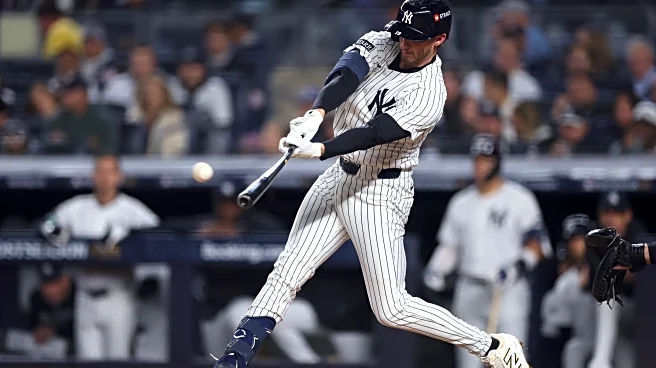
at the trade deadline, and the Yankees did just that by acquiring Ryan McMahon from the Colorado Rockies in exchange for pitching prospects Griffin Herring and Josh Grosz. McMahon is a defensive specialist and below-average hitter who strikes out a lot, and that’s exactly what he gave the Yankees in 54 games. He projects to start at third base for the team in 2026.
Another trade deadline acquisition, Amed Rosario, re-signed this offseason and will likely bounce between second base, third base, and the outfield during his platoon appearances. The Yankees’ starting lineup is overwhelmingly left-handed, so Rosario should slot in somewhere anytime they face a southpaw starting pitcher. When given the choice of starting McMahon or Jazz Chisholm Jr. against a lefty, they will likely opt for the latter, meaning Rosario could make most of his appearances in 2026 at third.
McMahon and Rosario’s acquisitions were part of a trade deadline makeover that reshaped the Yankees’ roster in 2025. That makeover cost them a significant chunk of minor-league talent, and third base was one of the positions that was hit hard. Here’s how the rest of the organization lines up at the hot corner:
The minor-league depth at the position is weaker than usual with many of the team’s top young options at third base being dealt away. Jesus Rodriguez emerged as a promising option in Triple-A and Parks Harber tore up Low-A and High-A last year, but they were both traded to the Giants (alongside Trystan Vrieling) in the Camilo Doval deal. Dylan Jasso served as the primary third baseman for Double-A Somerset for most of the year, but he was traded to Miami in the Ryan Weathers trade just a couple weeks ago.
These trades leave a lot of lineup questions at third base throughout the organization. Jorbit Vivas (who was discussed during our second base preview) played 33 games at third in Triple-A last season, but Jeimer Candelario is no longer with the team so Vivas could be the RailRiders’ primary third baseman. The recently-acquired veteran trio of Braden Shewmake, Paul DeJong, and Zack Short (who were discussed during our shortstop preview) could also produce a replacement for Candelario which would allow Vivas to remain at second base.
The departure of Jasso leaves third base wide open at Somerset. Tyler Hardman served as the primary first baseman last season and only played three games at third, but he’s played the hot corner in the past and could be an option for a position change if the team decides to promote Coby Morales to replace him at first. Josh Moylan led High-A Hudson Valley in appearances at third and has spent the past two years at the level, so he could also be in line for a promotion to Somerset. Moylan has been a slightly above-average offensive producer in each of 2024 and 2025, with walk rates between 13-15% and strikeout rates between 25-30%. Juan Matheus was another contributor at third in Low-A and High-A last year, but he was also part of the package that went to Miami in exchange for Weathers.
Other options for starts at third base this year at these levels could include Owen Cobb, Enmanuel Tejeda, Kaeden Kent, and Roderick Arias, all of whom were included in our season previews for shortstop and second base. With so few primary third basemen in the organization, players like these may find an opportunity for more playing time if they’re able to slot into an open role and adjust nicely at the hot corner.
In fact, FanGraphs’ Roster Resource tool only has three minor leaguers in the system listed as primary third baseman, none of them higher in the organization than Low-A. The first of these players is Bryce Martin-Grudzielanek, the team’s 20th-round pick from last year’s MLB Draft out of USC. Martin-Grudzielanek didn’t hit very well in his last two seasons in college, and was underwhelming in his first 24 games with Low-A Tampa.
It’s a bit ironic that the most promising third base prospect still in the Yankees’ system may very well be the lowest one on the totem pole. Richard Matic spent his age-17 season repeating the Dominican Summer League in 2025, but the results were night and day compared to his first year. After hitting .196 with a 71 wRC+ at age 16 against DSL pitching, Matic excelled in 46 games last season with a .336/.487/.566 slash line, five home runs, a 20.9/22.5 BB/K% ratio and a 167 wRC+. He’s a right-handed power bat with a 6-foot, 200-pound frame who could emerge as one of the most promising sluggers in the system if he can adapt to the Complex league and stateside competition. The list of DSL bats who fall off a cliff against stiffer competition is long every year, but this is what the ones who do make it look like. The last third baseman listed by Roster Resource is Leni Done, who signed as an international free agent last season and also hit five home runs in the DSL.
Third base is the most chaotic infield position in the organization entering 2026 due to all the roster turnover, though there are a few players who could take advantage of new opportunities due to this uncertainty. It’s unlikely that any of these players contribute at the big-league level anytime soon, but it’s worth following along to see who gets the first crack at filling in for some of these players who were traded away.