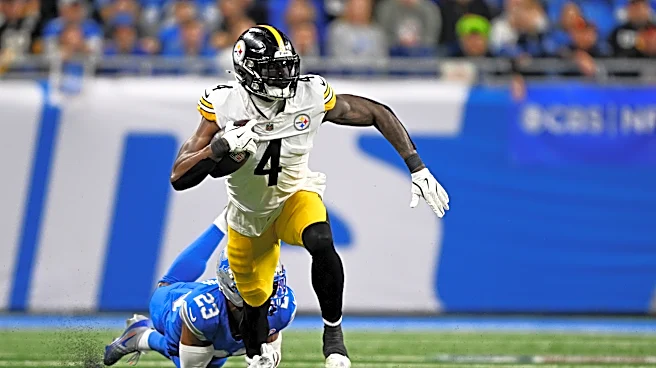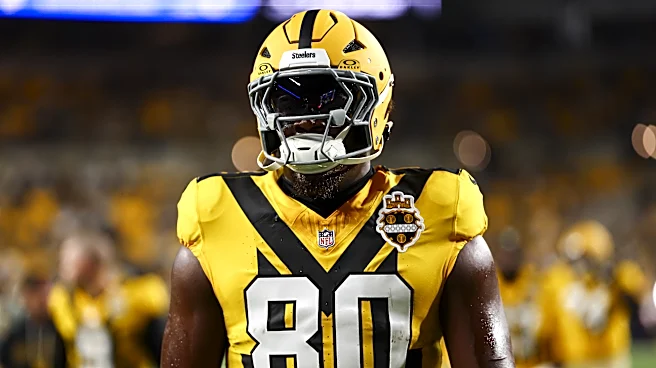







It’s been a little more than a week now since the 2026 NFL Draft. We spent much of last week analyzing and discussing the Steelers’ draft class, and as we enter the quietest period of the NFL calendar, there will be plenty more opportunities to do so. However, just because the news cycle will slow down for the next several months, it doesn’t mean NFL front offices still aren’t busy at work.
The Steelers typically wait until after the draft to address any contract extensions or restructures. Two promising
young defenders, cornerback Joey Porter Jr. and pass-rushing specialist Nick Herbig, are undoubtedly at the top of the minds of the organization and fans when considering which young Steelers deserve a second contract. But there’s another Steeler from the 2023 draft class who should be envisioning dollar signs after seeing the message the rest of the NFL sent with the 2026 draft: Darnell Washington.
Tight ends are en vogue

There are two constant truths about the NFL that I think are useful to remember. One is that while football is ever evolving, it is also cyclical. The other is that the NFL is a copycat league. The two often go hand in hand.
The NFL saw a passing boom in the 2010s, as teams began throwing the ball at higher rates and began innovating ways for their passing attacks to target and manipulate defenders who weren’t physically equipped to hang in pass coverage. Proof of this is easy enough to notice by looking at the players who take the field now. The 250-pound, run-stuffing linebackers that once were the backbone of NFL defense are all but extinct. They’ve instead been replaced by lighter, faster linebackers, and in some instances, an extra defensive back in lieu of a linebacker altogether. Likewise, on offense, the league meta during the 2010s shifted towards the notion that running backs don’t matter. Running games were still important, but the individuals playing the position became viewed — right or wrong — as more replaceable, and thus the position became largely devalued in the NFL Draft and in contract values. The NFL had become a passing league.
But in recent years, that began to shift. In 2020, the league averaged 240.2 passing yards per game, just slightly below the all-time peak set in 2015 (243.8). But that figure has been dropping since. The decline from the 2020 season to the 2021 season (228.3) was not the first time the average has taken a significant plunge — the drop off from 2016 (241.5) to 2015 (224.4) was larger, for example — but whereas the passing numbers bounced back following previous lulls, the average has continued to trend down in the years since 2021. In 2025, the NFL averaged its fewest passing yards per game (209.7) since 2006 (204.8).
Some of this trend is due to winning adjustments made by defenses, like the usage of more defensive backs, as well as an increase in split-safety looks and pre-snap coverage disguises. But offenses have started to find their counterpunch. With defenses emphasizing stopping the pass, naturally, offenses are running the ball more. It doesn’t take a genius to look at the smaller linebackers and the use of more defensive backs and come up with the solution that using bigger, more powerful players on offense could swing things back in offenses’ favor. That idea evolved even further in 2025, as more and more teams began to embrace using multi-tight end sets, or using a sixth offensive lineman lined up as a tight end, in the running game. The Steelers were among those teams, using multi-tight end sets at the eighth-highest rate in the league, and using 13 personnel specifically at the second-highest rate, per Sumer Sports.
But while the Steelers were effective running the ball out of 12 (5th in EPA per rush) and 13 (5th), they were not as dangerous passing, finishing 27th and 16th in EPA per pass, respectively. Teams like the Super Bowl-winning Seahawks (1st in 12 personnel EPA/Pass) and the NFC runner-up Rams (5th in 13 personnel EPA/Pass) were hailed as teams on the cutting edge of these deployments, finding ways to be top-10 rushing teams from these looks, while also creating explosives in the passing game. The Seahawks especially thrived in 12-personnel, using a stable of tight ends that featured players like 2024 fourth-round pick AJ Barner, 2025 second-round pick Elijah Arroyo, and ninth-year journeyman Eric Saubert. Meanwhile, their division rival Rams excelled in 13 personnel with a group that included former Seahawk Colby Parkinson, 2025 second-round pick Terrance Ferguson, 10th-year Ram Tyler Higbee, and 2023 fifth-round pick Davis Allen, all playing more than 400 snaps.
So what’s this have to do with the draft again?

As we mentioned at the beginning of this article, the NFL is nothing if not a copycat league. There’s usually some scramble to emulate one of the defining traits of each year’s Super Bowl winner, and all you have to do is look at the hiring cycles of the past decade to see how sought-after any shred of the McVay braintrust is.
Pair that with a 2026 draft class that was frequently described as “weird” and lacking blue-chip talent, and there was a perfect storm brewing for a tight end revolution. Depending on how you counted two players that were announced as fullbacks — Steelers selection Riley Nowakowski and Vikings selection Max Bredeson — the 2026 class saw a historic amount of tight ends selected.
But it wasn’t just that so many tight ends were picked in the draft. It’s when and what types of players were selected. While Oregon’s Kenyon Sadiq — a player who is arguably better as a blocker than as a pass catcher right now — was the only first-round selection, eight tight ends were taken on Day 2 of the draft. That ties 2023, Darnell Washington’s draft class, for the most Day 2 tight ends selected over the past decade. Vanderbilt’s Eli Stowers, a pass catcher who is a tight end in name only, was the second off the board, but that’s when things got interesting. The third tight end off the board wasn’t the highly ranked Max Klare — the Buckeye ended up as the fifth tight end selected, landing with the Rams and their insane glut of tight end talent — but rather Texas A&M’s Nate Boerkircher. Boerkircher and TE4 Marlin Klein from Michigan each had only 38 receptions apiece for their college careers, and were projected to go much later in the draft. I had both featured as selections in my Gems Series due to their abilities as blockers. The third round featured two more of my selections in Stanford’s Sam Roush and Ohio State’s Will Kacmarek, as well as Georgia’s Oscar Delp and Notre Dame’s Eli Raridon.
It’s safe to say, tight ends are having a moment.
Which brings us back to Darnell Washington. Steelers fans are aware of just how valuable Washington was to the team last year. While there aren’t many stats out there that can fully capture how good a player is at blocking, and PFF grades are certainly flawed in their own right, the fact that they had Washington graded as the seventh-best run blocking tight end in football feels like it reflects reality. Washington also had the 14th-most snaps in pass protection among tight ends and was used to help hide some of the warts coming from the Steelers’ left tackle play. Add in that he had a career high in targets (43), receptions (31), and yards (364), and Washington has all the markings of an ascending player in a league that is growing in appreciation of tight ends that can block and make explosives in the passing game.
In my 2026 mock off-season article for Read & React, I theorized that a possible Washington extension this summer could be comparable to ones signed by the aforementioned Parkinson (3-$24.5 million) or the Bills’ Dawson Knox (4-$52 million), both players more known for their blocking prowess than for their pass catching. While it’s true Knox and the Bills have since renegotiated that contract to help with cap space, the fact that they were willing to offer that much to begin with is an indicator that the desire is out there for teams to find players with Washington’s skill set. The Bears’ Cole Kmet signed a similar deal (4-$50 million), tying him for the fourth-highest total value among tight ends. Former Raver Isaiah Likely averaged 33.7 receptions, 392 receiving yards, and three touchdowns per year during his four seasons in Baltimore, all numbers comparable to what Washington produced in 2025. This offseason, Likely signed a contract that gives him the seventh-highest total value($40 million) and fifth-highest average salary ($13.3 million) in the NFL.
So what does this mean? It means the Steelers need to lock Washington up for the long haul this offseason. Because if they aren’t willing to pay him the big bucks, somebody else will.
Let us know what you think in the comments. Be sure to bookmark Behind the Steel Curtain for all the latest news, breakdowns, and more!