
I write the introduction last. We’re already at 2000 words. Let’s get to it.
Danny Wolf
We’re starting with Wolf because Head Coach Jordi Fernández gave his most insightful answer of the season in response to a question
about Wolf. Specifically, James Herbert of CBS Sports asked Fernández how he keeps directives clear when coaching a player who can do so many things — initiating the offense, posting up, attacking mismatches, playing off the catch.
“It’s a good question, because what we cannot do is like, get caught into the whole universe, right? Because otherwise, it’s not specific enough. And we have to give him clarity, especially when you go through the NBA season and the games keep coming, you can get lost in it. And I think right now for him, it’s — not to get into details — but we usually have three goals for each guy and how we’re gonna get there and how we see them. Like, their KPIs on their games, so whatever numbers come reinforce what the player development plan is.”
But Fernández did touch on the details, outlining three immediate areas of improvement for Wolf: Finishing at the rim, a readiness to catch-and-shoot, and “playmaking efficiency” (“Right now, the tendencies are, you know, dribble right away, dribble multiple times. And he sees the floor very well, he’s a good passer, but he hasn’t been an efficient playmaker, so we’re working on that.”)
Keen observers will realize those three traits constitute, like, nearly the whole offensive end. Now that Wolf is no longer making every three (4-of-his-last-25), his offense has been rough. Let’s just focus on the first area Fernández mentioned; right now, the 6’11” 21-year-old is shooting 59% at the rim and 42% from two as a whole, two poor marks.
He’s been in the rotation for a little over a month, so this is by no means a definitive sample. But much of Wolf’s scoring projection hinges on this area of the court. In one season at Michigan, Wolf shot 57% from two (63% at the rim), but less than 30% of his makes were assisted. Of course he’ll need to make threes, but to believe in Wolf as a big-time NBA player, you believe be taking all sorts of defenders to the paint and scoring.
Scoring three straight buckets over Alex Sarr…
…is the most encouraging sequence of his rookie season, particularly because it came after a rough stretch for the #27 overall pick.
“I think the part that doesn’t concern me is I’m getting to all my spots,” said Wolf at practice. “And if I weren’t, that’d be concerning, but I’m getting to all my spots, and I feel like I’m playing with great pace and at ease. I mean, I look at all these finishes, and I’m extremely capable of making them all and I know they’re gonna eventually start falling … it’s just on me to finish, and that means trying to dunk more and just trying to be more explosive toward the basket, as opposed to fading away from contact.”
Of course, that’s easier said that done. The day after his comments, Jabari Smith Jr. blocked a dunk attempt…
Wolf does have a varied skillset, but that doesn’t matter much if he’s a jack of all trades, master of none player. While he has barely a month of real NBA ball under his belt, it is his age-21 season. Fernández and the Nets believe in him, and he’ll get ample opportunity; hopefully we see a consistent scoring area emerge this season.
The first order of business, though: Wolf needs to stop passing up open catch-and-shoot threes just because he’s in a bit of a slump. (He can look at Noah Clowney to see how much defenders respect pure volume.)
Drake Powell
The Brooklyn Nets are the youngest team (by average age) in the NBA this season. They are also one of the slowest. Cleaning the Glass estimates that just 14.4% of their offensive possessions start with a transition play, the fifth-lowest mark in the league. The Nets couldn’t get a rebound for the first six weeks of the season, and frankly, their transition possessions were often disastrous, speaking to the relative lack of talent Jordi Fernández is operating with.
Even with an improved defense, the head coach was reluctant to loosen the reins: “With the better rebounding, we saw an increase of opportunities, the problem was the amount of turnovers that happened in transition. So, those are the things that we have to work on. We have to work on decision-making, you know, two-on-ones, three-on-twos, whatever the case may be when you have numbers going into the break. And we haven’t been good at all.”
However, the Nets are running at a league-average rate since December 1st. The rookies all benefit from those opportunities, but nobody more than Drake Powell, as we see on this second play here…
Not much has changed since I wrote this a month ago: “Powell has a pretty odd offensive profile overall. For someone who doesn’t handle the ball a ton, he turns it over a bunch, but he’s shooting well from every spot on the floor.”
This isn’t surprising for a player who had one of the lowest usage rates of all-time for a first-round draft pick; it’s tough to be upset at those long stretches where Powell disappears into the corner. Currently, he’s only comfortable attacking 1-on-1 matchups, so when help defenders appear in gaps, Powell is eager to give it up.
I can’t blame him: He’s only averaging one turnover a game, but those account for 15% of his possessions, about the same number as Wolf, per Cleaning the Glass. Fernández has talked about upping Powell’s aggression, but outside of playing more in transition, I’m not sure how they do that.
Here’s Powell on his short-term focus: “I think just continue to make a quick decisions, doing that on a consistent basis. I think that that can help my overall growth.”
So, yeah, it’s a work in progress.
Nolan Traore
Jordi Fernández has been in a pretty good mood over the past five weeks or so, coinciding with the Nets’ best stretch of basketball since he’s been in Brooklyn. But while walking off the floor after a loss to the Houston Rockets, Fernández was seen talking to Nolan Traore, and it was a bit jarring to hear him speak so candidly about their conversation in postgame.
“I need him to use his superpowers and touch the paint,” he said. “It felt like he got caught shooting the unders, and a lot of times, they’re going to go under because that’s what they want you to do. And if you keep shooting it and missing, then, you know — sometimes if you keep doing the same thing and seeing the same results, I think that’s the definition of insanity … I’m okay with a pull-up three. I don’t love it, because he hasn’t shown that he can make it consistently. He can shoot as many catch-and-shoot threes as he wants, but I just didn’t think he played the game the way I wanted to play the game.”
Jordi’s reaction to the second one is just great…
Fernández is right, to be clear. Traore’s catch-and-shoot numbers with Saint-Quentin were actually pretty decent, but the French guard could not make a pull-up to save his life. That’s mostly been the case with both Brooklyn and Long Island for Traore; he’s made a couple more pull-ups in the G League, but it’s really the spot-up opportunities that have been fruitful.
But Fernández wasn’t going Patrick Ewing mode for the sake of it. If Traore’s superpower really is speed, then a defender going underneath a ball-screen shouldn’t prevent him from getting into the paint…
Still, Traore has had a strong month or so — stronger than many thought he’d be able to have during his rookie season. I like Jordi keeping the pressure on, and apparently, Traore responds to it; he put up 12/1/5 on 4-of-7 shooting (all twos) against the Washington Wizards the day after the loss to the Rockets…
“He believes in me, but he wants more,” said Traore of his head coach. “That’s normal. You always want more. And I’m very demanding with myself too.”
Traore is shooting 33.3% from the floor with Brooklyn and hasn’t shown many of the ball-handling flashes or counters you’d like to see from a first-round guard. But the 19-year-old has had a couple of decent NBA minutes here and there, particularly defensively. That’s not enough for a victory lap, but you gotta appreciate the small wins too.
Egor Dëmin
It’s too early to definitively judge any rookie’s long-term outlook in January, but that’s definitely true of Egor Dëmin. To reiterate: Dëmin had a 26% usage rate as BYU’s lead ball-handler last season, and while he ran a ton of pick-and-roll, he had even more initiation responsibility with Real Madrid.
With the Nets, he’s sporting a 19.7% usage rate, virtually tied with Andrew Wiggins and P.J. Washington, for example. Despite the fact that he occasionally brings the ball up the court, a viewer with no knowledge of his pre-NBA career would easily identify Dëmin as an off-ball wing, a spot-up guy that will make open threes. (Completely anecdotal, but it feels like a wide-open Dëmin three is guaranteed to go in. He’s up to 37% on the year, though Brooklyn’s schedule is about to get a lot more tiring.)
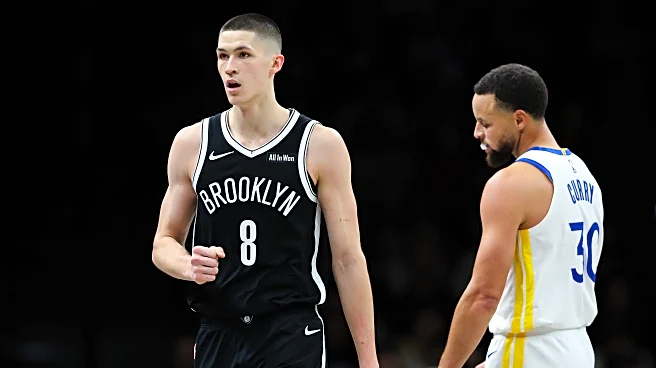
Were the Nets planning this route for Dëmin when they drafted him, or did they just bet on work ethic/attitude/feel and a shooting stroke that looked better than the numbers indicated? Is his rookie-season usage a reflection of the long-term plan? We won’t know the answers to these questions for a while, but when he shoots 7-of-14 from three, like he did against the Golden State Warriors, it hardly matters.
The next time he took the floor, he shot 3-of-12 (taking 7+ two-point attempts for the second time in his career), against the Washington Wizards, kind of encapsulating what we’ve seen from Dëmin so far. Sometimes, it feels like he can’t get into the paint on his drives due to handle/bend deficiencies, but other times, he just seems averse, a more fixable long-term problem…
A shot attempt like that isn’t really what Jordi Fernández means when he implores Egor to be more aggressive, but this is the trial-and-error stage, especially with how little he ventures inside the arc.
There are currently 176 NBA players with a usage rate of at least 19%, minimum 50 total minutes. Out of all those players, Dëmin has the 4th-highest 3-point attempt rate and the 5th-lowest free-throw rate — his neighbors in both categories are Buddy Hield and Klay Thompson. He will make tremendous physical strides from age 19 to age 21 (again, look at Clowney), but in their long-term vision, the Nets should not hesitate to add a high-usage ball-handler next to Dëmin.
It is possible that once Dëmin develops physically, he’ll return to more of his pre-NBA output. But most draft scouts were so hard on the Russian teenager because they saw a ball-handler who had far too many athletic flaws to play that role at the next level. What the Nets may have seen was a high-feel wing hiding in plain sight.
Right now, Dëmin is not a ball-handler. He has just 29 rim assists in 30 games, turns it over on 16% of his possessions, and the impossibly free-throw rate as mentioned. Scouts: 1.
However! Dëmin is shooting 37% from deep, his 6’8” frame has provided decent steal and block numbers, and somehow, Brooklyn’s current starting lineup has a net rating around +4. They are the NBA’s second-most played lineup.
Nets: 1.
Ben Saraf
Fair warning: I haven’t seen much of Long Island lately, so this’ll be short. But Ben Saraf had a monster, 40-point performance as part of the G League Winter Showcase on December 22…
Since then, though, Saraf is shooting 8-of-28 over three games, though he did have a career-high five steals on December 28 against the College Park Skyhawks. Of the five rookies, he has shown the least in his NBA minutes; he is often limited by a lack of comfort driving right, though he has made more high-level passes in the lane — hitting a late cutter or a tough skip pass — than Dëmin or Traore have so far.
However, it appears that Saraf may get another chance in the NBA soon: The Brooklyn Nets have called him up ahead of Wednesday night’s game against the Orlando Magic. Tip-off is scheduled for 7:30 p.m. ET.