



Everyone in life is under some sort of pressure.
Whether it’s a massive responsibility in your job, your family, or your education, there’s always something riding on your decisions. That’s a fact of life.
Pressure can be a good thing, it can get the most out of you. As the old saying goes, pressure creates diamond.
But it can also create rubble. Too much pressure and you and everything around you will crumble. It takes a certain type of person to overcome such pressure.
Now imagine the weight of tens
of millions of people on your shoulders. A type of pressure only similarly faced by presidents of entire nations. There’s a reason those guys seem to age decades in four to eight years.
When Mikal Bridges was traded to the Knicks for one of the largest draft pick packages in the history of the sport, he became the most intensely-watched non-All-Star in the history of professional sports. For the rest of his career, he’d be tasked with making himself worth all those picks that were given to Brooklyn.
If the Knicks never accomplished their ultimate goals, their failure would forever be linked, fair or not, to giving a king’s ransom for a complimentary starter.
Would he be remembered in Knicks history the same way Eddy Curry, Jerome James, and Andrea Bargnani were if they never got over the hump? I guess we’ll never know.

Bridges was born on August 30, 1996, in Philadelphia. He grew up in the city, but moved out to the suburbs in Chester County in middle school, eventually attending Great Valley High School in Malvern. A sophomore year growth spurt saw his basketball future come into clearer focus, eventually becoming one of the best players in Southeast Pennsylvania.
As a four-star recruit and a top-100 player in the nation, he chose Villanova over Penn State and Florida. There were three other players in Pennsylvania ranked over him in the Class of 2014; none of them reached the NBA.
At Nova, he did what many players did under Jay Wright; he paid his dues. He redshirted in 2014-15 and emerged as a key bench piece for the eventual national champions the following year, pouring in 11 points to their utter decimation of Oklahoma in the Final Four before logging 15 minutes in the thrilling final against UNC.
As a sophomore, he overhauled his jumpshot and raised his three-point percentage from 30% to 39.5%, joining the starting lineup for good by mid-November due to an injury to Phil Booth. It ultimately led to him winning Big East Defensive Player of the Year. Side-by-side with the likes of Jalen Brunson, Josh Hart, Donte DiVincenzo, and more, the Wildcats were once again contenders to win the whole thing, but were shocked by Wisconsin in the Round of 32. Bridges failed to make a single shot in that game.
Entering his redshirt junior season, he made even more strides as a scorer, serving as a perfect Robin to Brunson’s Batman, averaging 17 points on 43% from behind the arc and being named a Consensus All-American. His best games would come in the biggest moments, dropping 28 on Gonzaga in a neutral-site tournament, 25 in the Big East Championship Game, and 19 in the national championship game, going out as a two-time national champion.
Declaring for the 2018 NBA Draft, Bridges was the top NBA prospect on the team. DiVincenzo snuck into the lottery, and Brunson was reduced to a second-round pick, but Bridges was picked No. 10 overall by his hometown Sixers. His mom still worked for the team. It was the dream of all dream scenarios.
And then he was traded.
After all the emotions poured out with the possibility of staying home, Brett Brown traded him 25 minutes later for Zhaire Smith and a first-round pick. The pick would go on to be part of the Tobias Harris package a year later.
Putting aside how cruel that is from a front office to pull on a city and family’s heartstrings like that after making the pick, it shows the hubris and self-inflicted nature of the Sixers’ failure to build a winner around Joel Embiid. They’ve had so many talented players in their organization and decided to punt all of them for pennies on the dollar.
Jared McCain for scraps because your owner is cheap. Julian Champagnie, so you could have Mac McClung wear a Sixers jersey at the dunk contest. Bridges for a dude who’d be out of the league in three years and an overpaid wing that the city would despise. Oh yeah, they also let Jimmy Butler walk to give that same guy $150 million.
This is a franchise that deserved what they got.
But that’s a story for later. Bridges was now in Phoenix, where he’d soon be groomed as a quality 3-and-D starter around a core of Devin Booker and, soon, Chris Paul. He started out pretty innocently as a low-usage starter/sixth-man who would be the team’s defensive backbone.
The Suns weren’t playing many meaningful games, but it was clear Mikal was a winning player. He was a deflection machine on defense, and his jumper translated in his second season. In the bubble, he was a big part of the Suns’ 8-0 run that put them on the cusp of the postseason.
Bridges took on more responsibility in 2020-21 as a valuable third option behind Paul and Booker, benefitting beautifully from the Point God’s playmaking while being one of the best shooters in basketball. As the Suns evolved into one of the best teams in basketball, he was their heart and soul on both ends.
The Suns ripped through the postseason, with Bridges being tasked with guarding the likes of LeBron James and Paul George on their road to the NBA Finals. With Giannis Antetokounmpo and a determined Bucks team on the other side, Phoenix built a 2-0 lead, with Bridges himself scoring 27 points in one of the best games of his entire career. They could taste it.
But their hubris got the best of them. They got too confident, and the Bucks won the next four games to snatch the championship away from them. Utter heartbreak, but you had confidence they’d be back.
They wouldn’t.
Bridges stagnated offensively in 2021-22, but got to another level defensively. After never making an All-Defensive Team in his career, he took advantage of a weak field to grab second in Defensive Player of the Year voting behind Marcus Smart, but come playoff time, the Suns fell well short of expectations as a 64-win team.
Pressure got to the Suns’ front office midway through the following season. Their core was good, but they felt the desperation. The pressure was on them to get over the hump, so they decided to swing a trade for Kevin Durant at the deadline, shipping Bridges out in a massive package to a suddenly rebuilding Brooklyn.
But instead of falling into a malaise like many who go to a bad situation, Bridges played the best basketball of his career there, averaging 21.2 points, 4.5 rebounds, and 3.4 assists in 109 games across 1.5 seasons for a miserable Nets team, playing every single game to continue his Ironman streak.
Rumors circulated his entire time there of him reuniting with his Nova Brothers in New York. Hart, Brunson, and DiVincenzo had formed a compelling trio on the other side of the city and Bridges separately played with Hart and Brunson separately at the 2023 FIBA World Cup, where he made a tremendous highlight play.
The long-anticipated trade talks soon commenced after the 2023-24 season and culminated while I was on vacation in Italy. I woke up to one of the most stunning trades of my life.
Leon Rose had gone all-in. Bridges was expected to be a supercharged version of what he was in Phoenix. His defense slipped in Brooklyn at the expense of high offensive usage, but the Knicks hoped to find a balance to make him a dangerous two-way option.
With Karl-Anthony Towns suddenly joining the equation in late September, his importance was even larger to cover up for multiple defensive liabilities.
The pressure on him to live up to everything was immediate, which might’ve been why he looked to rework his jumpshot to become the dead-eye shooter he was during the 2021 NBA Finals run. It didn’t work… at all.
He was miserable from three in the preseason and to start the 2024-25 season. Through 17 games, he was shooting a flat 30% on 6.5 attempts a game. You could already hear the whispers behind the scenes as the Knicks struggled with the Celtics and Cavaliers to open the season.
Bridges was able to silence the doubters in late December, with a multi-game stretch of sharp shooting that peaked with a 40-point masterpiece on Christmas against Victor Wembanyama and the Spurs.
But he had a slow January after that and never quite got into a groove offensively. Outside of some massive individual moments to steal two crucial wins late in the season, you never got the game-breaking ability he was once capable of.
His mid-range was as automatic as it gets, and he was one of the best finishers in basketball, but he was constantly underwhelming. Any time you looked around on social media or watched sports programming, it was:
“We traded five first-round picks for this?”
Through the first five games of the Detroit series, the murmurs grew louder. He missed a potential game-tying shot in Game 2, and his inconsistent offense wasn’t helping. But as he has consistently done, he responded with a massive Game 6 to help them move on.
Then, against the Celtics, he had two of the most legendary defensive plays in franchise history to stonewall the defending champions and grab control of the series by the neck. In the same arena, he had a tumultuous team debut, and he had a huge fourth quarter in Game 2 after a terrible start to the game.
It can be argued that Bridges was the MVP of that series, and it temporarily changed the narrative surrounding him. After all, we got him because he’s a 16-game player, not an 82-game player. He didn’t play badly against Indiana in the Eastern Conference Finals, but struggled to contain Tyrese Haliburton after putting Jaylen Brown in a box against Boston.
As the Knicks decided to run back the same core in 2025-26, sans Tom Thibodeau, the pressure only grew stronger. Add some Giannis rumors into the mix, the pressure on Bridges became unfathomable.
“We seriously traded those picks for him when we could’ve waited for Giannis?”
“We’re going to waste the entire Brunson era because we traded all our assets for a role player.”
His play in the regular season was just as uneven as it was the previous year. This time, he came out with a rejuvenated jumpshot and was the league’s best corner 3 shooter for several months. He’d have flashes of brilliance, including a 35-point game in a six-point loss to Boston and a hyper-efficient 30-ball in Toronto in January.
But the lows were excruciating. After a strong start to March, he averaged just 10.6 points per game on mediocre shooting in the final 20 games of the regular season. The shouts got louder.
“How much of a sell low would it be if we traded him?”
“Could we send him and KAT to Milwaukee for Giannis?”
It didn’t get any better to start the playoffs. Bridges scored 36 points total across the first five games. He once again missed a game-winner in Game 2. When the Knicks fell behind 1-2, the pressure reached an all-time high. He was reportedly in tears after Game 3. It reached a breaking point.
Pressure was creating rubble.
Until Game 6. A nifty 24 points on 12 shots contributed to the historic beatdown in Atlanta and springboarded his dominant run through the rest of the Eastern Conference playoffs.
From Game 6 against Atlanta to Game 3 against Cleveland, he averaged 19.1 points on 69.1/47.6/100 shooting. He was shooting an unfathomable 75% from inside the arc. No matter what, he made big play after big play on both ends of the floor.
Even when he struggled in the closeout game against Cleveland, he made a big shot late in the first half to snatch whatever was left of their souls.
In the NBA Finals, he was fairly quiet for much of the series, but showed up in a big way in Game 2 with an efficient 20-6-6 as Brunson struggled, similar to the 2018 NCAA Final.
As the series went on, his defense on Stephon Castle got better and better. In Game 5, he was quite literally the only person other than Brunson who could make a shot. When the captain sat, his longtime friend kept the game from getting out of hand.
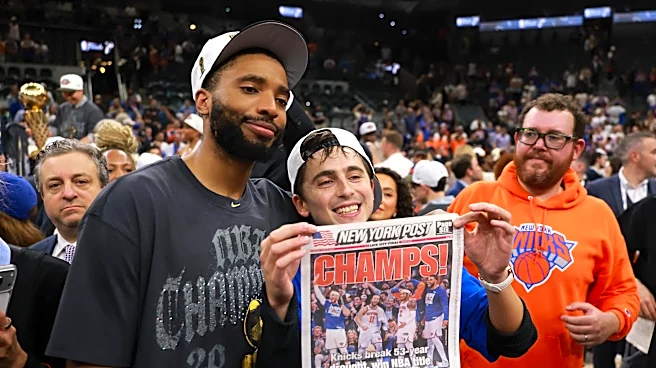
By the time the buzzer sounded, all the emotions flooded out. You want to know what it looks like when a lifetime of pressure condensed into two years finally gets released from your shoulders? When the disappointment of the past culminates in the ultimate glory? It looks like this:
In the end, all that pressure created a diamond. It created an NBA champion, freed from the shackles of a trade that would’ve defined him and his career until the day he died if they didn’t ever get it done.
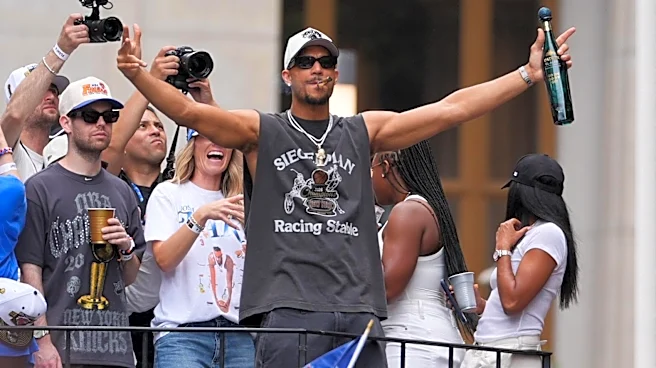
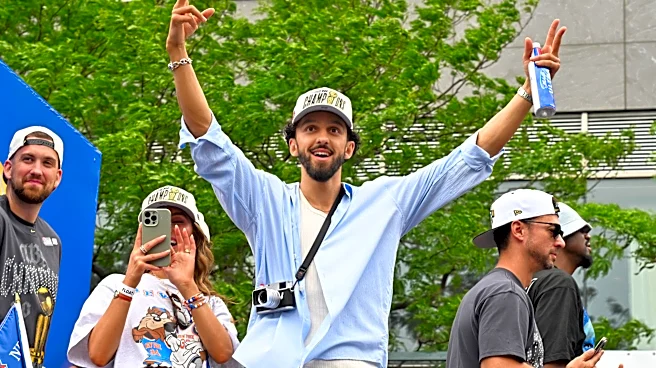
It’s no coincidence that, not long after the buzzer sounded, the usually reserved and PR-trained Bridges went absolutely wild on Instagram Live and at the parade. He reached basketball nirvana. Nothing could bother him now.
As he begins a four-year extension next year, he can do so knowing that his contributions to a champion has forever made that trade worth it and that it’ll no longer define him. Maybe it’ll make the modern-day Ironman play looser and we’ll see another level from him next season.
But that’s for October. Enjoy it, Mikal, you’re an NBA champion.
–
(P&T will be doing player-by-player article tributes over the next few weeks to commemorate the special team that ended our long, half-century nightmare)