





“Gotta be the shoes.”
This tagline harkens back to 1989 and a Michael Jordan-Spike Lee advertisement for Nike footwear. That’s when athletic footwear was in the early stages of what would become a revolution that remains ongoing.
While that advertising campaign was very much about who wore the shoes and what they might be able to do for the wearer, the quest to improve athletic performance continues. Sure, everyone wants good shoes, but today, the more interesting question is what those shoes — with
a little technological boost — can tell players and coaches about performance.
Back in September, I wrote about the Catapult vests players were using to measure their throws and manage workloads. When I was working on that story, I stumbled onto another wearable that Colorado Rockies players and coaching staff are using to gather data to measure and improve player performance: Plantiga force plates.
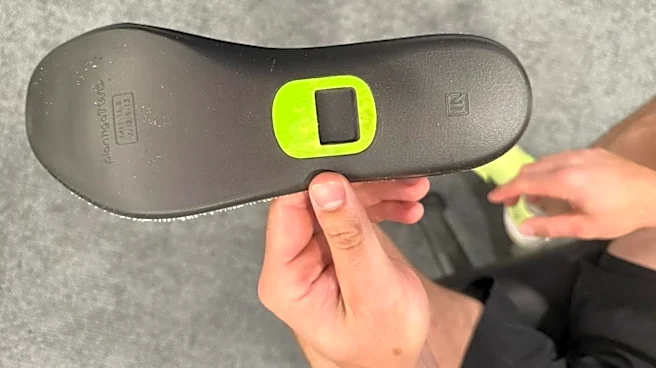
The technology requires the use of an insole that fits into a player’s shoe. A “pod” is inserted into the insole that does the actual measuring.
According to Rockies manager Warren Schaeffer, Plantiga “is measuring how your body moves, how much force you’re putting into the ground, the workload, all that.”
It’s technology that Brandon Stone, Rockies manager of performance science, explained like this: “Similar to Catapult, Plantiga helps us understand player movement by measuring acceleration and rotation through inertial measurement unit (IMU) technology. We use these technologies as complementary tools within our broader toolbox to better understand player movement and how it may affect on-field performance.”
That’s a lot to take in, but Stone as well as some Rockies coaches and players further explained the technology, which underscores another way in which the organization is using data to support player development.
As Stone put it in a phone interview, “We’re trying to build an ecosystem of tools that help us understand how our players move so that we can help guide or prescribe or change things if we need to. I think ultimately it’s like what dials can we turn a little bit in order to help optimize performance and health.”
What are Plantiga force plates?
According to their website, Plantiga features “[l]ab-grade sensor technology embedded in comfortable insoles. Captures gait patterns, asymmetries, and loads at 416Hz with clinical precision.” (To visit Plantiga’s baseball page, click here.)
“What we’re trying to detect is the smoke before the fire,” Matthew Jordan, the vice president of performance science at Plantiga, told Fast Company. “Imagine you’re at the point where your knee is just at the cusp of the next day it’s going to be like, ‘My knee’s killing me. I can hardly walk.’ We can see in the data before you reach that tipping point.” (Colorado Avalanche captain Gabriel Landeskog is a poster child for Plantiga.)
Take a look at Jake McCarthy’s Plantiga insole and pod:

“You don’t feel them or anything,” said relief pitcher Zach Agnos, who was an early Plantiga adopter.
After a player finishes doing his daily work, he pops out the pod and places it in the Plantiga charging dock located in the Rockies clubhouse. Then, the data is uploaded to the cloud and analyzed. That information is converted into a report that goes to a number of Rockies training staff, including Stone and bullpen coach Matt Buschmann.
Buschmann and Stone worked together when they were with the Toronto Blue Jays, so their collaboration on wearable technology is a logical evolution of their relationship.
“It was a really easy partnership to kind of get off the ground,” Stone said. “I try to be as available as possible during the day in season with the guys, too, so that we’re working hand in hand, and obviously (Buschmann’s) helping guide that from from the bullpen standpoint.”
Here’s how Buschamann explains the relationship between Catapult and Plantiga: “Catapult tells me (a player’s) volume and intensity. That tells you similar things, but it’s going to give us the strategy. So Catapult tells me how hard you’re throwing it. (Plantinga) tells me how you’re doing it that hard, whether you’re doing it differently from in the past, whether you’re doing more off your right leg compared to your left leg.”
And those changes have the potential to be significant.
“So a lot of times,” Buschmann said, “what that can do is tell you if you’re trying to attain something in a different way. That’s not a bad flag. It’s just like, ‘Well why?’ And if that why is because maybe you’re fatigued or maybe you’re dealing with some kind of stiffness or soreness, hopefully, that allows us to see that and kind of stop that before it becomes a larger problem down the road because (in) baseball, a lot of times, injuries are just small things become big things over time.
In other words, Plantiga allows the Rockies to establish a baseline for a player’s movements. Then, the coaching staff can look for changes in a player’s typical movement patterns and make adjustments.
“I would say we build a report off of the data,” Stone said, “and then, it’s just checking in and saying, ‘Is this within the player’s norm?’ And if it’s not, I think what we first do is just ask questions. So we try to aggregate information across the spectrum — and that’s all departments, not just performance science and pitching, but obviously, physical performance, medical and athletic training, mental skills, nutrition. All of those pieces are just as involved. We’re just trying to help say, ‘Okay, if a player’s movement patterns or their ability to be strong and fast and powerful, if those are changing, what’s changing? Why is it changing? And how can we positively impact that?’”
Those differences may be significant in terms of player performance.
“Fatigue is inevitable,” Stone said. “How you fatigue is going to be individual based on you.“
Plantiga gives the Rockies a way to measure that fatigue and then create an adjustment plan.
“Every player has a different amount of strength, power, speed, stuff that we all see,” Stone said, using McCarthy as an example.
“Jake McCarthy is super fast,” Stone said. “We obviously want to preserve that as much as possible. We also know that, based on science and research, he’s going to probably fatigue a certain way, and that way is going to be very individualized to him. So part of it is, as those things happen, are we managing it well? And then, really, all you’re trying to do is, if and when those things ebb and flow, you’re trying to adjust their routines.”
That’s where clear collaboration and communication between Rockies staff and players come into play.
“I think that’s the key relationship between the other performance departments. (The player might need) a recovery routine, a weight room routine, a mental skills routine. It might simply be adjusting nutrition, especially with the way that our travel goes in and out of altitude.”
Rather than seeing Plantiga as a tool for injury prevention, Stone views it a bit differently.
“If we can if we can maintain as robust of a mover and an athlete as he is throughout the year, then by proxy we’re hoping that we’re mitigating compensations or deviations in how they’re accomplishing running, jumping, throwing, swinging, fielding.”
It’s a balance.
“I’d say that Plantiga is, again, a little bit more like, how are they responding to the day-in, day-out work? And how are their general movements locomotively changing? And if those two things are lining up, then we’re working with all the other departments to help potentially adjust a player’s routine so that, again, they can maximize their performance during the game.
What do the players say?
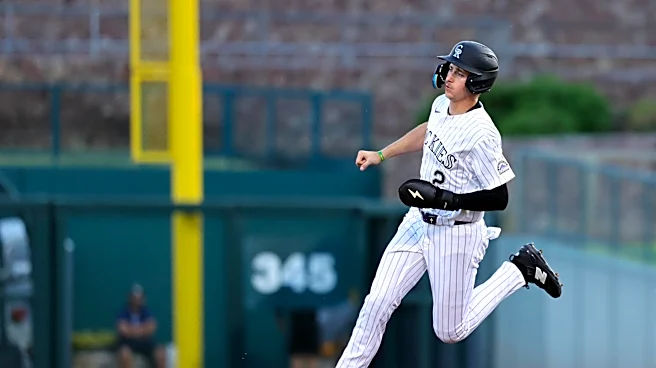
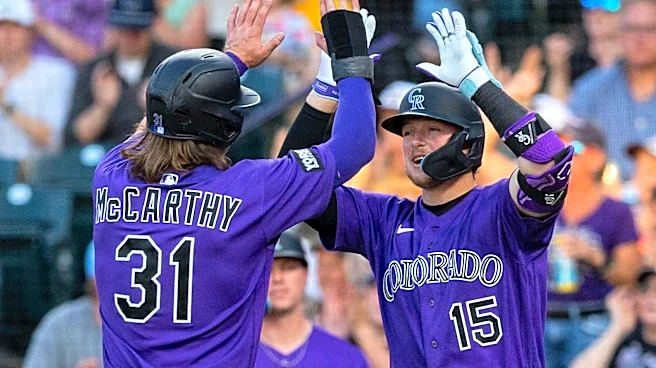
Outfielder Jake McCarthy, who logs a lot of miles between getting on base and running to the outfield throughout the game, is a fan. In the same way that Catapult can help pitchers manager their workloads, Plantiga can assist McCarthy in tracking his work.
“Running is a big part of my game,” McCarthy said, “so I’m like, ‘Hey, man, if you see anything that maybe is a red flag, please let me know.’ So I’m pretty interested.”
He added, “You know how much output force, how much you ran during the day, the speeds you’re running at.”
And he likes knowing the numbers, too.
“I think it’s cool to see the top speeds and stuff like that,” McCarthy said.
Plus, it provides an objective measure of what he’s done.
“If we play a four-hour game where I’m running around in the outfield a ton, they’ll kind of be like, ‘Hey, your workload was way higher than it’s been all year, so maybe make sure you’re drinking enough water, doing some recovery.’ So again, just a ton of stuff to learn from.”
That’s how a position player uses Plantiga. But what about a pitcher?
Zach Agnos provided some insight.
“You wear them when you throw before the game, so it can measure how much you throw in your workload and how much force you’re using, so it basically gets you a gauge on what intensity you’re at that day,” Agnos said.
“A day after you pitch,” he added, “you want to be lower intensity, so you can kind of match up the the workload, and then on the mound, you can pair it up with the biomechanics stuff around the stadium.”
That’s where Stone and his staff come in.
“Our guy Brandon Stone will look at it and let you know what you’re doing well, if something was off a little bit from that night compared to the baseline average for you. So it’s a really good way to not only measure workload but just to kind of get a basis of where you’re at and production of force and all that stuff and transfer.”
Stone commented on an interesting example that included Agnos, who, during the course of the season, moved to the third-base-side of the rubber.
“I would say in-game biomechanics is going to be the first thing that we look at to see if and when we make changes with pitchers,” Stone said. “Ultimately, performance is going to dictate that. But I would say from my role specifically, how are they moving to create that output? And if they’re moving well, then you feel more comfortable about that change.”
Then he added, “And again, I think that’s where generally you can say Plantiga would come in: Does he have the movement capacity to make the move on the rubber? Plantiga would be one of four to five tools that we use within that movement assessment paradigm to say, ‘Hey, we think he’s got the capacity. Okay, we’re going to make the move.’ And then we’re using the in-game data to really help drive if that move has been helpful from a performance standpoint. And then closing the loop is that periodically through the movements assessments with Plantiga is saying, ‘Okay, he’s not compensating based on the move on the rubber.’”
Like McCarthy, Agnos is a fan.
“I think it’s a really good tool for us to have.”
Why does it matter?
Joelle Milholm spent time last month examining how the Tampa Bay Rays and Milwaukee Brewers are finding advantages that help them win, including through their use technology.
Like Catapult, the Rockies use of Plantiga shows a team catching up and using technology to improve player performance.
Although the odds are unlikely that Plantiga inserts will transform the Rockies into a Michael-Jordanesque team in 2027, like Mike’s shoes, they’re another implement in the Rockies growing data toolbox.
Join the conversation!
Sign up for a user account and get:
- Fewer ads
- Create community posts
- Comment on articles, community posts
- Rec comments, community posts
- New, improved notifications system!
Download the SB Nation app on iOS or Android.
Please keep in mind ourPurple Row Community Guidelines when you’re commenting. Thanks!