









For the next month before the 2026
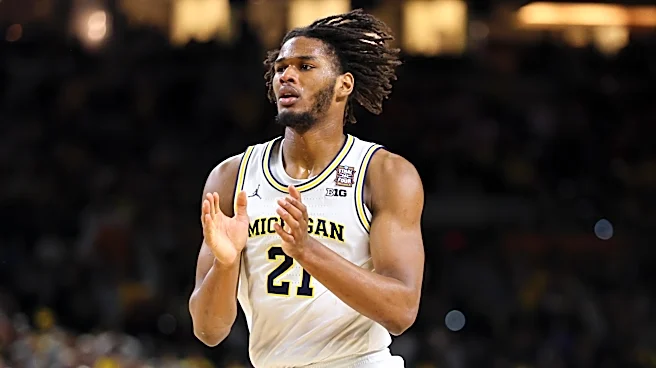
NBA Draft, we’ll take an in-depth look at different prospects here at Liberty Ballers and try to figure out which players would be the best fit for the Sixers at No. 22. Next up in this series is Michigan’s Morez Johnson Jr.Johnson was a key piece of Michigan’s 2026 national championship run, serving as the connective tissue of arguably the most dominant frontcourt in college basketball alongside Yaxel Lendeborg and Aday Mara. The Illinois transfer came into the season
as an under-the-radar prospect and leaves as a legitimate first-round pick, with a standout combine performance doing a lot of the heavy lifting to boost his stock.
Most mocks have him going somewhere between 15 and 20, meaning the Sixers at 22 will likely be watching him come off the board before their pick is on the clock. That would be a shame, because Johnson is arguably the best rebounder in this draft class and exactly the kind of physical, versatile big Philadelphia needs. If he somehow falls, it would be an easy call. If not, a trade up deserves serious consideration.
Profile
2023-24 Stats: 34 games, 33.7 minutes, 18.9 points, 5.1 rebounds, 2.6 assists, 0.9 steals, 1.3 blocks, 49.4% FG, 37.4% 3P, 80.1% FT
Team: Michigan
Year: Sophomore
Position: PF/SF
Height & Weight: 6’9” | 250 lbs
Born: January 25, 2006 (20 years old)
Hometown: Riverdale, Illnois
Strengths
Physically, there’s a lot to work with when it comes to Morez Johnson Jr. At 6’9″ and 250 pounds, he moves his feet exceptionally well for his size, giving him real switchability potential at the next level. He can contain smaller players in space on the perimeter, which is a genuinely valuable trait in today’s NBA, and his defensive instincts have continued to sharpen. Weak-side shot blocking, anticipation, and overall activity are all areas where he stands out. The 7’3″ wingspan only amplifies all of it, whether that’s contesting shots, disrupting passing lanes, or controlling the glass. He plays hard, embraces physicality, and brings consistent energy on both ends. There’s nothing soft about his game.
On the glass, Johnson might be the best rebounder in this class. He wins more times than not with a combination of strength, positioning, and effort rather than just raw athleticism. He controls his area well and has a knack for putting himself in the right spot before the ball even comes off the rim. Defense is often labeled the ugly or dirty part of the game, but Johnson is one of those guys who is simply a joy to watch on that end. He’s relentless, and regardless of context, rebounding is one of the most translatable skills a prospect can bring to the next level.
His impact goes beyond just the eye test too. When Johnson was on the court, Michigan’s defensive rating was the best in the NCAA. When he was off it, that number fell all the way into the late teens. Some will be quick to point out how talented and long Michigan was as a roster, but the same trend showed up during his earlier years at Illinois. The data follows him wherever he goes.
Offensively, Johnson is an efficient and physical scorer around the basket. He converts 62.5% of his field goal attempts while finishing through contact and above the glass, and his reliable hands and strong frame make him a natural lob threat and interior finisher. He does a really good job catching post entry passes on the move or in traffic, quickly gathering, sealing his defender, and finishing with power. His post game is still developing but there’s already a soft-touch jump hook in there and his footwork is trending in the right direction.
Beyond the rim, Johnson has more offensive tools than you might expect. He knocked down 36.4% of his threes on limited attempts and shot 77.3% from the free throw line, both of which point toward real long-term shooting upside. While his assist numbers don’t jump off the page I’d argue his passing ability is underrated too. He’s comfortable making reads out of the post and hitting skip passes. The feel for the game is there.
The year-to-year growth is probably what stands out most. Johnson went from 7.0 to 13.2 points per game while taking on a bigger role on a high-level Michigan team, and a late growth spurt added length that raised his ceiling in a meaningful way. He runs the floor well, thrives in transition, and by all accounts brings the kind of work ethic and leadership presence that teams love to have in a locker room. If you want a proven defender, rebounder, and locker room guy with offensive upside still left to unlock, Johnson is your guy.
Weaknesses
When it comes to weaknesses, almost all of them involve Johnson’s offensive game, which is best described as a work in progress. He’s not yet a high-level shot creator, and his offensive game can look raw when he’s asked to operate outside of structured situations. Self-creation facing up is limited, and there’s no real consistent pull-up or mid-range package to speak of yet.
The shooting indicators are promising, but his three-point volume is low enough that real questions remain about how translatable that floor spacing actually is at the next level. His post game has counters and the footwork is improving, but the overall polish and consistency still need work. He can also drift offensively when he’s not actively involved in a play, which is something to monitor going forward.
The turnover numbers are worth keeping an eye on as well. Johnson is averaging 1.3 turnovers per game to just 1.1 assists, giving him a negative assist-to-turnover ratio of 0.85. In isolation, a roughly 1-to-1 ratio at around one per game isn’t a disaster for a play-finishing, defensive-minded big. But the NBA continues to shade toward overall versatility, and cleaning that up would be a real separator for him. It’s worth adding some context though. Johnson is sharing the floor with Yaxel Lendeborg and Aday Mara, two players who should theoretically be generating real opportunities for him. Michigan’s offensive scheme also doesn’t put Johnson in the most favorable positions to pass or initiate, which likely deflates his numbers more than his actual ability warrants. In limited samples where he has been asked to make reads and deliver, the passing has looked fine. The talent around him may be masking more than it’s revealing.
On the defensive end, the concerns are relatively minor. He’s not an elite rim protector despite the physical tools, as his vertical pop and timing can be inconsistent. He’s also slightly undersized for a full-time center, which could impact his ability to anchor a defense against bigger NBA fives on a nightly basis. But given everything else he brings defensively, these feel more like things to monitor than genuine red flags.
Positional Fit
Johnson’s physicality is what makes him such an appealing fit as a modern NBA four. At 6’9″ and 251 pounds with a 7’3.5″ wingspan, he has the strength to bully opposing forwards on the block and the lateral mobility to hold his own on the perimeter in switch situations. His rebounding ability is arguably the best in this class, combining elite positioning, relentless motor, and sheer strength to control the glass on both ends. In today’s NBA, that kind of physical presence at the four is increasingly hard to find.
His shooting is the area to watch as he transitions to the next level. He flashed encouraging signs at the combine, going 17-of-25 in the three-point shooting drill, but his numbers at Michigan leave some projection on the table. If that shot develops into a reliable weapon, his value increases dramatically and opens the door to occasional small-ball five lineups. At 6’9″ that role comes with limitations, but his strength and length make it a realistic option in the right matchup. The floor is already high. The ceiling gets significantly higher if the shot is real.
Draft Projection
SB Nation mock draft: No. 14, Charlotte Hornets
Johnson would be a dream fit for the Hornets, who would greatly benefit from his athleticism, hustle, and rebounding. He wouldn’t be asked to overburden himself offensively too soon, given the plethora of playmaking and scoring already on this roster.