
Happy New Year!
The Washington Wizards closed out 2025 with a fun and somewhat unexpected road win against Giannis Antetokounmpo and the Milwaukee Bucks.
They squeaked out the 114-113 win despite going nearly six minutes of the fourth quarter without scoring a field goal, and despite Antetokounmpo getting a decent look on a buzzer beater that he missed.

The story for the Wizards starts with a strong game from big man Alex Sarr, and big contributions off the bench from Bub Carrington (hitting four consecutive
threes in the final period), Justin Champagnie and Marvin Bagley III. It includes a solid defensive game plan that sought to limit Antetokounmpo, and actually did — despite gaudy box score stats from the two-time NBA MVP.
Washington’s defensive strategy involved primary defense by Bilal Coulibaly, who battled to prevent Antetokounmpo from establishing position close to the basket and getting clean catches at preferred spots on the floor. Coulibaly did about as good a job as can be done against a determined Antetokounmpo, who has no quibbles banging, pushing, and shoving opponents — or letting loose with a stray elbow or three.
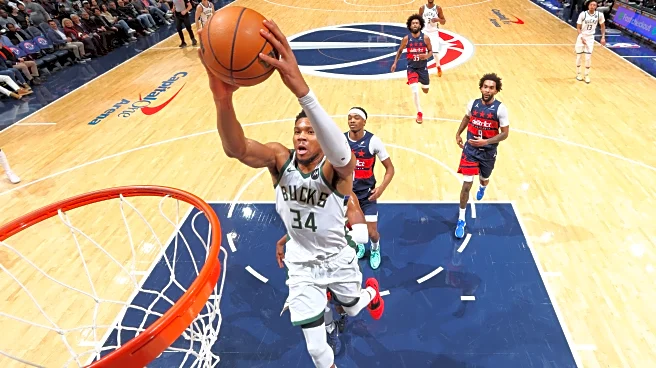
The Wizards sent loads of helpers when Antetokounmpo attacked, and while the Bucks great made shots from the floor and got to the free throw line, he also committed a whopping six turnovers. He finished the game with splashy headline stats — 33 points and 15 rebounds in just 28 minutes — his PPA (see below) was 145 (which is low for Antetokounmpo). The Greek Freak posted an offensive rating of 110 on staggering 50.7% usage.
One surprising stat for a team with Antetokounmpo: just 42 points in the paint. This is a reflection of Washington’s emphasis in limiting opponent scoring inside in recent weeks.
Bucks coach Doc Rivers should get a “thank you” card for his contributions to the win for his decades-long (and inflexible) strategy of eschewing offensive rebounding. The Wizards have been susceptible to teams in that area all season, and while the Bucks 26% offensive rebounding percentage was on the high side for them, their overall reticence to pursue offensive misses undermines their overall offensive efficiency.
Thoughts & Observations
- The Wizards started the game with Coulibaly seeking to front Antetokounmpo. The Bucks made that strategy more challenging by emptying the weakside corner to prevent backside help. They were abetted a bit by the refs, who did not call Antetokounmpo for pushing off.
- Impressive bounceback game from Sarr — 20 points, 11 rebounds (4 offensive), and 4 blocks. His offensive efficiency was “good enough” — 113 on 29.5% usage.
- Add the Bucks to the list of teams daring Coulibaly to shoot. They had Antetokounmpo theoretically assigned to defend the Wizards wing. He was more than happy to concede three-point attempts to Coulibaly. Who did not make the Bucks pay (1-4 from deep).
- Tre Johnson did not have a strong game overall, but his shooting is impressive.
- CJ McCollum played a solid game, including hitting the game-winning shot with 1 second on the clock. That shot was made possible in part by the way travels are called (or not called) in the 2025-26 NBA.
- That tapping sound you’re hearing throughout the NBA is from scouts updating scouting reports to tell their players to stick with Bub Carrington at the three-point line. He hit four straight threes to start the fourth quarter. He was 4-7 for the game, raising his season average to 44.9% — among the 10 best three-point shooting percentages in the NBA so far this season.
- Champagnie played a stellar game (again) — 12 points, 9 rebounds, 2 assists, 2 steals, 2 blocks. He led the team in playing time.
- AJ Johnson was part of the rotation, and he was pretty good — 8 points on 5 shots in 16 minutes, plus a couple assists and a steal. I didn’t love the turnovers, but maybe those will improve as he gets real minutes.
- Former Wizards player Kyle Kuzma looks lost in Milwaukee.
- The Wizards led the Bucks 23-4 in points off turnovers and 17-5 in transition points.
Four Factors
Below are the four factors that decide wins and losses in basketball — shooting (efg), rebounding (offensive rebounds), ball handling (turnovers), fouling (free throws made).
The four factors are measured by:
- eFG% (effective field goal percentage, which accounts for the three-point shot)
- OREB% (offensive rebound percentage)
- TOV% (turnover percentage — turnovers divided by possessions)
- FTM/FGA (free throws made divided by field goal attempts)
Stats & Metrics
PPA is my overall production metric, which credits players for things they do that help a team win (scoring, rebounding, playmaking, defending) and dings them for things that hurt (missed shots, turnovers, bad defense, fouls).
PPA is a per possession metric designed for larger data sets. In small sample sizes, the numbers can get weird. In PPA, 100 is average, higher is better and replacement level is 45. For a single game, replacement level isn’t much use, and I reiterate the caution about small samples sometimes producing weird results.
POSS is the number of possessions each player was on the floor in this game.
ORTG = offensive rating, which is points produced per individual possessions x 100. League average so far this season is 115.1. Points produced is not the same as points scored. It includes the value of assists and offensive rebounds, as well as sharing credit when receiving an assist.
USG = offensive usage rate. Average is 20%.
ORTG and USG are versions of stats created by former Wizards assistant coach Dean Oliver and modified by me. ORTG is an efficiency measure that accounts for the value of shooting, offensive rebounds, assists and turnovers. USG includes shooting from the floor and free throw line, offensive rebounds, assists and turnovers.
+PTS = “Plus Points” is a measure of the points gained or lost by each player based on their efficiency in this game compared to league average efficiency on the same number of possessions. A player with an offensive rating (points produced per possession x 100) of 100 who uses 20 possessions would produce 20 points. If the league average efficiency is 114, the league — on average — would produced 22.8 points in the same 20 possessions. So, the player in this hypothetical would have a +PTS score of -2.8.
Players are sorted by total production in the game.