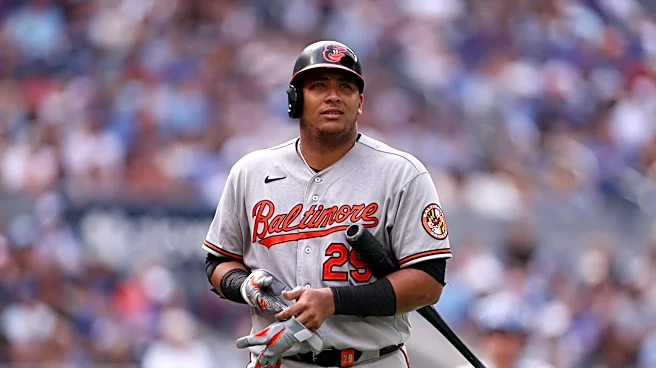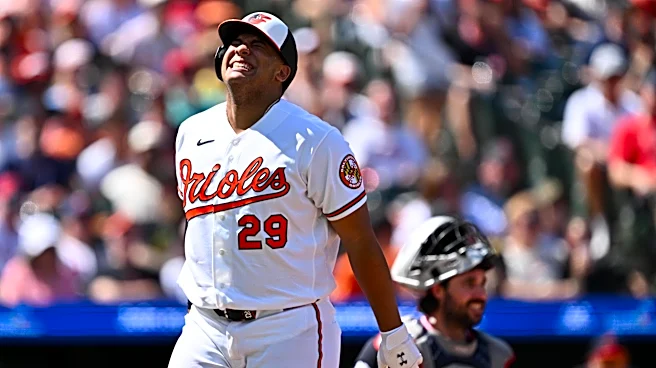




With the Orioles all but mathematically eliminated from playoff contention, an autopsy on the season that was can begin sooner rather than later. At a bare minimum that analysis should include a deep dive into the plethora of homegrown hitters that failed to meet their expectations coming into the season. Samuel Basallo’s immense struggles in the second half of the season should be at the very top of list.
Basallo’s extension signing last summer felt like a significant point for this era of Orioles
baseball. The club had finally managed to ink one of their homegrown prospects to a long-term deal, something the fanbase had been wanting for years. That player was a product of the organization’s renewed interest in Latin America, which had been almost nonexistent prior to 2018. And he was also a catcher, the same position that at the time was manned by Adley Rutschman, an all-star that had become the face of the team’s turnaround in the 2020’s.
We all know what has happened since.
The Orioles have gone through yet another disappointing season and appear set to miss the playoffs for a second straight year. Rutschman, despite injuries, regained his all-star form in the first half, but was unable to lift the team along with him. He was dealt to the division rival Red Sox in early August. Meanwhile, Basallo found himself a nice rhythm in the early portion of the season, but has also missed time with injury, and is now in the midst of a deep slump as the Orioles spiral out of contention.
Let’s look into that difference in performance a bit more.
Basallo’s IL stint for right shoulder inflammation began on July 22. From the beginning of the season through that date, he was hitting .241/.305/.450 with a 110 wRC+, 16 home runs, a 26.4% strikeout rate and 8.4% walk rate. Pretty good, especially for a rookie that is still just 22 years old.
He returned to the active roster on August 19. Since then, he is batting .150/.250/.217 with a 39 wRC+, one home run, a 26.5% strikeout rate and 7.4% walk rate. So it’s not as if he has seen wildly different strikeout and walk rates. But when he puts the ball in play, his results have been far worse than the earlier portion of the year.
We can see exit velocity is down as well. Pre-IL he was hitting the ball 91.3 mph on average, fourth on the team behind Pete Alonso, Coby Mayo, and Blaze Alexander. Since then, he’s averaging 86.2 mph on contact, on par with Jackson Holliday, who has similarly struggled in the second half, though that is worth it’s own blog.
Basallo’s line drive rate has been cut in half. Through July he had an 18.3% line drive rate. Since the start of August it is down to 9.5%. That has coincided with where on the field he is hitting the ball. Early on he pulled 46% of pitches. Now he is pulling just 38.1%. The difference in the two numbers has almost entirely shifted to opposite field contact.
At the same time it’s not as if Basallo is being treated all that different than he was early in the season. Opposing pitchers have maintained pretty consistent rates at which they have thrown fastballs compared to breaking pitches and off-speed offerings. Of course, that can look different against different pitchers, but day-to-day the young catcher has been getting similar looks all summer.

What has undoutedly changed, however, is Basallo’s ability to get his bat going. As mentioned earlier, he is not hitting the ball as hard as he was, and he isn’t pulling it as often. That starts to make even more sense when you see the continual downward trend in his overall bat speed. That has gone from 75 mph back in April and seen monthly deteriorations to a season-low 73.1 mph so far in September.

This feels like the right time to point out that Basallo’s IL stint was the not the first visible injury he sustained this season. He was scratched from a game against the Yankees on May 11 with left knee discomfort. He had an awkward swing on May 30 against the Blue Jays that left him grabbing at his left shoulder/pec. A few days later he was said to be dealing with a “bony growth” in his left wrist. Then there was the IL stint, and finally at the end of August he briefly dealt with a hand injury.
The way in Basallo handles his injuries was a point of contention for the Orioles back in mid-June. At the time, Orioles manager Craig Albernaz made a comment about how the emerging slugger needed to work on “knowing how to play through some pain and not being 100% all the time.” The next day, Basallo himself pushed back, explaining that players “are not robots.” Awkward, and based on everything we have seen maybe the catcher was right to slow down a bit.
Basallo’s continually deteriorating play would seem to indicate that he has not been at 100% for at least half the season. His exit velocities have been down since June. His bat speed has not recovered since April. And his statistical outcomes have all gotten progressively worse.
His month by month OPS this season has gone like this: .754, .974, .584, .694, .481, .444. Those last two are August and September, the two months since he was deemed “healthy” enough to come off the IL after two rehab games.
Look, it’s not as if Basallo is going anywhere. He is signed through 2033 at least with a team option for ‘34. And there was plenty of good news in his first two or three months of this rookie season to suggest he will become a staple in the middle of the Orioles lineup for a long time. But clearly the team needs to figure out what has changed since then.
Maybe they should have taken his discomfort earlier in the season more seriously. Maybe he needs to catch less frequently. If the bat is as good as the Orioles hope it will be, they will do whatever it takes to keep him in the lineup as often as possible, even if that may not align with what Albernaz or the organization expects from their backstop.