


In the last week, we talked about platoon splits for the various Astros position players, but platoon splits are only part of the equation. One of the more fascinating parts of sabermetrics is looking at how our conception of the game has changed over the years. If you watched the movie “Moneyball” you probably heard him utter, “his fielding does not matter.” That was an even bigger theme in the book. The entire message was that when teams make lineup decisions placing more value on defense than
offense then they were doing it wrong.
I am ashamed to say I said something similar in one of my first books. I’d have to go back and look at how I said it exactly, but it pretty much echoed what Billy Beane had said. Were we idiots? I suppose that is a fair way to think of it, but I would prefer to say we were not informed or simply didn’t have enough data. That particular book was published in 2004. We have learned a ton since then and any team discounting fielding does so at its own peril.
Fielding and hitting are still two very different things and there is not one universal metric that is universally accepted as the go to metric for fielding. We will look at three different sources in this piece, but there are more. Furthermore, we can be sure that each team has their own internal metric that they use. So, what we will see here is not meant to be gospel. In fact, these numbers will demonstrate how evaluating fielding is still very much in the eye of the beholder. This is even for those that use data regularly.
Before we bust out the numbers, I should note that a number of people are familiar with WAR without necessarily understanding its components. A replacement level player is not an average big league player. That is the first misconception. A player with zero WAR would be a typical everyday player in AAA. That is true with hitting and with fielding. A player with zero runs in any particular category is average. Average is better than replacement level. Obviously, how much better depends on the number of innings and the particular formula.
In a 1200 inning season, we could surmise that the replacement level fielder would actually be closer to -10 at a position. Of course, that changes depending on the position. The positions up the middle are worth more than the positions on the corners. There is a ton of math involved and I don’t want to get bogged down in the gory details. What we will do is look at the raw numbers in the first table and then convert those into a 1200 inning season to see what each player’s value would be over a full season.
Actual Numbers
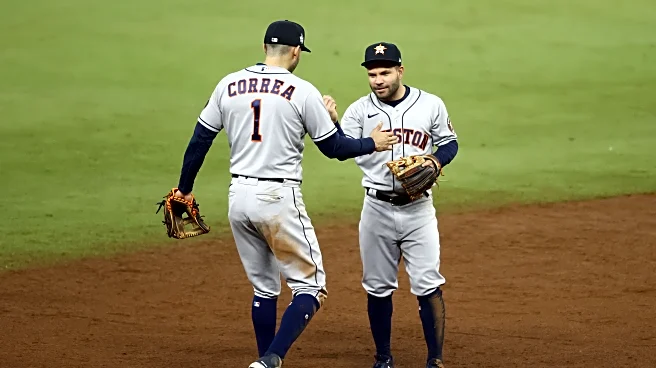
It should be noted that I did not include Carlos Correa’s innings at shortstop because he is not likely to play shortstop this season. Paredes has innings at third base, but he is likely to play the bulk of his time at first base and/or second base. Sanchez played most of his time in right field, but theoretically could also play some left field. Nick Allen played mostly shortstop, but also logged some innings at second base.
Our three sources for fielding can all be found at fangraphs.com. DRS stands for defensive runs saved. It is the metric from the Fielding Bible and uses video scouting to rate plays and how likely a player was to successfully field it. OAA stands for Outs above average. That and Fielding run value are Statcast numbers which do not rely on humans, so they are more systematic in their methods.
I try not to judge between the three because just the simple act of choosing one over the other introduces bias. It also leaves us open to cherry picking. For instance, I could say I love DRS for Smith and Sanchez, but prefer OAA or FRV for almost everyone else. What we can say is that teams probably gravitate to one of these over the others and without knowing which one we should simply report them all and let the chips fall where they may.
When we convert these to 1200 innings we are creating a math problem. By sheer definition, only eight of these guys could possibly reach 1200 innings and given the balanced nature of the Astros lineup, it is quite possible that none of these guys reach 1200 innings. However, looking at a real estimated run value helps drive home the relative cost or benefit of playing any of these guys for 150 games.
Per 1200 Innings
Like we said, the above mathematically can’t happen. However, we show this to show what would happen if Joe Espada simply plugged in eight guys into the same positions for 150 games. That would mean choosing between second base and left field for Altuve. As you can see, neither is an appealing option. This is why we will likely see a ton of mixing and matching.
Managers must synthesize this information along with the platoon splits to cobble a lineup together on a daily basis. Additionally, they have to consider load management, whether hitters are hot and cold, and what they have done individually against that day’s pitcher. It’s a lot to consider and it is important for us to keep that in mind the next time we want to crush Joe Espada for one of his managerial decisions.
Nick Allen wasn’t an Astro last year, but he and Mauricio Dubon are similar as fielders. It should be noted that when you total the number of runs together for the actual production we get +9 for DRS, +25 for OAA, and +17 for FRV. Effectively, that means that pitchers were a collective one to three wins better with this fielding team behind them than an average fielding team. If we added the 1200 inning totals together we get -31 for DRS, +17 OAA, and -1 for FRV.
Those numbers are obviously inflated since those amount of innings are not available, but it does show that simply putting the best hitters in the lineup and closing your eyes will create an inferior fielding alignment. The question is what is the effective difference between defensive runs and how that compares with the difference between runs created offensively. That is the whole ballgame.