
The 1992 Yankees season, the first under manager Buck Showalter, marked a modest if unexciting improvement from the previous two seasons. The moribund Yankee offense got a boost from newcomer Danny Tartabull,
and young outfield prospect Bernie Williams was starting to show signs of a breakout. But if the lineup was the area of greatest need after 1991, the rotation was the trouble spot for them following 1992. Despite a breakout season from Mélido Pérez—brother of Pascual—the Bombers had a dearth of reliable starters beyond him, especially in the southpaw department.
So the Yankees entered the winter meetings of that year in Louisville with a big bucket list. They threw their hats in the ring for the likes of Greg Maddux, David Cone, and other bonafide aces, but they failed to woo any of them. Maddux packed his bags for Atlanta to join Tom Glavine and John Smoltz. Cone returned to his hometown Royals. Doug Drabek and Greg Swindell signed in Houston, Chris Bosio inked a deal in Seattle. The list goes on. The Yankees went into the meetings looking for strikeouts, only to themselves strike out instead.
Thankfully, they had not exhausted all their options for experienced winning pitchers, or even lefties. Their first move was to acquire Jim Abbott in a trade with the California Angels on December 6th. Then, a few days later, they reached out to another lefty by the same first name. They’d sign him too.
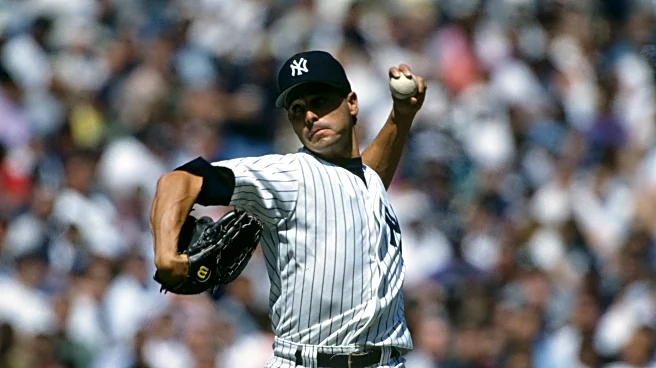
Jimmy Key
Signing Date: December 10, 1992
Contract: Four years, $17 million
Jimmy Key and his wife Cindy were enjoying a pleasant holiday cruise together after winning the World Series with the Blue Jays earlier that fall. The soft-spoken southpaw had reached the end of a fruitful nine-year tenure in Toronto, having helped the Jays cement themselves as perennial championship contenders in his own humble way. Key, who was born and raised in Huntsville, Alabama, was selected in the draft out of high school by the White Sox but chose to play at Clemson. A terrific two-way player, he recieved first-team All-ACC honors both as a pitcher and designated hitter in 1982. That year, the Blue Jays drafted him in the third round, and he shot up through their deep minor league system to reach the bigs two seasons later.
Manager Bobby Cox assigned Key to the bullpen his rookie season, but it was clear he possessed a starter’s repertoire. He won a rotation spot in 1985, and immediately broke out, with a 3.00 ERA in 212.2 innings, earning an All-Star selection and joining staff ace Dave Stieb and veteran Doyle Alexander to form a fearsome trifecta of arms. The Jays won 99 games that year, reaching the postseason for the first time in franchise history.
In that year’s ALCS, they took a 3-1 series lead over the Kansas City Royals, but could not find the knockout blow. Key started a pair of games in the series but never got the win, and the Jays let a golden opportunity to reach the World Series slip away.
The Blue Jays would miss the postseason the next two seasons despite two more superb seasons from Key, who reached his zenith in 1987 with a Cy Young runner-up campaign and an MLB-best 2.76 ERA. Not long after, he began to experience arm troubles which hampered his effectiveness over the next several years. It wasn’t until 1991, his age-30 season, that Key would return to form with an All-Star caliber effort. That year, the Jays went back to the ALCS and again fell short, losing to the Twins in five games. But they would be back.
Key had another strong healthy season in ‘92, joining the electric Juan Guzmán and veteran Jack Morris, who joined Toronto after beating them with the Twins and supplanted his nemesis Stieb as elder statesman. Additionally, David Cone joined midseason via trade. The Jays won 96 games, triumphed over the Athletics in six games in the ALCS, and reached their first World Series. Key shifted to the bullpen against Oakland, but would get to start Game 4 of the Fall Classic against the Braves. With Toronto leading two games to one, Key outdueled Tom Glavine across 7.2 innings of one-run ball to seal a crucial win. Armed with a 3-1 advantage in the series, the Jays sealed the deal this time in Game 6. Key, who pitched in relief, earned the win in the 11-inning clincher.
Key became a free agent for the first time in his career after raising the Commissioner’s Trophy. Having spent his entire pro career north of the border, Key was open to return there, but Toronto as a rule never signed pitchers for longer than three years, opening an opportunity for George Steinbrenner and the Yankees. They offered Key a fourth year, and after Toronto stuck to their policy, Key accepted the Yankees’ bid on that cruise ship in Hawaii. (As an aside, many sources including Jack Curry reported that Key’s agent was his then-wife Cindy—while a great anecdote, it’s not true: Key negotiated the deal himself and Cindy was listed as his agent to save on a fee.)
Key was a great fit with the Yankees for two important reasons. First, Key’s unflappability on the mound meant he wouldn’t prove overawed by the task of pitching in the Bronx—even in front of a fanbase with no patience to spare after the previous decade’s ineptitude. Second, his mild manner meant he was in little danger of incurring the wrath of The Boss — something which could not be said for Tartabull, our previous entry in this series.
The Yankees registered an 88-74 record in 1993, their first winning season in five years, and the first in the franchise’s incredible active streak of winning seasons which reached 33 consecutive years in 2025. Key was the Yankees’ most valuable player in ‘93, finishing with 173 strikeouts — a new career high — across 236.2 innings. Even as Mélido Pérez’s star faded and the rotation failed to excite beyond Key, he provided such metronomic consistency as to receive a bevy of down-ballot MVP votes, in addition to finishing fourth place in the Cy Young race. The Yankees finished a distant second behind Toronto, who repeated as World Series champs, but the upward trajectory was established.
Key and the Yanks appeared on the way to far greater things in 1994. The southpaw was pacing the league with 17 wins in 25 starts, as the Yankees entered the morning of August 12th with an AL East-leading 70-43 record, 6.5 games ahead of Baltimore. Then the MLBPA went on strike, and the resulting labor stoppage wiped out the remainder of the season.
In withholding their labor to prevent the institution of a salary cap, the players ultimately got what they wanted out of the strike, though the 1994 season continues to live on in eternal hypotheticals. The Yankees, of course, missed a huge opportunity to return to the Fall Classic with their captain Don Mattingly, who was still awaiting his first shot at October baseball. Ultimately, the tide of history following the strike favored the Yankees, hence why the main what-if story of ’94 told these days is that of the RMontreal Expos. But that strike also cost Jimmy Key the chance to lead a postseason rotation for the first time.
Key only made five starts in ’95 before going down with rotator cuff surgery, suddenly attaching some serious question marks to his name prior to the final year on his contract. Key returned to being a supplemental part of the staff rather than the headliner, turning in 30 cromulent starts for the AL East champions. He made four starts in their October run, including an eight-inning masterpiece in ALCS Game 3. Then, just like in 1992, Key put the lock on a Fall Classic clincher over Atlanta. Key threw 5.1 innings of one-run ball in Game 6 at Yankee Stadium, putting to bed the 18-year title drought.
As with the Jays following the 1992 title, Key left the Yankees after the 1996 championship, signing with the Baltimore Orioles. Key turned in one more All-Star season and postseason run with the Birds in 1997, then retired at the end of the following year at the age of 37. In all, Key reached five All-Star Games and finished top-5 in Cy Young voting three times; two of those times coming in pinstripes in 1993 and 1994 (the latter as runner-up to Cone). He accrued 45 fWAR over the course of a terrific 15-year career.
Jimmy Key was a control pitcher in every sense. He did not possess an overpowering fastball or knee-buckling breaking pitches, but had tremendous feel, poise, and command. No moment was too big, as he showed when he helped seal a World Series victory in the Bronx. That’s the kind of pitcher you offer an extra year when he hits the market; that’s an impact big free agent signing.
Additionally, the offseason of 1992-93 provides a great case study: sometimes Plan B or even Plan C works just as well as Plan A. The Yankees missed out on the biggest-name free agents, but Key turned out to be just as good, if not flat-out better than most of the cohort of pitchers they initially hunted. Fast forward to 2025, and the Yankees are themselves having a quiet winter, without any major free agent signings — but many quality players remain on the market. It’s never too late for a Jimmy Key-type signing to come around and change the narrative.
See more of the “50 Most Notable Yankees Free Agent Signings in 50 Years” series here.