




For the next month before the 2026 NBA Draft, we’ll take an in-depth look at different prospects here at Liberty Ballers and try to figure out which players would be the best fit for the Sixers at No. 22. Next up in this series is UConn’s Tarris Reed.
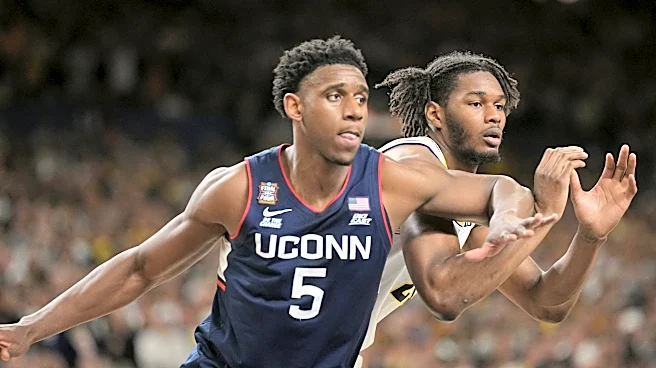
Reed was a cornerstone of UConn’s 2026 Final Four run, delivering one of the more dominant individual tournament performances in recent memory with a 32-point, 27-rebound showing against Furman. He is not the flashiest prospect in this class, but he is one of the most
physically ready. A blue-collar, paint-dominant big who does his best work in the dirt, Reed has steadily improved every season and arrives at the draft as a player who knows exactly what he is. For the Sixers, his frame, rebounding, and interior presence make him worth monitoring as the draft progresses.
Profile
2025-26 Stats: 35 games, 27.3 minutes, 14.7 points, 9 rebounds, 2.3 assists, 0.9 steals, 2 blocks, 60.7% FG, 61.7% FT
Team: UCONN
Year: Senior
Position: C
Height & Weight: 6’9.75” | 263.3 lbs
Born: August 5, 2003 (22 years old)
Hometown: St Louis, Missouri
Strengths
Reed’s bread and butter is his post game, and he has developed it into one of the more reliable interior scoring arsenals in college basketball. He converts at 60.7% from the field, finishing through contact with a soft hook shot and enough touch around the rim to make him a consistent threat whenever he gets the ball in the paint. He does not need much space to operate, and he does not waste possessions.
His rebounding is relentless. He wins battles on the glass through a combination of strength, timing, and motor, establishing deep position and refusing to give ground. That 32-point, 27-rebound tournament performance was not a fluke, and he had many other games where he was a double-double machine.
Reed checked in at the combine at 6’9.75″ barefoot, 6’11” in shoes, 263.6 pounds, with a 7’4.25″ wingspan and a 9’2″ standing reach. Despite his size, Reed moves with better-than-expected nimbleness around the basket. In pick-and-roll situations he is a willing and efficient roll man, using his hands and frame to finish at the rim without needing to create anything off the dribble.
Defensively, he protects the rim with purpose. His 2.0 blocks per game reflect both his primary shot-blocking ability and his awareness rotating as a help defender. He times his blocks well and holds his own in on-ball interior situations without fouling recklessly.
What stands out beyond the numbers is his composure. He knocked down clutch free throws in high-pressure tournament moments and played with a consistency that suggests his production is not fluky. He brings a physical, blue-collar mentality that fits naturally into a defined NBA role.
Weaknesses
The concerns with Reed are real and mostly tied to the direction the league has moved. At 6’9.75″ barefoot, he is undersized for a traditional NBA center, and matching up against true seven-footers night after night will test his frame regardless of how strong he is. His 9’2″ standing reach helps, but there is only so much it can compensate for.
The bigger issue is his lack of perimeter skill. Reed has no shooting range beyond the paint and offers no floor-spacing ability whatsoever. In today’s pace-and-space NBA, a big who cannot threaten defenses from the perimeter becomes increasingly scheme-dependent, and teams have to be intentional about how they deploy him.
His free throw shooting at 58.6% is a concern worth flagging. For a player whose offensive game lives at the rim and in contact situations, that number raises questions about touch and late-game reliability that will not go away until he proves otherwise at the next level.
Reed is not particularly explosive or quick by NBA standards, which limits his effectiveness against faster, more athletic frontcourts. Switch-heavy systems that force him onto guards on the perimeter could expose him regularly. More often than not, he will be deployed in a drop-heavy defensive scheme, which depending on the personnel around him, could be a strength or a liability.
At 23 years old by draft night, the age factor is worth acknowledging. It does not diminish what he has accomplished, but it does compress the perceived development runway compared to younger prospects at the same position.
Positional Fit
Reed projects as a backup center at the next level, full stop. His game is built for the interior and his value is tied directly to what he does in the paint on both ends. He is not a small-ball four and he is not going to be asked to guard on the perimeter in a switch-heavy scheme. The teams that get the most out of him will be the ones that use him in a defined role, protect him defensively, and let him do his damage in the post and on the glass.
The traditional center archetype has taken a backseat in recent years, but there is still a place in this league for a physical, paint-dominant big who rebounds, blocks shots, and finishes efficiently. Reed fits that mold. The question for Philadelphia is whether that profile fills a genuine need or whether the Sixers are better served by a more versatile option at 22, or elsewhere. His upside may be capped, but his floor is as dependable as anyone in this class.
Draft Projection
Most reputable mock drafts have Reed going somewhere in the late first round into the early second round, which means he should be available if the Sixers want him, whether that’s at 22 or in a trade-down scenario. Reed makes sense for most teams seeking a high-floor big who takes up space, has a proven winning pedigree, and does the things you want from a modern big, particularly with his finishing and rebounding. He’d be an excellent fit for a team seeking a backup big they can depend on and know exactly what they’re getting in terms of strengths and limitations. Reed is what he is, and that isn’t a bad thing.