
The mid-2000s were a strange time for the Yankees. The dynasty of the ‘90s engineered a hangover that lasted almost ten years, where the team regularly returned strong lineups but lacked the pitching depth
or that elusive “clutch” gene. In some ways, Gary Sheffield might be the poster boy for this period — he never had a bad regular season for the Yankees, but his first campaign with the team ended in the disaster that was 2004, and the club never got closer than that while he was in pinstripes.
Sheffield’s one of the great mercenaries in the history of baseball, an uber-talented hitter who walked around with a king-sized chip on his shoulder. He made the All-Star team nine times and won five Silver Sluggers during stints with eight teams, winning a ring with the 1997 Florida Marlins. That was already his third team in MLB, and he would be dealt away in ‘98 to the Dodgers, although I’ll attribute that decision more to the infamous post-World Series fire sale than anything to do with his personality. Shef did publicly state how embarrassed he was by the team’s teardown, but that’s not an attitude problem — that’s a statement of fact.
LA and Atlanta followed, and by the time December 2003 rolled around, Sheffield had logged 13 consecutive seasons of excellent hitting, with his worst year being a 123 wRC+ in 1993, split between the Padres and Marlins. The less said about his defense the better, but if you were looking to add a bat and some headlines, you could do a lot worse than Gary Sheffield.
Gary Sheffield
Signing Date: December 19, 2003
Contract: Three years, $39 million
Signed one year to the day after Hideki Matsui, the Yankees were clearly leaning into the bat-first approach — they had Derek Jeter at shortstop Opening Day instead of the shiny new toy Alex Rodriguez. GM Brian Cashman wanted the team to add erstwhile Montreal Expos standout Vladimir Guerrero and reportedly had an agreed-upon contract. But owner George Steinbrenner picked Sheffield, won over by his buggy-whip power swing and close ties to Steinbrenner’s adopted home of Tampa (not to mention a relation to uncle/former New York star Dwight Gooden).
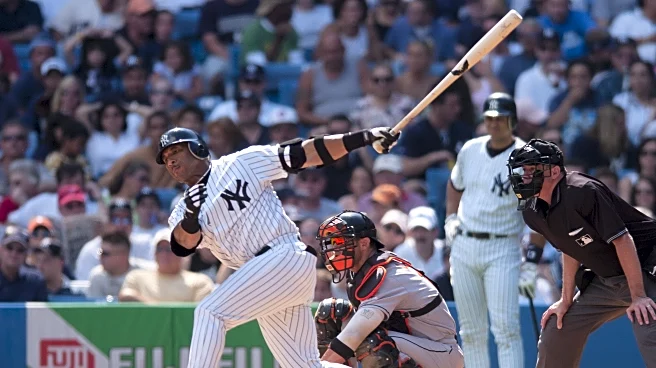
That first season was a tear for Sheff, as he finished runner-up for AL MVP, walloping 36 homers and leading the Yankees in RBI, runs scored, and OPS+. That ugly defense meant he posted just 3.8 fWAR, and the man who actually won MVP was none other than Guerrero. Nonetheless, Sheffield was the offensive force the club was hoping for. He was shuffled between third, fourth, and fifth in the Yankee lineup, producing wherever Joe Torre set him.
His first taste of October in the Bronx went well enough too, on the personal production side anyway. A 134 wRC+, .904 OPS line should be more than enough to placate even the toughest Yankee fans, but of course the end result of that postseason push left a bad taste in everyone’s mouth. Sheffield managed just a single base hit in 17 plate appearances in those doomed four games against Boston, just one of many Bombers who became duds on arguably the biggest stage in baseball history.
The kicker to all this was the season was played while Sheffield worked through a shoulder tear, one that would require surgery in the offseason. Herein lies maybe the most interesting thing about Gary — his attitude questions were real, and he had an ejection history a mile long:
The man was expelled from his Little League team for chasing a coach around at practice with a bat!
Despite that, he would unquestionably chew through concrete to perform at the highest level. He was the best fulltime hitter for the Yankees in his first season while playing with one-and-a-half arms. How much of that was sheer willpower and how much was pharmaceutically driven we’ll never know, but having a bat like Sheffield’s in your lineup would make any team better.
That first season would be Gary’s best, but 2005 was no off-year. A 137 wRC+ came in a year where he once again walked more than he struck out, but an ill-timed magazine story quoted him as possibly shading Jeter and A-Rod as “two players [covered] in a positive light, and everyone else is garbage” hung over yet another run toward October. Against the Angels that fall, Sheffield’s rather interesting defensive instincts were on full display in a fifth concsecutive disappointing postseason for the Yankees.
Poor Bubba Crosby.
That and a 65 wRC+ in an abbreviated October meant the funk was truly setting in for the Yankees, who were roundly becoming the uber-regular season team that fell on its face come playoff time. It wouldn’t get better the next year for Sheffield or the team either, as the slugger was laid low with a wrist injury and appeared in just 39 games. Sidelined for months, the win-now Yankees had to pivot and traded for a new right fielder in the more well-rounded Bobby Abreu. So when Sheffield returned, the Yankees got creative and stuck him at the open first base position with Jason Giambi at DH (primarily because of a wrist injury, but also because the Giambino was far from Don Mattingly on defense). He had never appeared at first before but was a good team sport about it adapting over the final nine games of the regular season. But Sheffield went 1-for-12 in yet another dreadful postseason run and that sealed the end of Gary’s time in New York.
The club did pick up his 2007 team option but sent the disgruntled star to the same team that had just eliminated them in the 2006 ALDS, the Detroit Tigers. Sheffield spent three more years in the bigs, coming to Queens sitting on 499 career home runs:
Gary Sheffield’s Yankee tenure was the epitome of George Steinbrenner’s leadership style. The Yankees outbid anyone they wanted for the biggest star available, even if the fit wasn’t exactly right, the player wasn’t as complete as he could be, or the team wasn’t as well-rounded as it should be. Excellent lineups, bad defense, and shaky pitching was the calling card of those mid-2000s teams, and Sheffield supplied two of those three.
Sheffield probably has a Hall of Fame resume, but his connections to BALCO, listing in the Mitchell Report, and productivity in his later years are all in concert with challenges other PED-linked players have found on their incomplete trips to Cooperstown. He’ll likely never have a plaque there, and his time in New York never got past the finish line, but he remains one of the most unique and feared hitters in baseball history. If I were to compile a list of players I’d most want modern Statcast data on, most want to dig into those underlying hitting tools like exit velocity, Babe Ruth, Ted Williams, and Barry Bonds would be at the very top, but Gary Sheffield wouldn’t be far behind.
See more of the “50 Most Notable Yankees Free Agent Signings in 50 Years” series here.