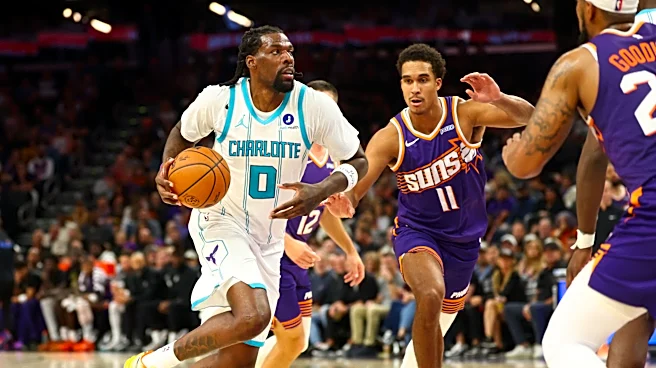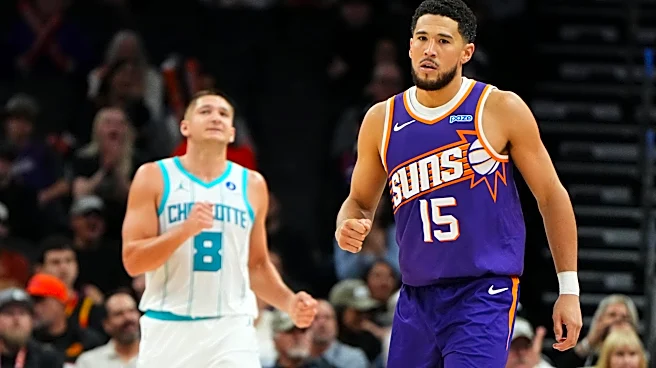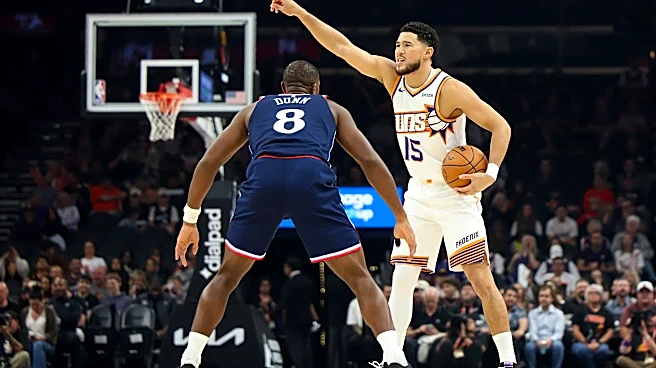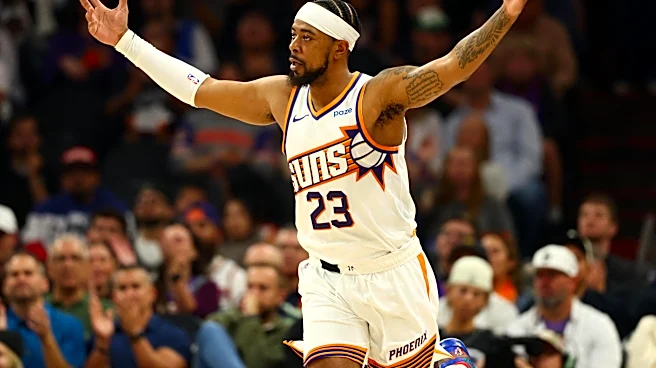



As precious seconds ticked off the clock late in Thursday night’s matchup between the Phoenix Suns and Charlotte Hornets, it was abundantly clear that Charlotte was attempting to intentionally foul Devin Booker. And Booker? He was ready and willing to accept that foul.
Unfortunately, head official Scott Foster apparently had his attention elsewhere, despite the action unfolding approximately five feet in front of him. Perhaps he was looking into the front row, spotted Steve Nash, and began reminiscing
about the good old days when he and his fellow officials allowed opponents to assault the two-time MVP with little consequence. Maybe he noticed Brandon Rafi sitting courtside and started thinking about calling Rafi Rafi the next time he needs a lawyer. Whatever was occupying his attention, it certainly wasn’t the intentional foul taking place directly in front of him.
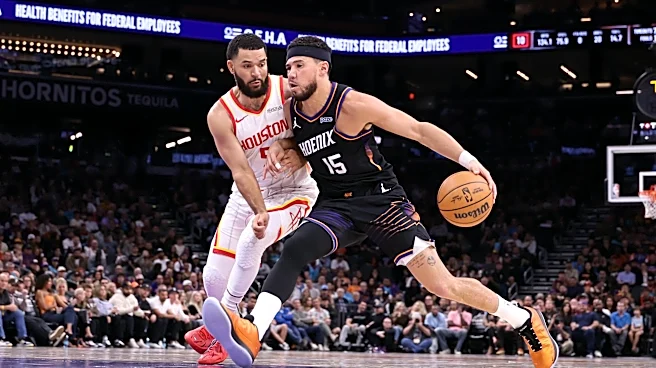
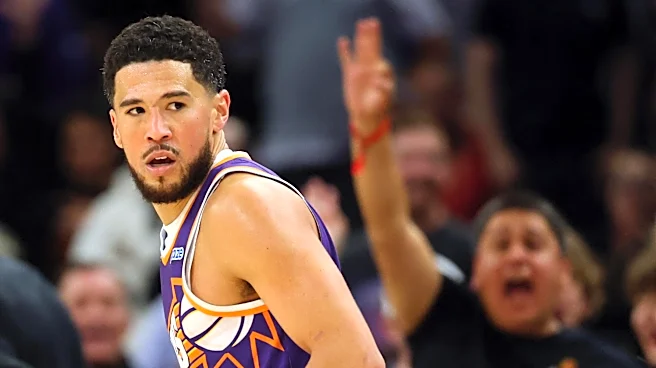
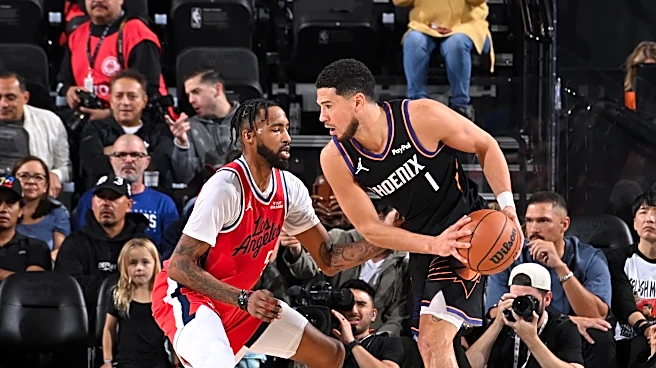
Booker responded with that familiar piercing stare, the one we’ve seen countless times when he’s wondering how an official could possibly miss something so obvious. But there was still a basketball game to finish, and with Sion James approaching to provide a double team, Booker decided to take matters into his own hands. He dribbled left, rose up, and buried a 28-footer that effectively sealed the victory for Phoenix.
No whistle? No problem. Sometimes the best response to questionable officiating is to make the officials irrelevant. And in that moment, Devin Booker did exactly that.
That moment encapsulated just how great Devin Booker has been to begin this season, with the exception of his three-point performance against Oklahoma City. For a team navigating a discombobulated, duplicative roster that is ultimately going to go as far as Booker can carry it, the Suns’ franchise cornerstone has been delivering. Nowhere has that been more evident than in the clutch.
Booker scored nine points in clutch time against Charlotte, continuing an impressive stretch of late-game execution. Through four clutch appearances this season, he’s shooting 66.7% from the field, 50% from beyond the arc, and has a +8 plus/minus. Those are encouraging numbers for a player whose late-game efficiency became a legitimate concern last season.
What impressed me most against the Hornets wasn’t necessarily the scoring. It was his decision-making. Every time Charlotte attempted to throw a double team his way, Booker recognized what was happening and responded decisively and appropriately. On one possession, he drove away from the pressure, penetrated the defense, and kicked the ball to Jordan Goodwin in the left corner for an open three-point opportunity. Goodwin missed the shot, but the process was exactly what you wanted to see. On another possession, Booker beat the double team himself and converted. He wasn’t forcing the issue. He was reading the defense, understanding what was available, and making the appropriate decision.
We are currently witnessing what can only be described as a Devin Booker heater. Over his last 7 games, he’s averaging 27.4 points on 49/40/95 splits.
Quite honestly, the Suns desperately need it because the rest of the starting lineup is struggling mightily. Perhaps it’s the lack of continuity and limited playing time together. Maybe it’s the absence of clearly defined roles, with players still attempting to understand where they fit within an offense that features overlapping skill sets. Whatever the explanation, the production from Phoenix’s starters has been inconsistent and inefficient.
Booker has accounted for 35.1% of all points scored by the Suns’ starting lineup this season. Think about that. More than one out of every three points produced by the starters has come from a single player. Meanwhile, the starters not named Devin Booker have combined to shoot 52-of-154 from beyond the arc, a pedestrian 33.8%. In the clutch, everyone without ‘Booker’ written on their back has combined to make 20% of their threes and 30% of their shots.
While the shooting inefficiencies that plagued Booker last season generated plenty of concern, those issues haven’t carried over into the early portion of this campaign. Against Charlotte, he connected on 4-of-8 attempts from deep, continuing to provide the offensive production and efficiency that Phoenix needs from its best player. He’s up to 25.5 points this season, doing so on 50/38/94 splits, adding 5.0 assists, and 1.2 steals.

Until the rest of the starting five figures out who they are, what their responsibilities should be, and how they can contribute more effectively on both ends of the floor, the Suns are going to need Booker to keep this heater going. Because if he has an ordinary night, there’s a pretty good chance Phoenix is going to lose. That’s an unfortunate reality, but it’s where this organization finds itself.
Devin Booker is in the prime of his career. This should be the period when the franchise has a clear understanding of what works alongside him, what complements his strengths, and how to construct a roster that maximizes his abilities. The organization has had plenty of time to figure that out.
Instead, we’ve watched Phoenix spend much of his prime fumbling through roster construction, repeatedly acquiring players with overlapping skill sets and similar positional responsibilities. Rather than consistently surrounding Booker with complementary pieces, the organization has continued placing additional weight on his shoulders, asking him to compensate for deficiencies that should have been addressed through better roster construction. Thankfully, at least through the opening weeks of this season, Booker appears more than willing to accept that responsibility.
But how long can he sustain it? How long can a team reasonably expect one player to account for more than a third of its starting lineup’s scoring while simultaneously serving as its primary offensive organizer and late-game closer? At some point, the supporting cast has to establish its identity and begin providing consistent production.
I’ve been quick to remind people that Devin Booker is the $57 million man whenever his performances fall short of expectations. When you’re earning that kind of money, there’s a certain level of production, leadership, and accountability that comes with the paycheck. And right now? He’s earning every damn dollar.
You earn that money by delivering in the clutch, which Booker has done. You earn it by becoming the stabilizing force that prevents an inconsistent team from completely unraveling. Check that too, as the team sits at 5-6. You earn it by showing up night after night, accepting the responsibility of carrying an offense while your teammates are still trying to figure out their roles, their responsibilities, and perhaps why they’re being asked to occupy spaces already filled by somebody else. That’s what Devin Booker has been doing.
And while I certainly hope the rest of the roster begins providing him with the support he deserves, there’s something worth appreciating about watching a player embrace that burden and continue delivering. Because for all the questions surrounding the Phoenix Suns right now, Devin Booker is providing the most important answer. He’s playing like the $57 million man.
We’ve spent plenty of time questioning Booker’s late-game execution, his decision-making, and whether he can consistently elevate a flawed roster. Right now, he’s answering those questions with his play. The Suns still have plenty to figure out, and Booker can’t be expected to carry them indefinitely. But for the moment, he’s reminding everyone why he’s the face of this franchise. And why, when the game is on the line, you probably shouldn’t leave him open from 28 feet.