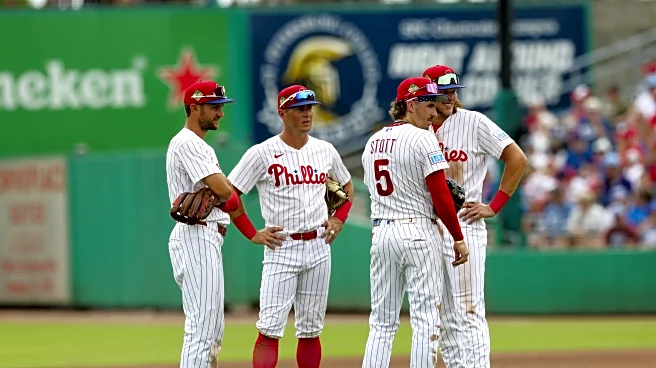

Opening Day is just days away, which means it’s almost time to officially turn the page on the 2025 season and move on to 2026. But until those games begin, the specter of 2025 will hang over everything and define the narratives for the start of the season. These are some of the numbers that will frame those narratives as the 2026 season gets underway.
96
This one may seem obvious, but 96 is the number of games the Phillies won in 2025. They once again improved on the previous season’s win total but also
once again stalled in the NLDS. The team has returned many of the same players, but they have widely been projected to win fewer games in 2026. Still, they are expected to once again be in the postseason, the question will be whether it be as a third straight NL East champion or as a Wild Card.
3
The last time the Phillies had a rookie hitter accumulate at least 3 WAR was Odúbel Herrera in 2015. You have to go even further back to find a rookie pitcher who accomplished the feat, with the last being Vance Worley in 2011. Justin Crawford and Andrew Painter will perhaps be the two players facing the most scrutiny as the 2026 season begins. The Phillies opted not to make any major, sweeping changes to their roster after another early postseason exit, rather they decided to look internally for a spark.
For the team to become the perennial, sustainable contender that ownership wants, you have to receive meaningful contributions from your farm, something the Phillies haven’t really seen much of over the last decade. The 2026 season doesn’t rest solely on the likes of Crawford, Painter, and potentially Aidan Miller, but the Phillies long-term competitive window will only remain open if some of these players become real big-league contributors.
43
That’s the percentage of pitches in the strike zone seen by Bryce Harper in 2025, the lowest of any qualified hitter. You have no doubt heard that exact phrase before, as it’s been a hot button topic in an offseason that also featured a rather public dispute/spat/kerfuffle between Harper and Dave Dombrowski. That disagreement stemmed from the latter’s comments about Harper not having an elite season in 2025. Harper and his agent Scott Boras pointed directly and indirectly towards lineup protection as one of the causes of his down season.
That percentage of pitches in the zone is unlikely to change in 2026, as Harper’s career average of pitches in the zone is 44.2%. The key to Harper recapturing that “elite” status and possibly the key to the entire Phillies season is if Harper can do more damage on those hittable pitches while not chasing outside of the zone, something he did at a higher rate than the previous two years.
149.2
That’s the number of innings Zack Wheeler threw for the Phillies last year, his fewest in a non-pandemic season since joining the Phillies. Wheeler’s season was of course cut short by a blood clot in August that later resulted in the Phillies ace needing thoracic outlet surgery. The Phillies weathered the storm in Wheeler’s absence thanks in no small part to the emergence of Cristopher Sánchez as an ace in his own right. But the Phillies rotation depth is much thinner this year, as Ranger Suárez is now in Boston and the back of the rotation is expected to be helmed by rookie Painter. Behind him and swingman Taijuan Walker, there is not much depth to speak of. The Phillies can’t afford to suffer another major injury beyond Wheeler, and they will need him to be a workhorse once he is able to rejoin the rotation.