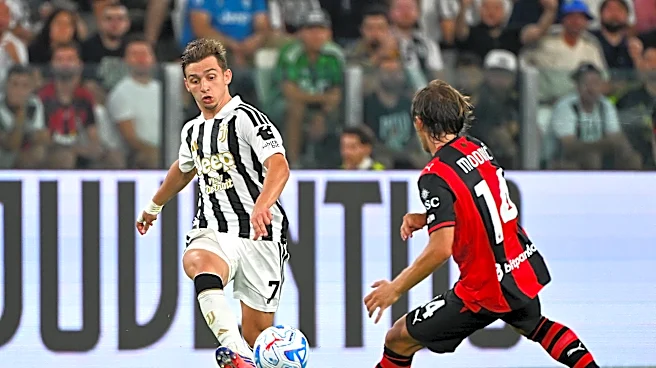


Three matches into the season, Luciano Spalletti has already established the league’s dominant defense. What we saw against Milan wasn’t just a good defensive outing. It was a masterclass in structural control — a theme that’s shown up multiple times in the first few matches. Rather than merely surviving attacks, Juventus are completely suffocating them before they can materialize. Through three games, Juve have allowed just 0.8 xG, putting them more than a full xG ahead of the second-best defense in Serie
A. Saturday was the clearest proof yet that this defensive transformation is real, repeatable, and elite.
Milan were effectively rendered impotent for 90 minutes. They managed just three total shots all match — two of which came from more than 20 yards out — for a paltry 0.11 total xG. Run this game back a hundred times, and Juventus wins probably 80 percent of them. When simulating the match based on the shots that happened, the five most common scenarios all involve shutouts. Yet, they walked out of the Allianz Stadium with a point off a pure anomaly — a shot that slid between Pierre Kalulu’s legs, placed in a spot just out of the reach of Guglielmo Vicario.

With football being a low-scoring sport, it’s prone to weird events having an outsized effect on the results. In a match where Juve’s process was nearly flawless, the scoreline failed to reflect it. However, that defensive dominance also highlights a natural contrast on the other end of the pitch. While the attacking process remains healthy — sitting comfortably in the top five in Serie A for xG created — the production still lags behind the elite standard set by the backline. Through three matches, the foundation for a dominant side is fully in place. But to understand why this team’s floor is already so remarkably high, you have to look at how Spalletti neutralized Milan’s build-up long before they ever reached the penalty box.
Press high, sit deep, deny everything
What made Saturday’s defensive performance so complete wasn’t a single, rigid setup. It was two distinct approaches, stitched together seamlessly depending on what Milan tried to do with the ball. Consistently, Juventus pressed significantly higher than they had in either of the first two matches. It’s arguably the most aggressive we’ve seen them out of possession this season, and for the most part it worked. Milan struggled to build clean possessions through the middle third, leaving them starved for territory.

Juventus controlled the middle of the pitch, with the exception of the space just beyond the initial press. But then they hit a wall. In the middle third, they couldn’t get within 30 yards of goal. They were content to let Milan have the ball in wide areas and far from goal, in spots they couldn’t convert possession into danger.
By squeezing Milan’s center-backs into uncomfortable angles, Juve repeatedly forced rushed long balls into the channels or direct turnovers along the touchline. This structural aggression prevented Milan’s primary creators from turning toward goal with time on the ball, systematically breaking the links in their chain of progression before they could get the ball into dangerous spots.

But the press wasn’t the whole plan. Instead of going all in with their press, when Milan did manage to play through the first wave Juventus didn’t recklessly chase the ball. Rather than leaving wide oceans of space behind a high defensive line for Milan’s runners to exploit in transition, Spalletti’s block instantly compressed into a compact, low-risk shape.
Notice the clusters of actions around each team’s defensive thirds without much in the middle. Juve were more than comfortable inviting Milan close, only to deny them the spatial margins to do anything meaningful once they arrived. It’s a hybrid setup—a high press backed by a low-block shield—and that willingness to sit deep rather than keep pressing at all costs is precisely what made the high press sustainable for 90 minutes.

The results speak for themselves. Three shots. 0.11 total xG. An average shot distance of almost 23 meters. Frame it however you want, they’re all just different ways of saying Milan never really threatened from anywhere dangerous. And during the 24-minute stretch after Milan took the lead, they didn’t manage a single shot. Even with Juventus chasing the match, pushing numbers forward and replacing a midfielder with a striker, Milan were unable to create chances or threaten the goal.
Individual sparks in a static attack
While the underlying numbers show a healthy attacking process on paper, the eye test against Milan revealed an offense still struggling to find its rhythm. Without Kenan Yıldız available to link play, Juventus often struggled to generate fluid combination play through the central channels. The team managed to create chances, but they were largely born out of individual initiative rather than coordinated group mechanics — a dynamic that placed an oversized burden on the wide players to manufacture threat out of thin air.

Once again, Manuel Locatelli operated between the center-backs during the initial build-up phases before moving higher as the ball crossed into the final third. That three-man base created clear lanes and angles to bypass Milan’s high press, adapting smoothly once they broke the first line of danger. Locatelli, Pierre Kalulu, and Francisco Conceição combined consistently, largely leaving the central channel vacant. Playing heavily through the flanks routinely forced Nico González to drift wide and pair with Conceição in the right half-space to try and unlock Milan’s defense.
On the left, Zeki Çelik played a more advanced role than he had in the first two matches of the season, using his positioning to combine with Kerim Alajbegović — whose performance was far more impressive than a box score would suggest. He took a couple of shots from just outside the box and advanced play into dangerous areas on several occasions, but his most compelling action was far subtle.

What actually stood out was a moment that won’t show up on any viz. While receiving a pass to run 1v1 at his defender, he slipped and lost his footing completely. Yet his touch to deaden the ball was impeccable, killing its momentum despite being totally off-balance so he could recover and safely recycle possession back to the base. It’s an unspectacular moment, but it highlights a level of poise and maturity that most 18-year-olds simply don’t possess. Young and inexperienced players usually struggle to adapt on the fly — they lock into a plan and force it, even when the picture in front of them changes. Alajbegović had the presence of mind to improvise. That soft touch and tactical restraint speak volumes about his ability to contribute in a meaningful way.
Largely, though, the heavy creative burden once again fell squarely on Francisco Conceição on the opposite wing. He generated several quality looks, attacking central areas inside the box rather than settling for low-value attempts from out wide or long range. None found the net — a recurring theme early in his career — but looking at where those attempts ended up, it wasn’t a shot selection issue. A couple were well-struck and well-saved, and nothing on the tape suggests he needed to be more selective with his triggers.

What really stood out on film was how much of that threat he had to manufacture on his own. His touches were concentrated almost exclusively in that right-side pocket near the box, but Randal Kolo Muani rarely offered an outlet to combine with when he arrived. Individually manufacturing looks rather than receiving them through fluid group mechanics is a tough assignment, and he acquitted himself remarkably well under those conditions.
Zoom out to the season as a whole, and Saturday’s performance fits comfortably into a broader pattern. Conceição consistently cuts into the right side of the box to create attempts for himself, and he consistently peppers the corners of the net. He is picking out tight spots with razor-thin margins for error, and he is simply missing by inches.
There is a broader analytical question buried there about separating intrinsic shot quality from spatial placement when judging finishing, and Conceição serves as a clean case study for a framework I’m building that should be ready to share in a few weeks. For now, his underlying output remains encouraging rather than concerning. The volume and the chance quality are both present. The finishing should follow.
Adaptation vs. automation
Ruben Amorim’s substitutions were designed to preserve his system rather than alter it, introducing fresh legs against a tiring opposition. His changes were a series of strict like-for-like swaps. For the entire 90 minutes, that approach did little to disrupt what Juventus had already solved; the system Milan arrived with was the system they left with, and Juventus demonstrated all night that they had structural answers for it regardless of personnel.
The goal itself serves as a perfect illustration of just how little Milan actually generated. It stemmed from their only shot inside the penalty box all match—taken from a wide angle rather than a central one—which had to thread through a defender’s legs and beat Vicario in a manner he won’t be pleased with upon rewatching. It was not a sequence born from tactical adjustments or an exploited structural gap; it was a low-probability event landing at precisely the right moment, in precisely the right way.

Spalletti’s response, by contrast, fundamentally altered the geometry of the match. Rather than executing straight swaps like Amorim, he restructured — reassigning players into different roles and pushing extra numbers forward to chase the game. That adaptability has quickly become a defining hallmark of his tenure. When Spalletti reaches for his bench, he isn’t merely swapping bodies; he is changing the tactical shape—and he is usually proven right.
My primary critique lies in his timing, a point frequently raised by his critics. Juventus’ first wave of changes didn’t arrive until the 67th minute, with the final substitution delayed until the 88th. If a manager trusts their bench to actively alter the trajectory of a match — and Spalletti’s track record demonstrates that his bench can and does — those players require sufficient time to exert an influence. Chasing an equalizer with 20 minutes remaining is a far steeper climb than doing so with 35. This management of game-state timing is a trend worth monitoring as the season unfolds, rather than treating it as an isolated grievance from Saturday.
In the end, a 1-1 draw at the Allianz Stadium leaves a lingering sense of unfinished business. On the pitch, the structural process has been consistent and overwhelmingly positive. Through three matches, Spalletti has constructed a defensive platform that is as dominant as it is repeatable, suffocating opposition and reducing them to mere crumbs of chances. The dropped points were not the product of systemic failure — rather, they were the unpredictable variance inherent to football: a single low-probability strike sliding through traffic on an evening where Juve’s game plan largely neutralized the opponent.
The real challenge moving forward isn’t just accelerating the attack — it’s navigating a squad that is already dangerously thin. With three long-term injuries on the books alongside a growing list of short- and medium-term absences, the margin for error is shrinking rapidly. As Conceição’s creative load and Alajbegović’s precocious maturity show, the individual quality is there, but asking a depleted rotation to sustain this level of high-intensity pressing and individual manufacturing is a massive gamble over a long season.
If Spalletti can protect his remaining core and pair this ironclad defensive foundation with a bit more offensive fluidity, Juve’s high floor will keep them in the mix until their stars return. But if the injuries keep piling up, even the best tactical process in the league will be pushed to its absolute limit.