
With the 2025 Texas Rangers season having come to an end, we shall be, over the course of the offseason, taking a look at every player who appeared in a major league game for the Texas Rangers in 2025.
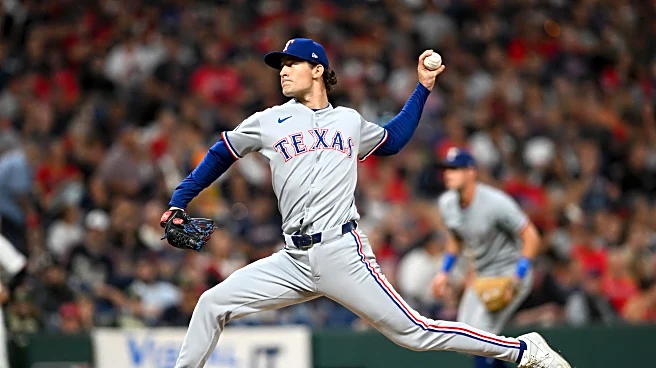
Today we are looking at pitcher Jacob Latz.
The 2017 draft didn’t work out too well for the Texas Rangers.
Texas signed five picks to bonuses of at least $500,000.
First rounder Bubba Thompson got $2.1 million. He was fast and toolsy but didn’t hit. He did spend 109 games in the majors, and stole 27 bases,
and got a ring because he was in the majors in 2023 with Texas. Thompson retired from baseball after the 2024 season, enrolled in South Alabama, and walked onto their football team as a quarterback. He was on the roster in 2025 but didn’t appear in a game, and transferred in January to West Florida.
Supplemental first rounder Chris Seise got $2 million. He impressed with his ability and makeup, and was considered at one point possibly the team’s best position prospect, but injuries and the pandemic meant he only played in 31 games from 2018-21, and he has been out of baseball since putting up a 591 OPS for Frisco in 2023.
Second rounder Hans Crouse got $1.45 million. After an impressive 2018 season he was appearing on top 100 lists, but he regressed, was traded to the Phillies in the Kyle Gibson/Spencer Howard deal, had a decent run for the Angels in 2024, was released by the Angels after 2 AAA appearances in 2025, and didn’t sign with another team until January of 2026, when he inked a minor league deal with the Orioles.
Third rounder Matt Whatley got $517,100. He got good marks for his makeup and glove, but didn’t hit. He became a minor league free agent after 2023, re-signed with Texas for the 2024 season, then signed with Toronto for 2025. Toronto released him in May, 2025, without him ever appearing in a game for their organization, and it appears he is out of baseball.
11th rounder Obie Ricumstrict got $500,000. He never hit and was released in 2022.
So the big dollar draft picks from 2017 didn’t pan out.
The Rangers did end up hitting on a couple of pitchers they selected that year, though.
One of them was John King, who got $10,000 as an injured 10th round senior sign out of the University of Houston. King pitched for the Rangers from 2020-23, then was traded to St. Louis as part of the Jordan Montgomery trade in 2023, so like Thompson, King got a World Series ring. He signed with the Miami Marlins this offseason, and made their Opening Day roster out of the bullpen, and will be out in the pen with fellow former Rangers Pete Fairbanks and Tyler Phillips, and teammates with Liam Hicks and Heriberto Hernandez.
The other was Jacob Latz, who got $386,100 as a fifth rounder out of Kent State. Well, kind of out of Kent State…King spent his first two seasons at LSU, redshirting his freshman season due to elbow surgery and pitching only 8.1 innings in 2016. He wasn’t eligible to pitch for Kent State as a junior, but showed enough in side work that the Rangers drafted him and gave him slot money*.
* I am assuming that was slot money for a fifth rounder in 2017. If not, it is close. I’m not going to go look it up.
Latz made his major league debut in 2021 without actually being on the 40 man roster, as he was a COVID replacement call up. He was added to the 40 man late in 2023, made three appearances in September, and earned himself a ring.
After doing good work in the major league pen in 2024, he started 2025 in AAA, but was called up in mid-April, and stayed in the bigs until the numbers game with the trade acquisitions resulted in his being sent down on August 1. He returned in mid-August and stuck around the rest of the season.
Latz had a rather interesting 2025 campaign for the Rangers. Used out of the bullpen early in the year, the team had him make a few spot starts in the middle of the season, and he acquitted himself well. Texas plugged him back into the rotation in late August during the Injurypocalypse, and he made four more respectable starts, went back to the pen for a couple of outings, and then started once more, in the next to last game of the season.
Latz is a four pitch pitcher, throwing his fastball half the time, his change and slider each a little over 20% of the time, and his curveball the rest of the time. His fastball and slider were both were his best pitches.
Latz’s fastball has average velocity, but it plays up due to his extension and vertical movement. Interestingly, Latz’s fastball showed three more inches of armside run in 2025 compared to 2024, going from having below-average horizontal movement on the pitch to above-average horizontal movement. His heat map shows he consistently located the fastball at the top of the zone.
Latz’s slider was his best pitch in 2025, as he allowed a .244 wOBA and .260 xwOBA against it. As one would expect, he threw the slider to lefties much more frequently than righties, but had success against both sides with it.
The changeup was Latz’s weakest pitch. As one would expect, he threw it mostly against righthanders, and generated a 41% whiff rate with it. When batters made contact, however, they hit it hard, resulting in a .362 wOBA and .343 xwOBA on the change.
As one would expect, in light of all that, Latz showed significant platoon splits in 2025. Righthanded hitters hit .250/.338/.382 against him, while lefties hit .170/.239/.302 off of him.
What is notable, though, is that the x-numbers on the splits are much closer than the raw numbers. Righthanders had a .316 wOBA and .318 xwOBA against Latz, while lefties had a .240 wOBA and .309 xwOBA against him. Latz also showed a sizeable split between actual and xwOBA against lefties in 2024, with a wOBA of .303 and an xwOBA of .339.
Latz is a fly ball pitcher who strikes out an average number of hitters and issues an above-average number of walks — his 10.6 walk rate in 2025 put him in the 15th percentile, per Statcast. While one would expect, given that, that Latz’s success is driven by avoiding hard contact, he actually is below average in that regard (31st percentile), although he did avoid barrels.
One would think that, given those peripherals, Latz would have especially benefitted from the Shed’s pitcher-friendly tendencies in 2025. Latz did have a superior ERA at home (2.23) as compared to the road (3.28), but he actually allowed a higher OPS at home (683) than on the road (642), with his slugging allowed being 38 points higher at home, which undercuts that theory.
Given all that, it is not surprising that Latz shows a big spread between his actual ERA in 2025 (2.84) and his FIP (3.72) and xERA (4.11). He benefited from both a .272 BABIP and an 81.1% strand rate, and, I suspect, the stellar outfield defense that he had behind him.
All this makes it hard to figure out what to expect from Latz going forward. He turns 30 in April, but also still has two options remaining, which gives the Rangers some flexibility. He didn’t make the rotation out of spring training, and is probably best suited for a role that allows the Rangers to take advantage of that versatility, spotting him against lefties sometimes, using him in a multi-inning role sometimes, and having him make the occasional spot start when needed.
Previously: