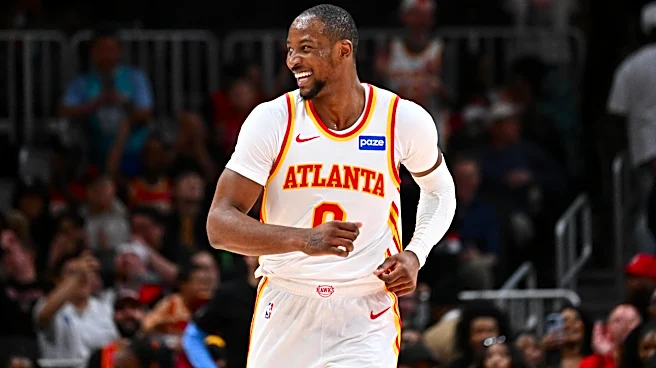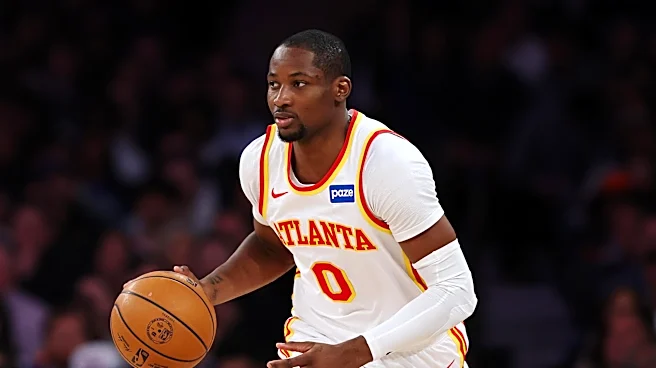








The Lakers’ interest in landing Jonathan Kuminga this offseason is one of the worst-kept secrets in the NBA. On Friday, Jake Fischer of The Stein Line provided additional context as to where things stand with that.
“It’s believed that the Lakers hope to package their lone tradeable first-round pick swap left over in 2032 along with Jarred Vanderbilt in a sign-and-trade proposal for Kuminga. Sources say Atlanta, however, has not considered taking back Vanderbilt in a deal that sends out Kuminga.
“There
are said to be multi-team scenarios that the Lakers could pursue that offload Vanderbilt to a different team than Atlanta. That would help the Lakers provide Kuminga with an offer richer than the two-year, $20 million deal that sources say they originally presented him.”
We recently explored how trading Vanderbilt or waiving him and stretching his dead cap hit over the next five years could give the Lakers enough cap space to sign Kuminga to a deal of that size. Fischer added that Kuminga “would naturally be hoping for a richer deal than that,” but he is “open to various contract structures below his 2025-26 season salary of $22.5 million depending on what sort of sign-and-trade scenarios materialize.”
He concluded by saying, “The most clarity that can be offered on Kuminga’s future: If he indeed leaves Atlanta, it is almost certainly going to be via sign-and-trade rather than a move facilitated by cap space.”
So, let’s explore what that might look like for the Lakers.
How a Kuminga sign-and-trade could work
If the Lakers did acquire Kuminga via sign-and-trade, his contract would need to be at least three years (excluding any team/player options), although only the first season would need to be fully guaranteed. They would have to complete the sign-and-trade prior to the start of the regular season, too.
If the Lakers manage to salary-dump Vanderbilt separate from a Kuminga sign-and-trade, they’d have roughly $13.4 million of cap space left for Kuminga. That would top out at a three-year, $42.3 million contract or a four-year, $57.7 million deal.
But if the Lakers can convince Atlanta or a third team to take Vanderbilt as part of a Kuminga sign-and-trade, they could use an expanded trade exception to offer Kuminga even more.
Teams above the first and second apron can’t take back more salary than they send out in a trade, but teams below the first apron can. For instance, if the Lakers salary-dumped either Jaden Hardy or Jake LaRavia’s $6 million contracts, they could take back 200 percent of that salary, plus $250,000, or $12.25 million in total.
If they salary-dumped Vanderbilt, they’d be allowed to receive roughly $9.1 million more in salary than they were sending out, which would equate to around $21.5 million. If the Lakers were willing to go that far for Kuminga, his three-year deal could be as high as $67.8 million, and a four-year deal could be $92.5 million.
However, the Lakers need to remain mindful of the first apron as well. They’re already hard-capped there after acquiring Walker Kessler via sign-and-trade, which means they cannot have more than $209.015 million in salary on their books at any point between now and June 30, 2027.
If the Lakers salary-dumped Vanderbilt and gave Kuminga the most they could via the expanded trade exception ($21.5 million), their payroll would be up to roughly $205.2 million once they officially signed Austin Reaves, Collin Sexton and Kevon Looney. They’d have 14 players under contract, so they’d still have enough wiggle room under the first apron for one veteran-minimum deal ($2.45 million), but they wouldn’t have much in-season trade flexibility. They’d be roughly $1.35 million below the first apron if they filled that 15th roster spot with a minimum contract before the season started.
The Lakers are otherwise out of salary-cap exceptions after spending the room mid-level exception on Sexton, so they might not mind getting that close to the first apron. But they do need to keep their hard cap in mind as they negotiate with Kuminga and the Hawks on sign-and-trade permutations.
If the Lakers can find a taker for Vanderbilt, the expanded traded player exception grants them plenty of flexibility to give Kuminga more than the two-year, $20 million deal that they’ve already reportedly offered. The main questions are where they could dump Vando, how much it would cost to offload him, how close they’re willing to get to the hard cap, and how many years they’re willing to guarantee on Kuminga’s contract if they do acquire him via sign-and-trade.
Unless otherwise noted, all stats via NBA.com, PBPStats, Cleaning the Glass or Basketball Reference. All salary information via Spotrac and salary-cap information via RealGM.
Follow Bryan on Bluesky.