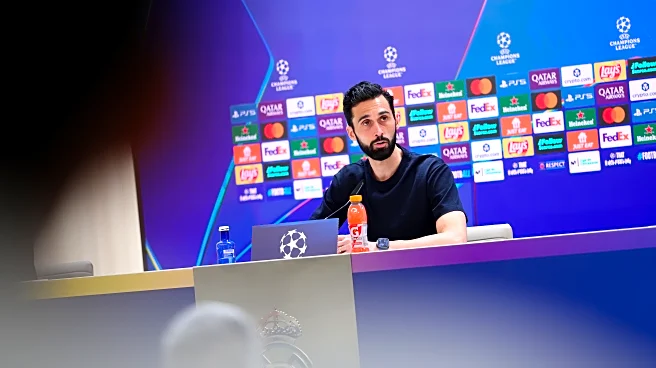

Alvaro Arbeloa has now managed Real Madrid in 10 games in LaLiga and the UEFA Champions League. His predecessor, Xabi Alonso, was at the helm for 25 games in these two competitions. While Real Madrid’s form may not have taken a drastic leap, there is a change in mood in the dressing room, especially amongst some of the leaders, such as Vinicius Jr. and Fede Valverde.
On the pitch, however, how different is the team playing under Arbeloa, compared to Xabi Alonso? Alternatively, how are they similar?
Crosses & Long Balls
The numbers here are remarkably close on the surface. Arbeloa: 1.2 crosses attempted, 0.3 completed, and 2.5 progressive long balls attempted, 1.0 completed per 90. Xabi: 1.2 crosses, 0.3 completed, and 2.6 long balls, 1.1 completed. The per-90 numbers are essentially identical — both managers use the long ball as a vertical progression tool and are not a crossing-heavy side. The long ball spread under Arbeloa also feels slightly less directionally varied — more mid-to-forward range — whereas Xabi’s long balls cover a wider range of angles and start positions.


Defensive Line
This is derived from the average positions of Real Madrid’s center-backs and full-backs under both managers. Xabi’s line sits at 44.6%, Arbeloa’s at 43.2% of the defensive height— Arbeloa is actually defending deeper. Both are mid to low-block systems. It must be noted that after the October Clasico, Xabi Alonso was no longer the same manager; he had to practically bid farewell to this high-press system altogether.


Team-level Pass Receptions
This is one of the most striking similarities in the entire dataset. The zone-by-zone breakdown for both managers is almost a mirror image — central attacking zone 11% vs. 11%, central midfield areas 10%/10% each side, left side of the box 8% under Xabi vs. 7% under Arbeloa. Whatever personnel changes or tactical tweaks Arbeloa brought, the overall build-up structure and where the team receives passes collectively have remained consistent.


Vini Jr.
Under Xabi, Vini’s dominant zone was the left inside channel at 26%, with the top-left zones contributing 13% and 15%. Under Arbeloa, the dominant zone is still the left inside channel, but at 22%, with the zone above it at 19% and 13%. The profile is essentially the same inverted-winger shape, but Arbeloa’s Vini receives slightly more in the left wide-top zone (19% vs. 13%), suggesting he’s being fed earlier or wider before he can drive inside.


Fede Valverde
Under Xabi, Valverde’s heaviest reception zone was the right central area at 15% – he played a lot of games as a full-back. Under Arbeloa, the map is far more spread across the lower half of the pitch — the two dominant zones are the lower-right central areas (12% each) and the central midfield horizontal band (9-12%).


(Xabi Alonso dataset – August 15, 2025, to January 12 – LaLiga and Champions League, Arbeloa dataset – January 13, 2026, to February 28, 2026, raw data from Opta, visualizations by @mhassanfootball)