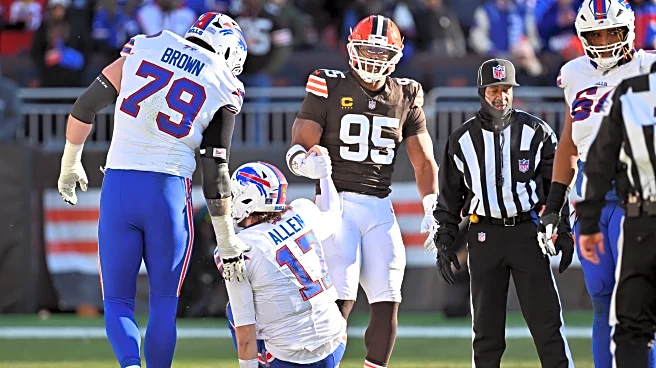

The Buffalo Bills squeaked out a win over the lowly Cleveland Browns, with mistakes marring the matchup. Some of those mistakes came in the form of flags but for these gaffes there wasn’t much impact on
the game, which is good news for Buffalo. They couldn’t really afford anything more going wrong.
They also did me the favor of making things really easy this week for analysis, so that’s cool too. Let’s take a look!
Standard and Advanced Metrics
Penalty Counts

Our first chart of the day is a mirror match with both teams have the exact same number of assessed and total flags. Even better, in both measures the two teams are below league average — which is good new for me as it means less data to look at, plays to review, etc. It also helps justify the entire premise of this series, as the mirror match won’t hold on for very long.
Penalty Yards

The left side of the graphic shows the assessed yards, and the case I believe most reasonable people would make on this is that even though there’s a gap between the two teams forming, it’s pretty minor. Based on the traditional metrics, you would conclude the two teams had a very even day.
The right-hand side is the beginning of the advanced stats. In this case, we add yards negated or otherwise impacted by penalties. I say “otherwise impacted” because in Buffalo’s case only one penalty impacted yards in addition to assessed, and it’s the rare instance of a negative outcome. I’ll point it out below. Furthermore, the Browns had more yards impacted than assessed, making a gigantic gap between the two teams in this measure.
Penalty Harm
Cleveland Browns

I won’t spend much time dissecting the Browns’ penalties because as is tradition, opponent flags are always deserved because they’re wicked, awful beings who deserve all these and more. Most of these are pretty ho-hum to be fair.
Offensive tackle KT Leveston Jr. had a rough day, accounting for three of the six flags. The two false starts were the yards only, of course. The offensive holding was the usual 10 yards but also wiped out a five-yard run by quarterback Shedeur Sanders.
Speaking of Sanders, I don’t believe I need to discuss the intentional grounding flag except for the formula. The flag cost the Browns 14 yards and one down. For the formula, if you’re new to this measure in Harm, each yard counts as 0.1 Harm and each down counts as 1.0 Harm.
Center Luke Wypler had the worst flag of the day, with 6.0 Harm. The flag was called for 10 yards but wiped out a 40-yard gain as well as a first down from second, or one down negated. That’s 1.0 + 4.0 + 1.0 = 6.0 Harm. Spoiler alert: This single flag had a greater Harm rating than all the Bills’ flags combined.
The one flag I didn’t mention was the illegal shift by defensive tackle Adin Huntington. Coming on 2nd & 4, the penalty was declined thanks to analytics. The result of the play was an incomplete pass. That left the Bills with 2nd & 9 (accepting the flag), or 3rd & 4. The Bills preferred 3rd & 4. That gave the Browns one shot to gain four yards. Accepting the flag gave them downs that needed to average 4.5 yards each. While technically the average gain needed is higher by accepting the flag, the volatility of having to defend two plays rather than one means the down is pretty important.
The Cleveland Browns accumulated 10.9 Harm total, which is a tick above our bad-day threshold but nothing crazy.
Buffalo Bills

The Buffalo Bills had a total of 5.8 Harm, easily under the bad-day cutoff. The Bills had very minor infractions overall. The offside call on defensive tackle T.J. Sanders was declined. Kicker Michael Badgley’s flag for kicking short of the landing zone put the ball on the 40 rather than the touchback line of 35 for a shift of five yards. Defensive back Jordan Hancock’s face mask call was on special teams and yards only. That gives us three to talk about.
Linebacker Matt Milano’s tripping flag was 15 yards assessed but came on third down, giving Cleveland two free downs.
The defensive holding by defensive end A.J. Epenesa was our oddball “negative” impacted yards. The Browns had gained two yards on the play, which were negated when they decided wisely that five free yards is better than two earned. It was a net gain of three yards for 0.3 Harm.
Last but not least is the false start on left guard David Edwards. Usually I don’t discuss false starts but I have to in this case. It wasn’t declined but still had zero Harm. That’s because this flag occurred when the Bills were essentially already on their own end line after Josh Allen barely avoided being sacked in the end zone. There was nowhere to go, so the official result of the penalty was for zero yards.
I promised that the Bills made it easy on the refs, so here’s proof of that. Half of the flags under the microscope and all three easy calls.