


Several rotational decisions warrant extensive conversations. But for the Washington Wizards, starting point guard isn’t one of them.
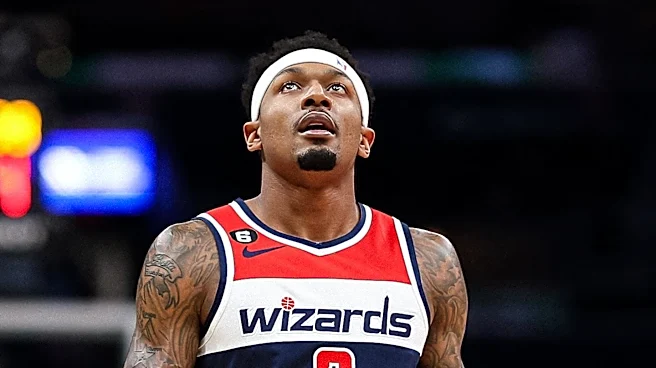
In June, the Wizards signed Trae Young to a four-year, $212 million contract extension to serve as their starting PG for the 2026-27 season and beyond. He’s the team’s best distributor since Russell Westbrook. And they paid him like it.
Who backs Young up is the real question.
Will head coach Brian Keefe side with more traditional point guards like Bub Carrington or Tre
Mann? Could Kyshawn George or Will Riley play a point-forward role?
Below, we examine the point guard position, with statistics and analysis of each option Keefe must weigh as training camp approaches.
The starter
As mentioned above, Young is the clear choice here. And for good reason.
The 28-year-old is a four-time NBA All-Star who’s just one season removed from a league-best 11.6 assists per game. His career 9.8 assists per game ranks third all-time behind John Stockton (10.5) and Magic Johnson (11.2). That’s pretty good company.
An MCL sprain, a quad contusion and back irritation held Young to just five games after a January trade sent him to Washington for Corey Kispert and CJ McCollum. He averaged 15.2 points and 6.2 assists while shooting 59.5% from the field and 42.9% from 3-point range.
The Wizards’ 109.7 offensive rating ranked 29th last season. In just five games with Young, that figure rose to 114.2, tied for 18th best in the league.
Players like Bilal Coulibaly, a career 31% 3-point shooter, saw a spike in their efficiency thanks to the gravity and court vision Young brings. Coulibaly shot 41.4% (12-29) from 3-point range during that stretch.
Washington’s offense will run through Young, whose on-ball percentage peaked at 51.9% in 2021 and hadn’t dipped below 45% until last season. Furthermore, Young had a stretch from 2020-2025 in which he created more than 47 points per game, a figure that each year ranked in the 96th percentile or better among guards.
While the 6-foot-2 guard possesses elite PG tools, his defense was a primary reason Atlanta shopped him to the highest bidder. The stats tell the story.
Atlanta went from one of the league’s worst defenses (122.0 defensive rating) to a top-10 unit (112.9 defensive rating) after Young’s departure. Apart from contract concerns, the Hawks ran out of patience on the defensive end.
Washington believes surrounding Young with size and impactful individual defenders can mitigate his past defensive struggles. A frontcourt of Alex Sarr and Anthony Davis alongside perimeter defenders like Coulibaly and Kyshawn George is a good start.
Who backs up Young?
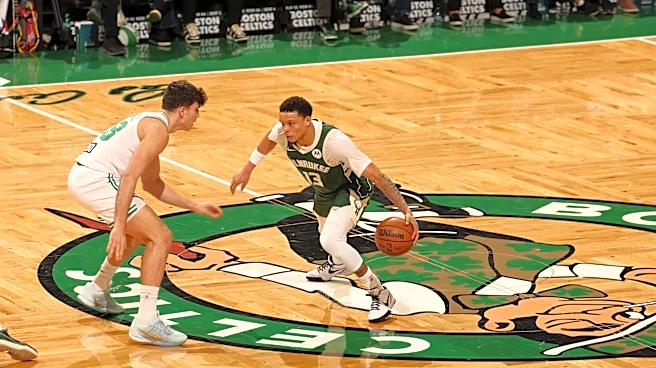
Carrington vs. Mann
This is where the conversation gets interesting because, on a roster filled with depth, Keefe must decide if development trumps winning.
A traditional battle centers around Carrington and Mann — two combo guards who’ve each played their fair share of NBA point guard.
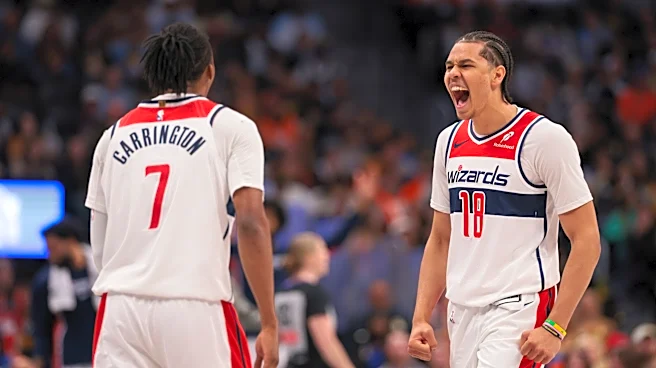
Carrington, Washington’s No. 14 selection in the 2024 draft, was named the team’s opening-night starter before early struggles brought him to the bench just five games in. His inability to get two feet in the paint and break down defenses led to high turnover numbers (2.5 per game as a starter) and an inefficient Wizards offense.
But it wasn’t all bad for Carrington, who shot an impressive 40.8% from three on five attempts per contest. He also averaged nearly 11 points and five assists, which is a solid offensive season for a 20-year-old guard.
While Carrington’s court vision and decision-making require improvement, defense remains his greatest flaw. The Pitt product’s 125.7 defensive rating ranked dead last among qualified players last season, as did his -746 plus-minus rating.
Those numbers are inflated due to Washington’s rebuilding philosophy and Carrington once again playing in all 82 games. But his defense certainly needs to improve if he’s tabbed as the team’s backup PG.
Mann isn’t much different than his counterpart. If anything, his numbers indicate he’s a less efficient version of Carrington whose 32.3% clip on threes, 39% rate on twos and 1.6-to-1.0 assist-to-turnover ratio are those of a rather poor offensive player.
A point-forward in D.C.?
Forwards, now more than ever, are capable point guards.
Think LeBron James, Ben Simmons, Luka Doncic and other 6-foot-7 and taller forwards who, over the last decade, have headlined a shift in who qualifies as a point guard.
George (6-foot-8) and Riley (6-foot-9) fit into this realm. And each has proven worthy of minutes at the position.
Tasked with heavy on-ball minutes last season, George produced 4.5 assists and created 25 points per game. His ability to see over opposing defenses helped him navigate screens and find open shooters or rollers for easy buckets.
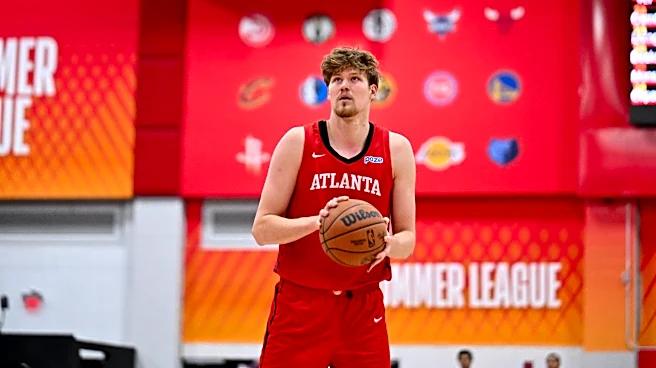
Riley showcased similar skills across the final 30 games of last season and two 2026 Las Vegas Summer League contests. Considering the Wizards’ battle for minutes, allowing George or Riley to run the second unit might be Keefe’s best option to get his nine or 10 best players on the floor every night.
If Young, Coulibaly, AJ Dybantsa, Davis and Sarr are the team’s starters, and Tre Johnson, Justin Champagnie and Deandre Ayton come off the bench, that leaves two openings between George, Riley and Carrington.
Does Washington fill those spots with the most deserving players, even if it means using a point-guard-by-committee approach during the non-Young minutes? Or do they task a more experienced guard to handle those responsibilities?
The decision rests with Keefe, with the season less than a month away.