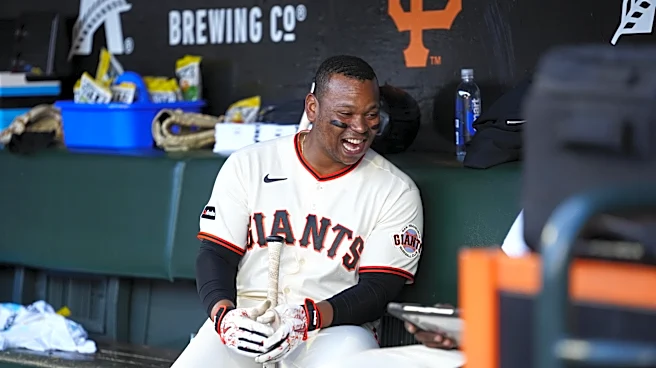




On Monday, I suggested that the team’s pitching woes were the fifth-most important story of this historically bad 2026 season and yesterday I handed some flowers to Bryce Eldridge and the Giants’ player development pipeline as a meaningful positive story, but today is all about being petty. Yes, I think the third-most important story of this 2026 season was Rafael Devers making all the losers and the haters eat crow, suck it long and suck it hard, and burnish in people’s mind that he is That Dude.
He nearly tied his career high in homers (38) with 37 through 148 games and 633 plate appearances. His 136 wRC+ was exactly what he put up last season between Boston and San Francisco. He has been 36% better than the league average for 3 years now, and his 3.5 fWAR also matches basically what he’s always been: a 3.5-4-WAR player. And that’s basically as a DH and not dreadful first baseman. Despite needing season-ending surgery, he was still the 14th-best hitter in baseball, in the same bunch as Bryce Harper and Riley Greene. He was on a 40-homer pace and finished 9th in MLB with those 37. He was the first Giant in 5 years to have 90+ RBI (he ended the year with 98).
So, I can’t myself among those losers he mashed in the face of. What was I thinking when I wrote this?
[…] Devers is definitely experiencing a physical decline of some sort (he’s not hitting the ball as hard), but the decline from a good player to a practically useless one appears to be entirely self-engineered. It’s unlikely that a 29-year old goes out like this based on aging alone. But, as Buster Posey is fond of saying, baseball is hard.
The situation isn’t hopeless, especially since Devers wound up having a good year after a rough time following the trade last year. It’s just that nothing the Giants have done this year and most of the last decade should give anyone hope for a better future.
Well, okay. There it is. Misery is contagious. Because the Giants had been such a bummer, I simply mapped those vibes onto Devers’ season to that point and on the occasion of the 1-year anniversary of his acquisition: .235/.293/.413, 7.5 BB%, 30.3 K%, 9 HR, 33 RBI (94 wRC+).
And, nope, he was hurt! Not a physical decline! He also had a fantastic post-trade 2025 with the Giants and wound up playing in 163 games. I, and many others across the sport, let a bad start to the year confirm some statistical suspicions. Everyone’s been trying to predict his downfall and all because the Red Sox signed him to a long-term deal and then came to regret it when they viewed his AAV as being too cumbersome to manage under their self-imposed salary cap upon the realization that they needed more money to cover holes they didn’t realize were there.
But I was just a loser. I was never a hater. Just disappointed that this was another Giants move that didn’t seem to be working out in a season that already promised to be extremely painful. These were the haters:
One Year Later, the Rafael Devers Blockbuster Doesn’t Look So Great
The Giants’ Long-Term Contracts Are Becoming A Big Problem
Rafael Devers has already become the worst contract in baseball
Nearly one year after his controversial trade, Rafael Devers is now the 3rd worst player in MLB
Giant problems: How the 2026 season has gone off the rails for Rafael Devers, Buster Posey and San Francisco
The Red Sox made the right move by trading the overrated manchild that is Rafael Devers — It has only been one year, but Rafael Devers is already wearing out his welcome in San Francisco
Inside the Giants’ tailspin: Everything that’s gone wrong since the Rafael Devers trade
And here are some more in the hours following the trade (in case you needed a refresher).
Sure, less than a week after the 1-year anniversary there was a major public dispute between he and Tony Vitello which necessitated an apology, but that was a part of the larger story of Tony’s Terrible Start. I never accepted the Boston message that he was a clubhouse cancer, mainly because it was coming from Boston.
Grant Brisbee did a deep dive that offered up a pretty simple explanation:
Devers missed most of spring training, and when he returned, he faced pitchers who threw much harder than when he was a rookie. They pumped fastballs by him at the letters, which has always been the way to pitch him, but he was so concerned with them that he was whiffing on pitches down the middle. Devers wasn’t walking, so pitchers could expand the zone and get him to chase. He couldn’t get in a rhythm.
[…]
I don’t think it’s an accident that the nadir of Devers’ season in terms of OPS was April 30 (.537). It fits with the image of a player taking a deep breath and starting over. April couldn’t hurt him anymore. He immediately started an eight-game hitting streak, and while nothing can really hint at the kind of tear Devers has been on lately, he’s been the same hitter as always, which is pretty good indeed.
The tear he’s referencing is .275/.367/.588 (.955) from May 1st through September 7th. He was the third-best hitter in baseball (159 wRC+), trailing only Pete Crow-Armstrong (177) and Yordan Alvarez (166). When the smoke settled on the season, his average exit velocity of 93 mph was in the top 4% of MLB and his 51.6% Hard Hit rate was top 6%.
Folks, this elite hitter continued to be an elite hitter.
So, why is this such a big story deserving of the #3 spot of this top 5? It changes the narrative for many aspects of the Giants.
- They can pull off a big trade — they might have even won it
- Power hitters can hit for power at Oracle Park (19 HR, .533 slug at Oracle, 18 HR, .517 slug away)
- The Giants’ lineup really was just one big bopper away from being well above average — during this Devers hot streak, the Giants as a team were 10th in MLB (103 wRC+)
- Buster Posey is not completely ignorant about running a baseball operation
It’s very important to create some organizational certainty. Knowing that the middle of the order is basically set for the next couple of years is a very good thing. It makes it easier to build a lineup and it takes the pressure off, say, Bryce Eldridge to be the 40-home run guy. Not many lineups have 35-40% better than the league average hitters in them.
“Why don’t we just get good players” is a simple enough idea, but the reason why not every team does it is for the same reason why a lot of firms shy away from the seemingly obvious move: consequences. What if the obvious move doesn’t work out? If it were so obvious a move, why hadn’t somebody done it before? Doesn’t that indicate a huge downside? Well, sure. Devers’ contract could be a huge weight around the team’s next in a few years, but what really compounds it are the Adames and Chapman deals. I think Buster Posey made the move ignoring that for the enormous upside: what if we get one of the best hitters in baseball into our lineup?
The main reason why there was so much blowback from non-Giants fans is because most internet people are trying to get jobs in front offices and the best way to post into that position is to emphasize surplus value. The rest of the noise was Boston media-generated. At the end of the day, if the Giants think 3-4 years of Devers bringing 40+ home run power into Oracle Park is worth the obvious downside of the final 4 years then I don’t really see what the problem is; the Giants might need a flawed profile like him more than the Boston Red Sox, but they probably could’ve used a hitter like him in 2026, when their offense was below league average (99 wRC+).
It’s easy to forget that these professional athletes have a bare minimum of professionalism that gets them into nine-figure deals and they don’t necessarily need revenge as a motivator to rebalance themselves after a stumble — but my goodness, it’s nice to think that Rafael Devers’ season got better exponentially as he silenced his critics one after another with every clout and multi-hit game. The Giants might’ve had a bad season that put them on a course for oblivion, but not Rafael Devers. He had a great one, and if the Giants have nothing else, at least they have him.