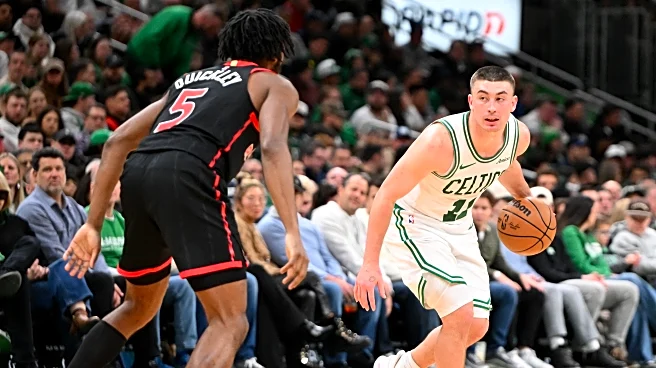

BOSTON — Payton Pritchard finished Friday’s Celtics win against the Toronto Raptors with an impressive statline: 27 points (12-19 FG), 8 assists — and just a single turnover.
The scoring is noteworthy; Pritchard has had some quieter offensive nights this year, and he’s only tallied at least 27 points six times this season (whether ‘only’ is even a fair qualifier there is debatable). He began the season in a shooting slump — shooting 17.4% from three in October — and still hasn’t found a consistent
groove from the outside, despite outside shooting being one of the biggest strengths of his game.
But the part of the stat line that’s almost become the norm is Pritchard’s assist-to-turnover ratio: tallying 8 assists and just 1 turnover has allowed Pritchard to become a starting guard in the NBA. Even through early-season shooting struggles, the Celtics guard has always been consistent in one area: taking care of the ball.
Pritchard has the NBA’s best assist-to-turnover ratio (4.53) among players who play at least 20 minutes per game and tally at least 2 assists, and since entering the league, he’s always been near the top of that leaderboard, albeit in smaller samples.
That’s been key to both his — and the Celtics’ — offensive success. The Celtics have the second-most efficient offense in the NBA, and, to Pritchard’s surprise, the single most efficient offense since early December.
That’s the result of a confluence of factors, but Mazzulla would point back to their low turnover rate if he had to pick one.
“The most important thing is valuing the basketball,” said the Celtics head coach. “If you can play the majority of the game, almost guaranteed to get a shot every single time, that is going to help your efficiency. There are so many things that go into that — our spacing, our screening, our ball handling, our execution, our reads, all those things go into making sure you have to get a shot every time.”
As a team, the Celtics average the fewest turnovers per game at 11.9, and have the second-lowest turnover percentage at 12.4%.
“I feel like we just do a good job taking care of the ball,” Pritchard said. “My college coaches would always say, if you’re getting shots on the rim and not turning it over, you’re due for some points.”
Pritchard heads that charge, averaging just 1.2 turnovers per game despite shouldering a lot of the team’s offensive load. Mazzulla attributes that to one deep-rooted habit: an unwavering ability to not pick up his dribble.
“The biggest thing is he knows how to keep his dribble,” Mazzulla said. “That, to me, is the biggest thing. He knows how to keep his dribble. He knows how to get himself out of tough spots. He knows how to make plays. He creates situations. He had a great knack for knowing how to keep his dribble.”
Pritchard said that not turning the ball over is something that has long been ingrained in him, starting from when he played a few grades above his own during youth basketball, and spanning through his time as the freshman point guard at the University of Oregon.
“Growing up, when I played up for my age, and in high school, when I was a freshman and when I was a freshman in college, I wasn’t going to be on the court if I turned the ball over,” he said. “So my job at first was to run the offense, don’t turn it over, and only take open shots. So I learned how to master that.”
Payton Pritchard has also been lethal in the midrange
A big part of Pritchard’s on-court success this season has been his ability to score the ball inside the arc. Though he’s shooting 33.5% from three — far below last year’s — he’s hitting 58.2% of two-point attempts.
Pritchard has shouldered a ton of responsibility in the Celtics’ offense; he’s averaged 16.9 points (third most on the team) and 5.2 assists (second-most behind only Derrick White).
“We’ve leaned on Payton to almost be a go-to guy at times, because he has that ability to break guys down, get into the pain, use his body well — and he’s getting better,” said Jaylen Brown. “I think he’s been in my bag for sure, my midrange bag.”
Pritchard has been particularly lethal from the non-restricted area paint shots; among the 142 players who have attempted more than 50 shots from that zone, Pritchard has been the single most efficient player. He’s hit 63.6% of paint jumpers on 118 attempts, even beating Nikola Jokic’s elite 62.1%, per NBA.com.
“It doesn’t really matter how tall you are, if you have great footwork, great balance, and you know how to use your leverage, and Payton has taken advantage of a lot of situations,” Brown said. “We need him to do that. He’s one of the guys on our team who is capable of that. So anytime I’m on the floor with him, and I see he has a favorable matchup, or I see he’s got it going, I’m looking to kind of get him the ball a little bit to get him going.”
All of it is still a work-in-progress. Nearly every time he addresses the media, Pritchard points out there’s a lot of basketball left to be played this season — and a lot more room for growth, particularly given that it’s his first year as the team’s starting point guard.
“To be honest, I don’t even know if I figured it out fully yet — it’s still a learning process,” he said. “Every game, we’ll just keep growing and growing. How many games [in] are we? 37? It feels like I’ve gotten better from the beginning of the year. But, still more steps to go.”