




Yesterday, I looked at the free agents who might fit the Giants’ lineup and last week I examined the free agent and trade markets for starting pitchers. Today, a far more respected entity, MLB Trade Rumors, offers up a list of potential trade targets for all the teams, pitchers and hitters alike. Right now, the San Francisco Giants have, for the first time in a long time, one of the best farm systems in Major League Baseball. Does that make it the right time to trade prospects for major league upgrades?
Let’s evaluate the list and find out.
The Giants are suggested for five players: 3 hitters, 2 pitchers. The hitters are outfielders and the pitchers are starters. So far, MLB Trade Rumors is on the right track. Yesterday, I noted that the hitting group was pretty thin in the outfield, and that any notable move was likely to make the acquisition the best of the bunch. And, even if we all agree that the entire pitching staff needs to be reworked, grabbing a starting pitcher or two should be the first order of business in that process.
But of this group, only 2 players would be under team control beyond 2027. That’s important because the Giants aren’t one big trade away from being a playoff team, nor should they approach this offseason that way. If they’re going to expend prospect capital — or even somebody from their major league roster (MLBTR offers up four potential trade candidates from the Giants) — it ought to be somebody who will be around for at least a couple of years. There’s no compelling reason to do otherwise.
You’ve probably noticed by now that I haven’t named any of the players mentioned. I didn’t want to cannibalize their work for a post so fresh — although, it’s notable that they listed CJ Abrams as a trade candidate but did not include the Giants as a potentially interested team, even though they tried to trade for him last offseason. But beyond preserving some first 24 hour clicks for MLBTR, I don’t think the names are as important as the idea. Should the Giants trade prospects or major league talent to acquire major league talent that’s nearing the end of team control? The answer has to be no.
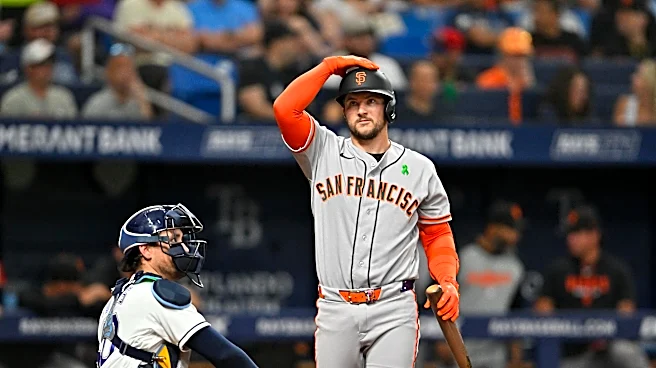
But MLB Trade Rumors’ article does list a Giant. Their rankings try to balance value and likelihood of a deal, and for those reasons, they’ve got Rafael Devers at #19. Now, the Giants made Devers available as recently as three months ago, so this isn’t outlandish. Just yesterday, I celebrated Devers’ season for how it flipped the narrative about him and demonstrated that he’s just a hitter who hits no matter where he is. Their reasoning is fine:
The Giants wouldn’t get much of a prospect return, but this might be their best chance to unload one of their long-term contracts and clear payroll room to spend on pitching or outfield help.
If the money is equal, let’s say, then of the Adames-Chapman-Devers trio he’s the easiest to move. He’s the youngest, the best hitter of the bunch, and plays a position with a more predictable age/decline curve and one that points to a solid performance tale over the length of the contract. But there’s a massive however: in order to make the money equal, the Giants would have to get Adames ($155.7 million) and Devers ($211 million) at least down to what Chapman’s still owed ($100.67 million). MLBTR is in the range of $30-46 million in buydown.
But trading Devers for salary relief is a bad reason to trade Rafael Devers. And at the end of the day, whatever money that will be spent on free agency is likely to go towards paying a premium on players a great farm system could produce for far less of a cost or who will simply be adequate rather than significant improvements. They’re better off trading young hitters for young pitchers… but those are the trades with the highest difficulty.
Maybe the Giants have turned the corner in their player acquisition and development pipeline or maybe they just have a good crop. That’s what time will tell. What is an absolute certainty right now is that the major league roster needs a lot of improvement. So, rather than try to execute the most difficult kind of trade or try to clear massive salaries off the books, why not do the easiest thing and simply add payroll?
The Giants spent an estimated $189.76 million on their major league roster in 2026. They’re currently projected to be around $173.93 million to start next season, about a $15 million difference. They can double that without any trades just by getting out from Harrison Bader’s $13 million (easier said than done, sure, but they’re working on it) and non-tendering a couple of their arbitration guys. Committing to a payroll of $210 million, let’s say, gives them about $52 million to work with. That seems like a perfectly fine amount for a team that’s kicking off a whole new rebuild while not trying to tank. By the way, that’d be more in 1-year spending than the team committed in 2025 ($36 million) and 2026 ($44.95 million).
The final thought in all this is that the second-best use case with a farm system is being able to leverage it to acquire players in trades. They have an “excess” of middle infielders to offer and some intriguing upside pitching prospects, too, but the Giants haven’t had a farm system that just makes their team better in such a long time that it stands to reason letting it play out for that purpose is the best move right now.