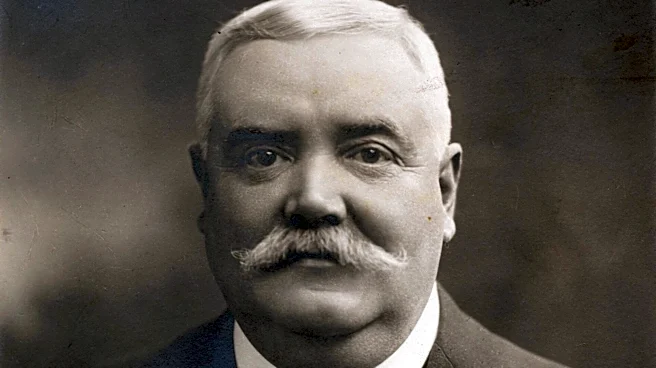









“As a matter of fact, I found him eventually in a pub. He looked distressed and down at heel.
He said to me, ‘Well ye beggor Jack, what’s th’deeing heor hinny’.”
And so began the career of Sunderland’s most successful manager (to date).
The football club that became Sunderland AFC had crept rather than sprung into life in 1879.
The Sunderland and District Teachers Football Club had been formed at a meeting in the British Day School in Norfolk Street by a group of teachers working in the town. James Allan,
a second master at Hendon Boys School, is credited with having a major role in the formation of the club, having played football in his native Scotland.
In 1879 though, football in England was in its infancy and very much played second fiddle to the game we know as Rugby Union, but which at that time was called Rugby Football.
From very humble beginnings the club grew, as the game grew nationally and within the region. The popularity of the game grew to such an extent that on April 17th 1888, the English Football League (EFL) was formed, with the express purpose of organising a regular schedule of fixtures for the best clubs in the country. Prior to this, teams had relied on informal friendlies and cup games.
The twelve founding members of the EFL were all from the Midlands and the North West of England, and the first champions in 1888/89 were Preston North End, who went through the season undefeated and rejoiced in being labelled “The Invincibles”. Only Sunderland beat them that season!
Sunderland (by this point officially named Sunderland Association Football Club) had grown into an affluent entity with the appointment of wealthy backers to the club’s management committee, such as shipbuilders Robert Thompson and James Marr, as well as mine-owner Samuel Tyzack (who became the club’s first ‘proper’ treasurer). With the affluence came ambition, and the management committee had firmly set their sights on a place in the EFL.
It can reasonably be argued that Sunderland’s first game as a professional team was in this first season of the EFL. Blackburn Rovers, who were founder members of the EFL and would finish fourth in the table, were the opposition at the Newcastle Road ground and were beaten 4 – 3 in Sunderland’s first game of the season.
Sunderland also beat EFL teams Bolton Wanderers and Everton at Newcastle Road, who would finish fifth and eighth respectively in the EFL, and towards the end of the season beat champions Preston North End (The Invincibles) and Wolverhampton Wanderers, who finished third in that inaugural EFL season.
These were high-profile victories that thrust the club into the limelight of the EFL’s governing body. Coupled with these results were victories and performances against the best that Scotland could offer at this time, including Third Lanark, Dumbarton, Glasgow Rangers, Greenock Morton and Dundee Harp. There was also a defeat, but by all accounts a good performance in a cracking game at Newcastle Road against the all-conquering Renton.

Sunderland’s proximity to Scotland gave them an ideal opportunity to ‘run the eye’ over some of the best players in Great Britain, as well as learn from these teams north of the border, where generally the game had developed into more of a team-passing game rather than the kick-and-chase style of the English game.
Despite all the positive results and eye-catching performances, there was to be no admission to the EFL in its second season for Sunderland.
The Management Committee addressed the issue of what else they needed to do off the pitch to bolster their position.
John (Jack) Grayston, an original playing member of the team back in 1879, was carrying out the secretarial duties alongside his full-time job of teaching and, as the club and its ambition grew, so did the responsibilities of the post (which were more akin to a hybrid manager – secretary role as we might recognise it today).
Grayston had indicated to the committee that he could not reasonably continue and was charged with identifying the best man for the job. He recommended a Byker lad, Tom Watson, who had been secretary at Newcastle West End and East End.

Watson had helped Newcastle West End secure St James’ Park and made them a force to be reckoned with, often by recruiting players from north of the border.
In December 1887, Watson had organised for St James’ Park to be loaned to Shankhouse (Cramlington) for an FA Cup tie with Aston Villa. A massive crowd had turned up, causing major concern for spectator safety that the club seemed unprepared for. Watson resigned over the incident, though he did take up a similar post with Newcastle East End in the 1888/89 season.
Jack Grayston was personally acquainted with Tom Watson, having got to know him through their respective roles with their clubs. He had a high regard for him and knew that, at this point in time, he was unemployed.
What happened next was retold in a series of articles published in The Sunderland Weekly News in 1931, written by Jack Grayston (then aged 69).
“The chairman gave me £10 to fit him (Watson) out and bring him across to our committee meeting, to be held that night. I went to Newcastle, got to his house and found him out. As a matter of fact, I found him eventually in a pub. He looked distressed and down at heel. A friend had invited him in to liven him up.
His first salutation was, ‘Well ye beggor Jack, what’s th’deeing heor hinny?’
‘Come on Tom, I have a job for ye,’ said I.
‘He’s tha lad, I’se cummin,’ he replied.
I fitted him out with a new suit etc. He duly presented himself at Ellerslie Terrace (the club’s HQ) and got the job at £150-a-year…”
(Though there is some doubt about the £150-a-year salary, which may have been closer to thirty-five shillings per week – £1.75 in new money!)
The club also found Watson a house to live in on Warwick Road, which was very close to the Newcastle Road ground (and for those who might not be aware, the site of the current Stadium of Light).
Even allowing for the passage of time and dimming memory, it is clear that Jack Grayston not only played some part in helping get Sunderland up and running but also, as club historian Rob Mason neatly put it in his fine tome The Definitive History of Sunderland AFC:
“In recommending Watson, Grayston was responsible for one of the finest pieces of recruitment in SAFC’s history.”
His first season in charge saw a number of high-profile victories and performances against EFL teams including Bolton, Preston, Wolves, Everton and Notts County. They also beat Aston Villa at Newcastle Road, winning 7 – 2 in a game that prompted Villa director and EFL founder William McGregor to remark that Sunderland had “a talented man in every position”.
Thus the label “The Team of All Talents” was born.
Watson had embarked on an aggressive recruitment of players from Scotland, including such stars as Johnny Campbell, John Harvie, Davey Hannah, Hugh ‘Lalty’ Wilson, Jaimie Millar, Ted Doig, Donald Gow, James Hannah, James Gillespie, Peter Meechan, Andrew McCreadie, Harry Johnston and Robert McNeill during his six years managing the club.
His scouting trips north of the border saw him often accompanied by Sunderland treasurer Samuel Tyzack, and they became a highly efficient team, scouring Scotland for all the best talent it had to offer.
They became so good at “reiving” this talent that they were not always welcomed at clubs and indeed were made quite unwelcome when identified. Rumour has it that Samuel Tyzack would often don the collar of the clergy to throw any would-be aggressor off the scent of their presence!
Tom Watson managed Sunderland from June 1889 to his last game on April 11th 1896.
In his time as manager the club won the EFL Championship in 1891/92, 1892/93 and 1894/95. They also finished runners-up in 1893/94.
The 1894/95 season not only brought the league championship, but they also became World Champions!
It is fair to say that at this time only Scotland and England were playing football as we might know it to any reasonable degree of competence. In previous years the cup winners in Scotland and England had met. This was the very first time the league winners in each country would contest this World Championship Challenge Match.
Sunderland won a thrilling match against Hearts at Tynecastle Park by five goals to three.
All twenty-one players who took the field were Scottish. Every Sunderland player had been recruited by Tom Watson.
Whilst his tenure as manager saw three league titles in six years, the lack of an FA Cup trophy may have been a source of regret to Watson. He guided the team to three semi-finals, the first of these in their very first season in the EFL, going out after a replay to Notts County.
Sunderland lost the other two semi-finals to Aston Villa, their great rivals over this period, who went on to win the trophy on each occasion.
A fifth-place finish in Tom Watson’s final season brought his tenure to a close, as the team remained unbeaten at Newcastle Road all season.
Watson had been approached by Liverpool, who had offered to double his salary by all accounts following their promotion to Division One of the EFL.
After some consideration, Watson agreed to the move and went on to become Liverpool’s longest-serving manager, guiding them to league titles in 1900/01 and 1905/06. In doing so, he became the first manager to lead two different clubs to the league championship.
He also took Liverpool to their first FA Cup Final in 1914, losing 1 – 0 to Burnley.
Tom Watson passed away in April 1915 at the age of fifty-six, having contracted pneumonia on a trip home to Newcastle to celebrate his birthday.
In a postscript to his death, for many years he remained in an unmarked grave in Anfield Cemetery. In a joint effort by historians and officials from both Liverpool and Sunderland, with club historian Rob Mason as the driving force, funds were secured for a headstone in 2015 to suitably mark the resting place of a manager who, to this day, remains Sunderland’s most successful manager, as well as a legendary Liverpool figure.
We will leave the last words to Jack Grayston from his Grayston Memoirs in 1931:
“I know valedictory addresses are often magnified, but I say this in all sincerity and truth: that he was a magnificent secretary. He could rule his team with kindness and firmness, and always made himself the chum of the rank and file, who looked upon him as a brother.”