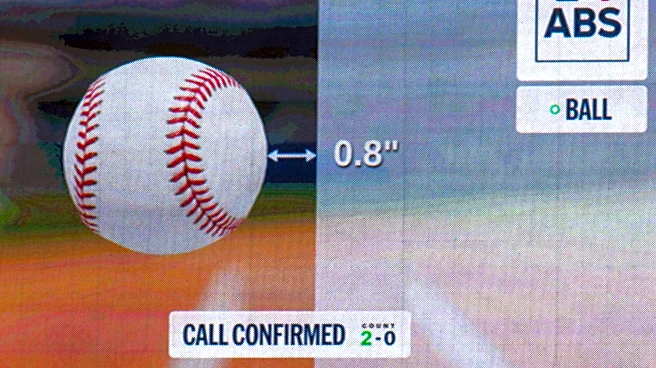



As I was recapping Saturday’s extra-inning loss to the Reds, my thoughts and emotions ran the gamut when it came to ABS, umpiring, and the intersection of the two. I touched on a few of those in the recap itself, but the broad outlines were this:
- The ABS system (officially, the Automated Ball-Strike Challenge System) brought a level of fairness back to the game, in that some clear mistakes were overturned
- The home-plate umpiring on Saturday was awful and a challenge system overall goes some way toward ameliorating that, when it happens
- There was heightened drama in the game, and it didn’t all stem from Wilyer Abreu’s two-out, ninth-inning heroics, or the intensity of extra innings
I had some other thoughts about ABS that I didn’t include in the game recap because it felt just a little out of scope for that format. Keeping in mind that this Red Sox season is still getting off the ground, so the sample size is currently miniscule, here’s
me poking around this topic a little bit more.
Pros

CB Bucknor, the home plate umpire for Saturday’s game, was not on point in any way, shape, or form. He simply didn’t have it. It is objectively true that his ball-strike calls were off the mark, proven by six challenges (out of eight total) that overturned his initial call. (He was also far from on-point, but within his rights, in his missed check swing call on Trevor Story. Let’s come back to that.)
Eugenio Suárez struck out twice in the sixth inning with two outs and the bases loaded, on called strikes and on successive pitches. (What a weird sentence to write, but it is factually correct. We live in strange times, my friends.) Suárez challenged the call each time and prevailed. This was way more exciting, and important, than Roman Anthony using up the remaining Red Sox challenges in the first at-bat of the third inning, when the stakes were low. Ultimately, the Suárez reversals didn’t matter because the Sox retired him anyway, but it restored to the Reds their rightful opportunity to proceed with the inning and hopefully capitalize.
This is important and is certainly the point of the whole ABS system.
Something I wasn’t expecting was the additional excitement the challenges added. You could see and hear the crowd’s reaction when the result of each Suárez challenge was revealed. They went wild. The cheer that went up was as loud as if he had hit a home run. It was a high-stakes moment, as discussed, and Suárez is a batter who can turn on the power, so anything seemed possible. And for it to happen twice! Unprecedented.
In-game excitement, yes, count me in. Is it also possible that some of the fun comes from rebelling against authority in some small, albeit sanctioned, way? For me, I think that might be true; I felt it also when Roman Anthony won his initial challenge. In a world where computer programs monitor my keystrokes to let coworkers know that I’m not actively tapping away at the keyboard…where cameras track my nearly every movement, through my neighborhood, my city, my workplace…where Rob Manfred, Sam Kennedy, John Henry and more are trying to get more money from me while investing increasingly fewer resources of their own, generally speaking…little wins can take on a bigger profile. Maybe this is one of those micro-wins, one minuscule way to enjoy the feeling of beating the system, even for just a moment? I don’t know, but my therapist may have additional thoughts on the subject.
Cons

This isn’t really a con of the ABS system but it can’t be left out of the discussion of Saturday’s game: the call that arguably could have mattered was Story’s controversial strikeout on a checked swing in the eighth inning. It hurt because the Red Sox had some momentum going, with batters on first and second with two outs, in a one-run game. But this was a situation not governed by ABS, nor was it subject to challenge at all.
Lou Merloni mentioned several times that Bucknor did not consult with the first base umpire on his decision. Quick rules review: because Story was deemed to have swung and a strike subsequently called, there was no possibility of appeal. If Bucknor had called a ball (having decided Story had not swung), an appeal would have been possible, most likely from the Reds’ catcher, or the manager. In this case, it could have been appealed and then Bucknor would have been required to ask for a ruling from a corner base umpire (first base, in this case, since Story is right-handed) who has a better angle. With a strike call in this situation, there is no possibility for appeal (see Rule 8.02 (c) of the Official Baseball Rules (and please don’t ask me why I can order the bound and printed 2026 version, but MLB itself posts the 2025 rules on their website. It is what it is. See what I mean about micro-wins?). Could Bucknor have asked for assistance before making that strike call? Yes, if he thought he didn’t see it. Based on his quick ejection of Alex Cora, he seemed more than willing to double down, so I wouldn’t necessarily expect him to say he didn’t see, wasn’t sure, or needed help. This is veering into pop psychology territory but is all a way of saying that ABS righted several umpiring wrongs on Saturday even though it didn’t come through for the Red Sox where it felt like it might have counted. Of course, this is all a what-if game because even if the opportunity was restored to the Red Sox to proceed with the at-bat, who says Story would have executed?
Aside from Story’s at-bat, introducing checked swings into a discussion on ABS isn’t totally out of nowhere. Check swing challenge testing has been underway. Could this make a difference in the future? Perhaps, but first MLB may need to actually define a checked swing; there is currently no definition at all.
Here’s a true con, but one which was within the Red Sox control: Roman Anthony wasted a challenge. So did Carlos Narváez, for that matter, and they each did it in extremely low-stakes situations. In the first inning of the second game of the season, to me, Narváez’s challenge felt like a new toy. He lost his challenge, but Anthony’s first challenge generated a fuck yeah! adrenaline boost in me for proving the umpire wrong. Maybe Anthony felt the same. But by the very next pitch, when he challenged again, the novelty had already worn off. It was the third challenge of the day by the Sox, and it was only the first batter of the third inning. It was a 3-1 pitch, for godsakes. Anthony was wrong, the Red Sox were out of challenges far too early in the game, and that will serve as a strategy lesson.
I also wonder if ABS lengthened the time of the game. It will take more games and data to see if that’s true, but it feels true about Saturday’s game. Sometime during that game, I wrote “3 hours???” in my notes, well before it went to extra innings. The 2025 nine-inning average game time was 2:38; the final game time for Saturday was 3:32. This game didn’t spend an hour in extra innings, so it was empirically a long game through nine. Was it a coincidence that there were also multiple ABS challenges? It’s completely anecdotal at this early stage of the season. But I have to ask: is ABS at odds with one of baseball’s central goals of increasing engagement and interest in our beautiful sport by keeping game times manageable?
I find myself, for now, in support of ABS, in that it can restore opportunities that were wrongly taken away, but it also tried my patience on Saturday. Red Sox hitters will need to develop ABS discipline to match their plate discipline, or turn off their egos, or whatever in order for the team to use this tool to their advantage. These are quick thoughts on a big subject that will continue to play out in the 2026 season.